
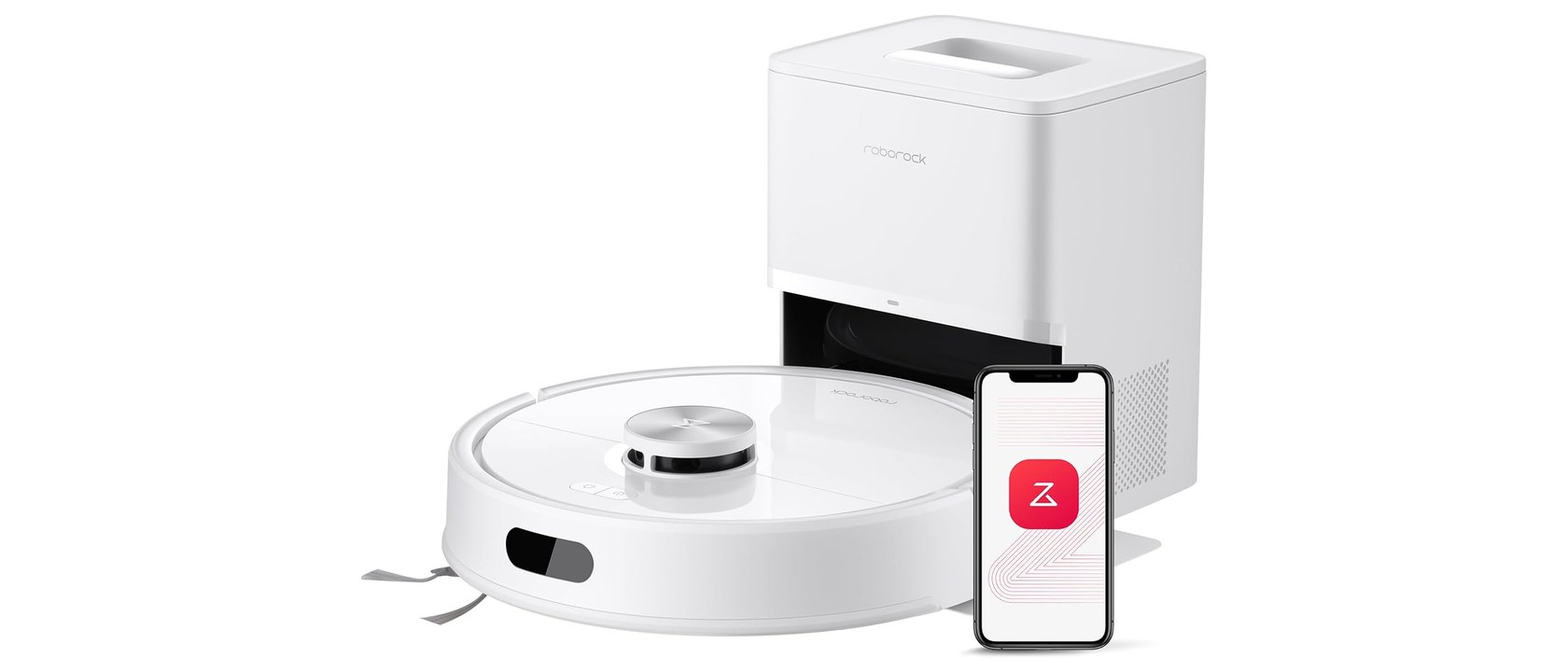
The verdict
A Wirecutter top pick whose cleaning genuinely earns the praise — as long as you clear the floor first, treat the mop as a bonus, and accept that a loud minority of owners have had reliability trouble.
Pros
- 10,000 Pa peak suction — independent labs measured sealed suction among the highest scores they have ever recorded in this price class
- Self-empty dock with a 2.7 L sealed bag, so bin emptying drops from an every-run chore to a once-a-month-or-less task
- PreciSense LiDAR navigation with multi-level mapping — Wirecutter found it missed fewer spots than robots costing two to three times as much
- The Roborock app is the most capable in this price tier — per-room suction, no-go zones, 3D maps, five cleaning modes
- Detachable mop module with three electronically controlled water levels — and you can skip mopping entirely
Cons
- The Amazon rating sits at 3.9 stars across more than 16,000 ratings, with reliability — not cleaning — the dominant complaint cluster
- No camera or obstacle avoidance of any kind — cords, socks, and toys must be cleared before every run
- Independent testing measured hair wrap slightly worse than the category average despite the Dual Anti-Tangle marketing
- The mop is a basic drag-along pad that never lifts over carpet and used roughly double the average water in testing
- Dock emptying is loud, and the app connects over 2.4 GHz Wi-Fi only
Best for
- Hard-floor and low-to-mid-pile carpet homes that want weeks of hands-free vacuuming with systematic LiDAR routes
- Multi-level homes — the mapping system stores up to four floor plans and recognizes which one it is on
- Buyers who want flagship-tier cleaning behavior and a mature app at a value price, and are willing to tidy the floor first
Not ideal for
- Homes full of cables, toys, or clutter — with no obstacle avoidance, the robot will find all of it
- Mixed-floor homes that want real mopping — the pad does not lift over carpet, so wet rugs are a real risk
- Anyone who wants true set-and-forget dependability — a meaningful share of owners report units that misbehave
roborock Q7 M5+ Review: Why the Rating Is Lower Than the Reviews
The short answer: the Q7 M5+ is that unusual product where the professional reviewers and the customer average disagree, and both are being honest. Wirecutter picked it as a top robot vacuum and found it picked up Cheerios, birdseed, fur, and dust at a first-rate level — missing fewer spots than machines costing several times as much. The Amazon listing averages 3.9 stars across more than 16,000 ratings, and when you read the complaints, they are mostly not about cleaning: they are about Wi-Fi setup friction, mapping glitches, and a minority of units that developed faults within months. The cleaning is real, the value is real, and so is the reliability noise. If your floors are reasonably tidy and you can live with a 2.4 GHz-only setup process, this is one of the strongest value robot vacuums on the market. If you need it to work flawlessly out of the box with zero fuss, read the sections below first.
Rating: 4.0 / 5
What the Q7 M5+ is actually built for
The Q7 M5+ is roborock’s value-tier vacuum-and-mop combo, positioned as the upgrade to the well-regarded Q5 Max+ and slotting below the Q8 and Qrevo lines. It launched with a specific formula: take the flagship behaviors people actually notice — LiDAR navigation, systematic cleaning routes, a self-emptying dock, a mature app — and cut the costs almost nobody misses at this price, namely camera-based obstacle avoidance and any serious mopping hardware.
The Amazon listing shows more than 16,000 ratings averaging 3.9 stars as of October 2026, and the product has ranked near the top of Amazon’s robotic vacuums category. That combination — huge volume, mediocre score — is the defining fact about this robot, and it deserves more than a shrug. Amazon’s own review-summary module for this model breaks the sentiment down: suction power draws heavily positive mentions, the app draws positive mentions, and reliability is the largest negative cluster by a wide margin. The professional testers mostly did not hit those faults. Thousands of owners did. This review treats both as data.
Where the formula lands, honestly, is this: the Q7 M5+ vacuums like a much more expensive robot, navigates like one, and cuts exactly the corners its price implies — no obstacle sensors, a mop that is best described as a damp cloth on a clip, and a setup process pinned to 2.4 GHz Wi-Fi.
Specs at a glance
| Specification | roborock Q7 M5+ |
|---|---|
| Suction | 10,000 Pa HyperForce (Max+ mode, full battery, per roborock’s internal testing to IEC 62885-2:2021/5.11) |
| Brush system | Single main brush with JawScrapers comb + anti-tangle side brush |
| Navigation | PreciSense LiDAR, 360° scanning, multi-level maps (up to 4 floors) |
| Obstacle avoidance | None — bump navigation only |
| Self-empty dock | RockDock Plus, 2.7 L sealed dust bag |
| Self-empty interval | “Up to 7 weeks” per the US product page; “7–9 weeks” per the series page and Amazon — see below |
| Vacuum + mop | Yes — detachable mop module, 3 electronically controlled water levels |
| Mop lift over carpet | None |
| Climbing ability | 2 cm thresholds |
| Robot dimensions | 325 × 325 × 99 mm |
| Dock dimensions | 212 × 178 × 259 mm |
| Runtime | Not published by roborock for this model — see the battery section |
| App connectivity | 2.4 GHz Wi-Fi only |
| Voice control | Alexa, Google Home, and Siri per roborock’s series page |
| Colors | Black and White (this review covers the White listing) |
| Warranty | 1-year limited |
Specifications are from roborock’s official US product page, its Q7 series page, and the Amazon listing. Where roborock’s own channels disagree with each other, both figures are given and discussed below. Confirm current details on the retailer page before buying.
One purchasing note before anything else — Amazon sells this model in black and white under separate listings with separate review pools. This review covers the White listing, and the rating quoted above is from that page. Confirm the color on the product page before ordering.
How the Q7 M5+ compares
| roborock Q7 M5+ | roborock Q5 Max+ (predecessor) | Shark Matrix Plus 2-in-1 | |
|---|---|---|---|
| Suction | 10,000 Pa (peak claim) | 5,500 Pa | Not published in Pa |
| Brush system | Single anti-tangle brush + side brush | DuoRoller — dual rubber rollers | Self-cleaning brushroll |
| Navigation | LiDAR, no camera | LiDAR, no camera | 360° LiDAR with object detection |
| Obstacle avoidance | None | None | Yes — detects and avoids objects day or night |
| Self-empty base | 2.7 L bagged, weeks between changes | 2.5 L bagged, up to 7 weeks | Bagless HEPA base — 30 or 60 days by model |
| Mopping | Detachable pad, 3 water levels, no lift | Not included (mop kit sold separately) | Sonic mopping, scrubs 100×/min, no lift |
| Battery | About 180 min measured in Quiet mode on bare floors | Up to 240 min claimed | 110 min |
| Voice control | Alexa, Google, Siri | Alexa, Google, Siri | Not listed on Shark’s official product page |
| Warranty | 1 year | 1 year | 1 year |
Competitor figures are from each brand’s official product pages and the retail listings as of October 2026. Runtime and suction figures are manufacturer claims measured under different conditions, except where noted as measured. Shark’s product page does not state a suction figure in Pa — treat the first row accordingly rather than assuming parity.
Three things in that table are worth dwelling on.
The suction upgrade over its own predecessor is the headline. Ten thousand pascals against the Q5 Max+’s 5,500 is nearly double, and independent lab testing backs the marketing in relative terms — Vacuum Wars measured roughly 2.24 kPa of sealed suction, among the highest scores that lab had recorded, and more than triple what it measured on a budget Eufy competitor. The 10,000 Pa figure itself carries roborock’s own footnote: measured in Max+ mode with a full battery under the IEC 62885-2 standard. That is an honest, standardized claim — but it is a peak, not an everyday figure, and Max+ mode is also the loudest and hungriest setting.
It is the only robot in this table that cannot see obstacles. The Shark actively detects and avoids objects; the Q7 M5+ feels its way with a bumper. Wirecutter actually framed this as a partial strength — the robot gets as close as possible to furniture before lightly bumping, which paradoxically improves edge coverage — and TechGearLab confirmed its coverage is thorough. But both outlets, and the negative reviews, converge on the same practical rule: pick up the charging cables, socks, and pet toys before every run, because the robot will not dodge them for you.
The Shark inverts this product’s priorities. It offers real obstacle avoidance, sonic scrubbing, and a bagless base with no consumable bags — against a much shorter 110-minute battery and no published suction figure. The roborock bets everything on suction, runtime, and its app; the Shark bets on automation intelligence. Neither is wrong; they are different bets, and your floor clutter level decides which one wins.
If the suction-plus-dock formula is what you are after, check the Q7 M5+’s current Amazon listing — and confirm the color variant on the page before ordering.
Suction: the one spec here that survives independent testing
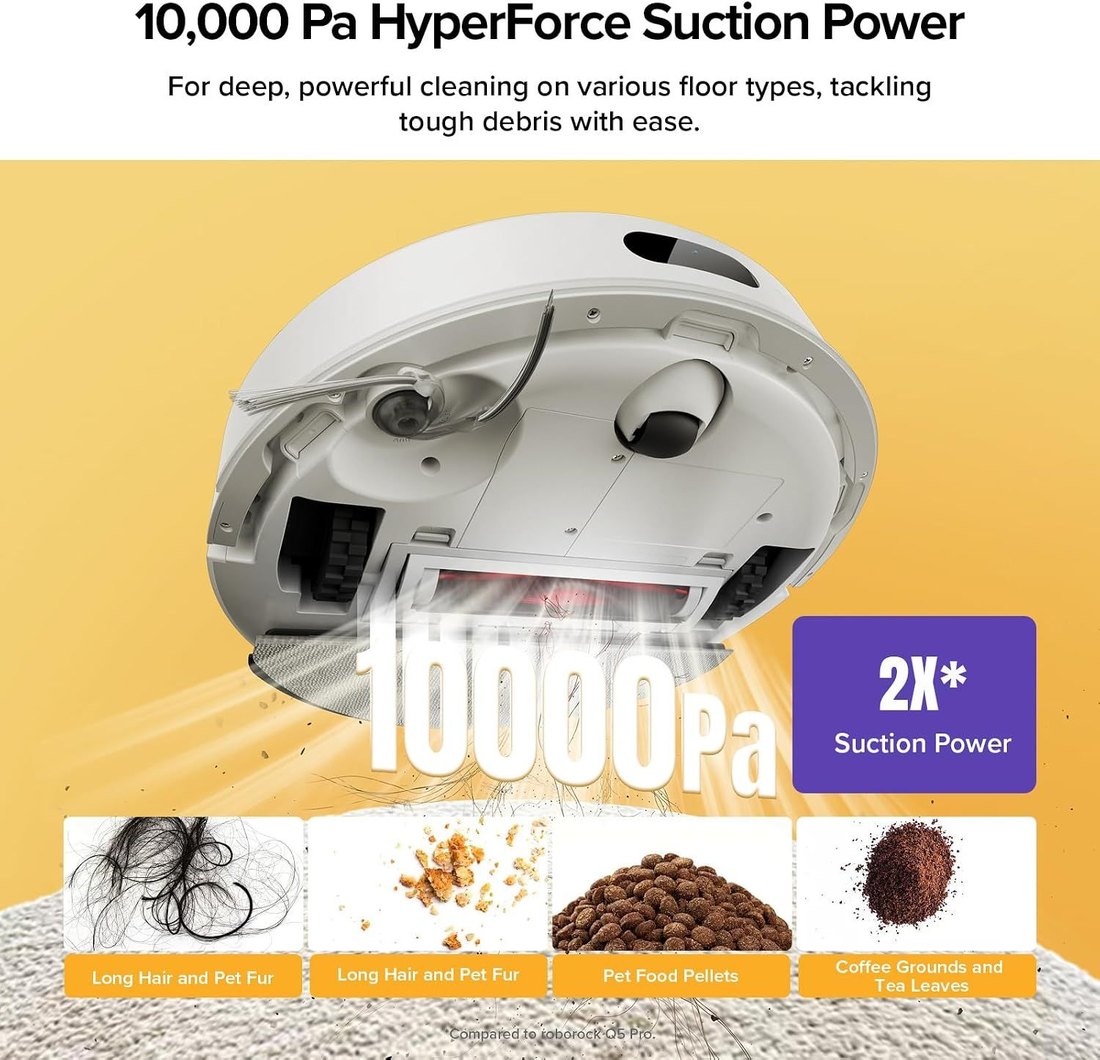
Most budget robot marketing inflates a Pa number and hopes nobody measures. The Q7 M5+ is the opposite case: independent testing found the real-world suction lives up to the spec sheet in relative terms. Wirecutter described its pickup of Cheerios, birdseed, fur, and dust on both hard floors and carpets as first-rate, and noted it snagged every Cheerio placed around barstool legs — a task that stumped several pricier robots in the same test. Vacuum Wars’ measured suction landed among the highest scores in its database for the class.
Two honest caveats belong next to that praise. First, the single main brush means the robot is measurably weaker along walls and thresholds than dual-brush designs — Wirecutter called this out directly, and it matches the geometry: one brush, set back from a round chassis, simply reaches less edge. Second, testers noted the robot can leave debris at hard-floor-to-carpet transitions, where one wheel rides carpet and the other rides bare floor. Neither flaw contradicts the headline; both define where it applies.
The self-empty dock: four sources, four intervals
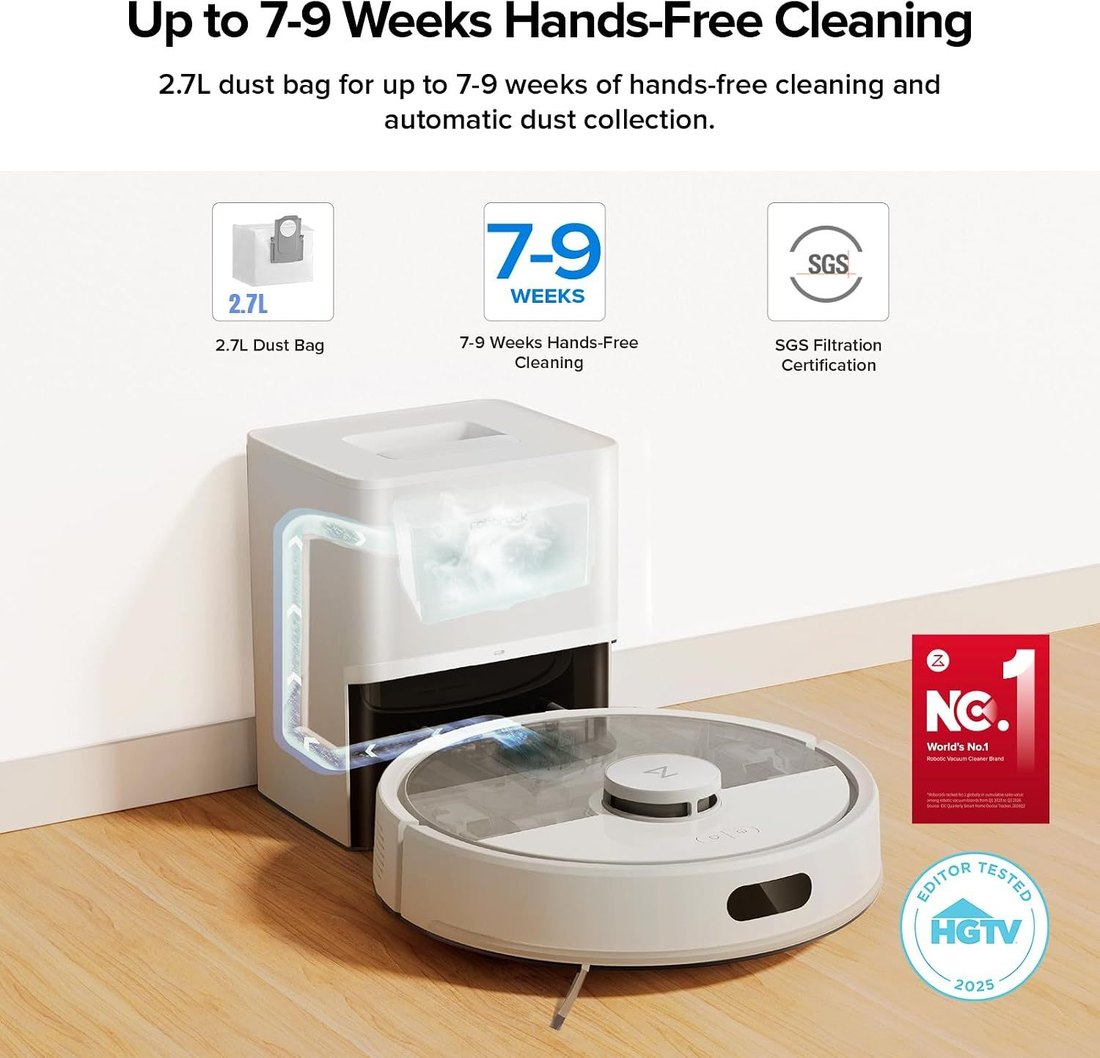
The dock is the Q7 M5+’s best convenience feature and its least consistently documented one. Count how many different intervals are in circulation for the same 2.7-liter bag:
- roborock’s US product page — “up to 7 weeks”
- roborock’s Q7 series page and the Amazon listing title — “7–9 weeks”
- Wirecutter, citing the company — bag changes “every six or seven weeks”
- Long-term owners in reviews — commonly six weeks in shedding-pet households
These are not contradictions so much as a range of conditions, and roborock’s own fine print says as much — the interval depends on household size, pets, and cleaning frequency. The honest planning number for a pet household running daily cleans is closer to six weeks than nine. What is unambiguous is the mechanism: the dock pulls the robot’s bin contents into a sealed 2.7 L bag, which is cleaner and less allergy-irritating than open-bin designs, and the app notifies you when the bag is full. The trade-off is that the empty cycle itself is loud — multiple testers called it the loudest moment of the robot’s week, though it lasts only several seconds. Schedule cleanings for hours you are not on a video call.
Pet hair: where the marketing outruns the measurements
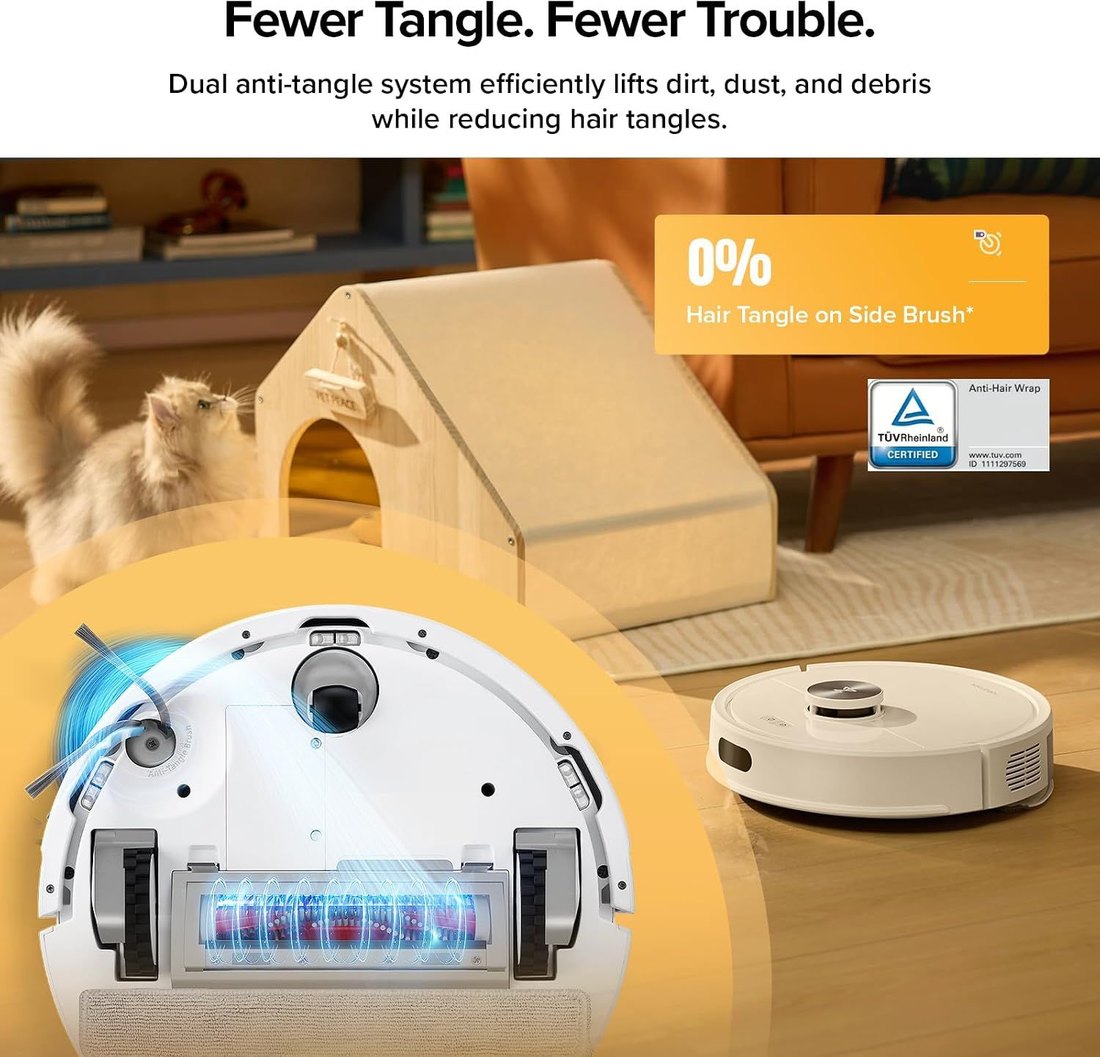
This is the section where roborock’s marketing most needs unpacking, because the listing leads with a “Dual Anti-Tangle System for Pet Hair,” and the independent measurements do not fully support the promise.
The system is real hardware — a JawScrapers comb over the main brush plus an anti-tangle side brush that roborock rates at zero percent hair tangling. But in Vacuum Wars’ standardized seven-inch hair tangle test, the Q7 M5+ measured 43 percent hair wrap against a roughly 38 percent category average — slightly worse than typical, despite the comb. TechGearLab separately found pet hair to be the robot’s weakest category, with longer fur wrapping the roller. Flattened pet-hair pickup measured around 79 percent — solidly average, despite the exceptional raw suction.
The fair reading is not that the anti-tangle system is fake — reviewers agree it reduces maintenance compared to nothing, and the side brush does resist wrap. The fair reading is that a single-brush robot with a comb is not the same class of hair machine as the dual-rubber-roller flagships, and the “for Pet Hair” in the listing title sets an expectation the test bench does not confirm. If your home has a heavy-shedding long-haired pet, plan on pulling a hair donut off the brush every couple of weeks regardless of what the box says.
Navigation and the app: the part that justifies the brand premium
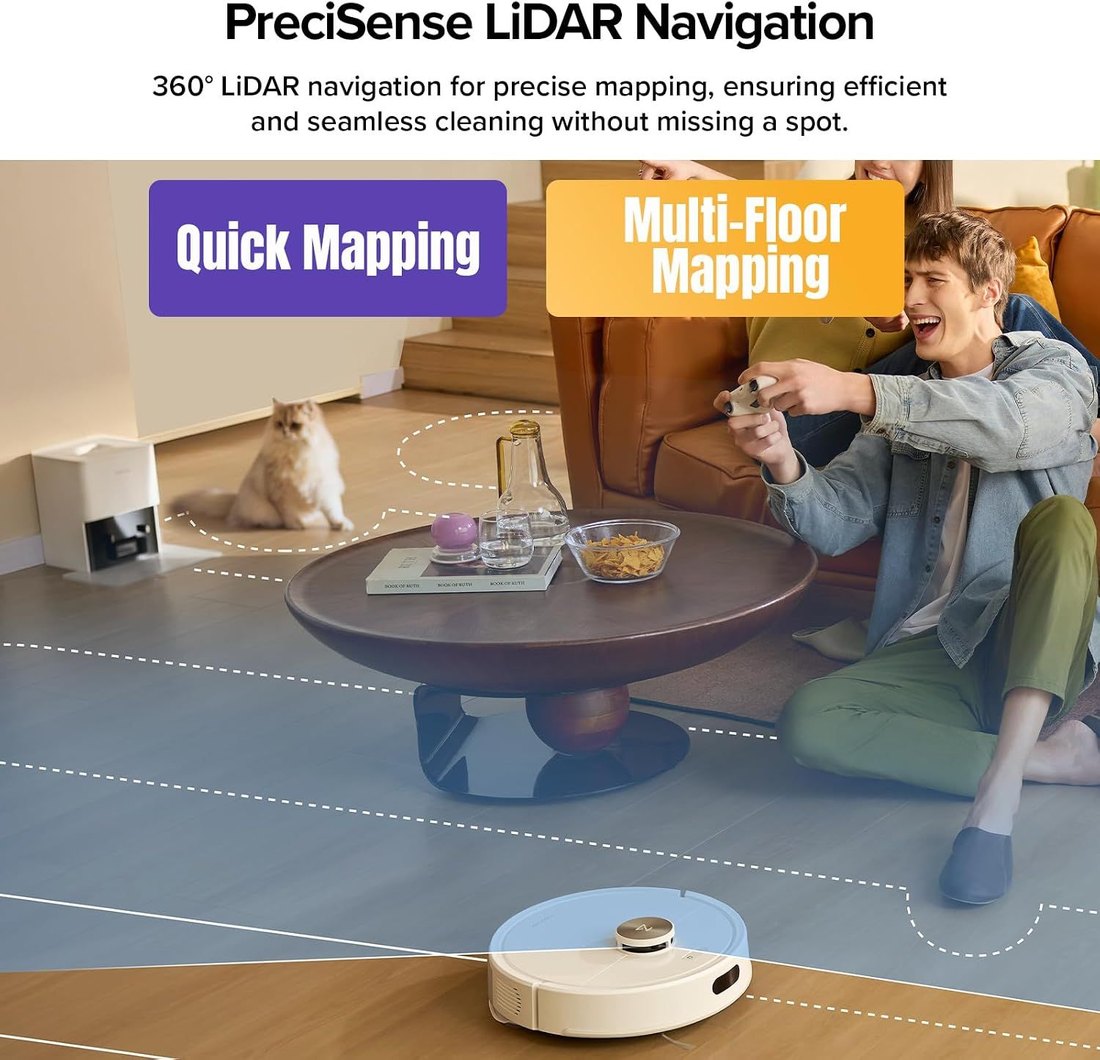
If suction is what the Q7 M5+ does well for its price, navigation is what it does well period. The PreciSense LiDAR system maps quickly, plans tight methodical rows, works with the lights off, and stores up to four floor plans — carry the robot upstairs and it recognizes which map it is on without you telling it. Wirecutter’s navigation verdict was that it identifies problem areas, efficiently navigates with relatively few issues, and misses fewer spots under furniture and near edges than bots costing double and triple.
The app is the other genuinely flagship-grade component. Per-room suction settings, no-go and no-mop zones, 3D map views, five cleaning modes from Quiet to Max+, scheduled cleans, spot cleaning, real-time progress — Wirecutter called it faster and more accurate at mapping than most competitors, and among the most user-friendly they tested. Voice control works through Alexa, Google Home, and Siri.
The two caveats, both real: setup requires a 2.4 GHz Wi-Fi network — the single most common complaint in the negative reviews — and a recurring minority report describes “ghost” obstacles, where the robot errors out or stalls with nothing visibly in the way. Testers did not encounter it; hundreds of reviewers did. If your router broadcasts only 5 GHz, solve that before the robot arrives, not after.
Mopping: treat it as a bonus, not a feature
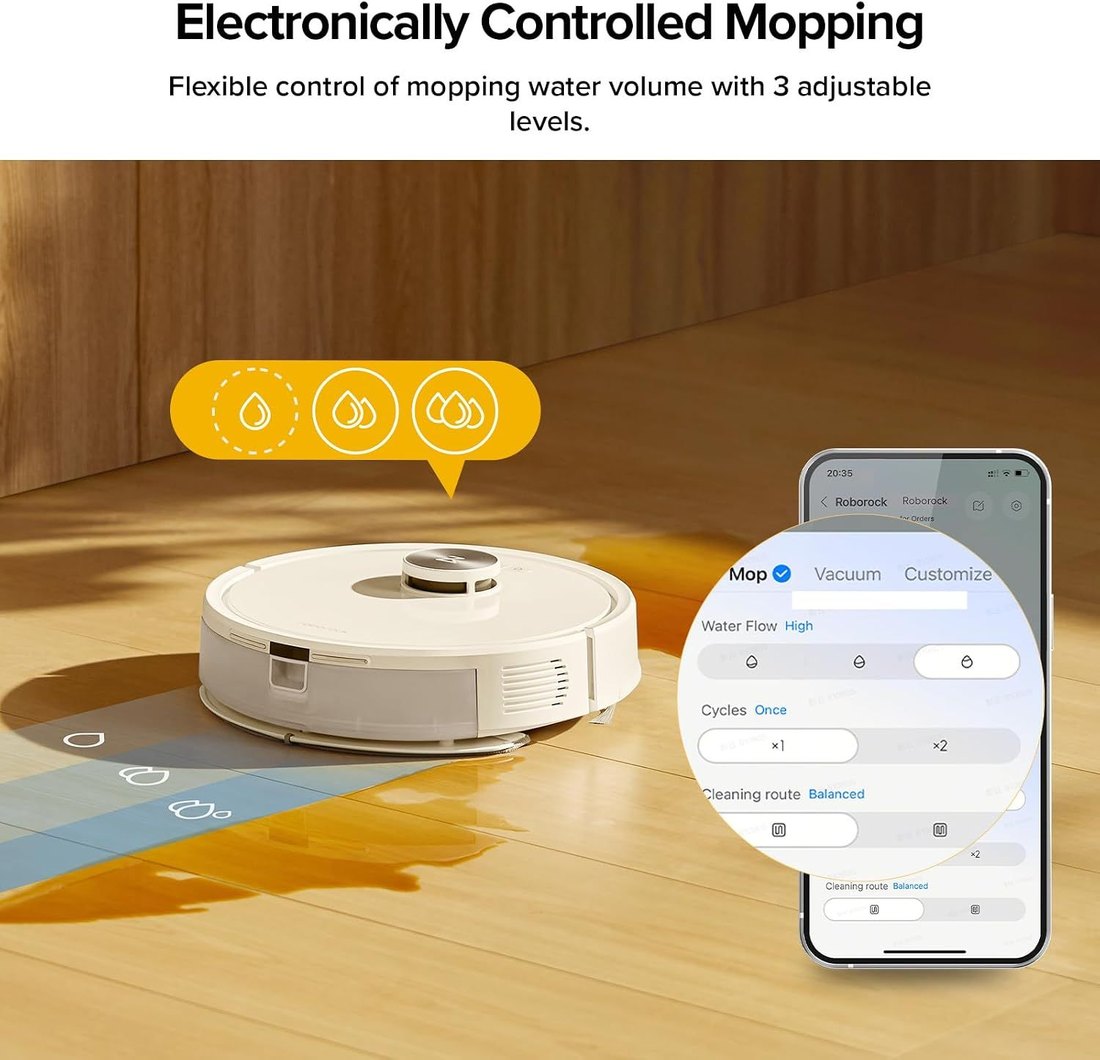
The mop is a flat pad on a detachable module, dampened by an electronically controlled water tank with three flow levels. It vacuum-and-mops in one pass and captures fine dust a dry run would leave. That is the complete list of its virtues.
Testing was more mixed than the feature list implies. On the positive side — and this surprised the labs — dried-stain performance measured well above average, and TechGearLab called mopping a standout for the price. On the negative side, the robot used roughly double the category-average water to get there, still left floors looking streaky in testing, and — the structural limitation — the pad never lifts over carpet. On a mixed-floor home that means either wet rugs, or manually removing the module before carpet rooms, or drawing no-mop zones in the app and trusting them. Wirecutter, the friendliest outlet in this review, still reduced its verdict to “very basic mopping functionality, which works just fine.”
The right mental model: this is a maintenance mop for hard floors between deep cleans. If mopping is your actual mission, this is not your robot — roborock’s own Qrevo line is the step up, at a step-up price.
Battery and runtime: the spec roborock does not publish
Here is a curious gap: for all the marketing on this listing, roborock’s official pages do not state a runtime figure for the Q7 M5+. Retail copy and roundup sites variously claim 150 or 240 minutes. The most credible datapoint is Wirecutter’s measured experience: about 180 minutes on bare floors in Quiet mode, dropping significantly on Turbo and Max settings but still enough to cover a 1,500-square-foot home, with recharge-and-resume covering larger spaces. Treat the 240-minute claims circulating online as inheriting the predecessor’s battery rating rather than a measurement of this model.
Two efficiency notes from testing: the dock recharge between segments is not instant, so very large single-level homes should expect at least one break in a full run, and off-peak charging is supported — a small feature, but one that quietly reduces running cost if your utility offers time-of-use rates.
Where the Q7 M5+ falls short
Three limitations deserve their own space.
The reliability complaints are a pattern, not noise. On Amazon’s own review-summary module for this model, reliability is the largest negative cluster — hundreds more negative mentions than positive — and the recurring stories follow a template: worked well for one to three months, then stalling on start-up, dying mid-clean, or phantom obstacle errors. The cleaning majority is real and large; so is this minority. Practically, this means the return window matters: put the robot through daily runs in its first month rather than easing in, so any unit-level fault surfaces while exchange is still free.
It needs a tidier floor than you think. No camera, no structured light, no obstacle sensors — a charging cable or a sock is a trap, and the negative reviews are full of robots stuck on things a flagship would have dodged. The robot compensates by cleaning closer to furniture than shy robots do, but the pre-run tidy is not optional; it is the operating cost of the missing sensors.
The anti-tangle claim should be read as “reduced,” not “anti.” Covered in detail above — 43 percent hair wrap measured against a 38 percent average means the marketing phrase outruns the benchmark, and long-haired households should budget a few minutes of brush maintenance every couple of weeks.
Who should buy the Q7 M5+
- Hard-floor and low-pile carpet homes that hate emptying bins. The dock converts a daily chore into a six-to-nine-week non-event, and the sealed bag is genuinely better for allergy sufferers than open bins.
- Multi-level homes. Four stored maps with automatic level recognition is a feature buyers used to pay flagship prices for, and it works as advertised here.
- Value buyers who will actually use the app. Per-room behavior, no-go zones, and scheduled cleans are where this robot quietly outclasses its price tier — and where it will still feel current in three years.
If two or more of those describe you, see the Q7 M5+ listing on Amazon — and double-check the color and variant on the page before ordering, since the black and white versions are separate listings.
Who should skip it
- Cluttered-floor households. Cables, kids’ toys, laundry — with no obstacle avoidance, every run becomes a pre-tidying ritual. The Shark Matrix Plus’s object detection is the cheaper peace of mind here, not a more expensive robot.
- Mixed-floor homes that want real mopping. No mop lift, streaky results, double water use. Buy a vacuum-only board like the Q5 Max+ and mop by hand, or step up to a mopping-first design.
- Heavy-shedding, long-haired pet homes. Average pet-hair pickup and above-average hair wrap is not the combination the listing title promises. Flagship dual-roller designs earn their premium precisely here.
- Anyone allergic to setup friction. The 2.4 GHz-only requirement trips up enough owners to be statistically visible in the reviews. If your network is complicated, budget an evening for setup — or buy the robot from a retailer with a long return window.
How to choose a robot vacuum at this level: a short checklist
If you are comparing across brands rather than choosing between this review’s picks, five questions sort the field faster than any spec sheet.
- Can it see, or only feel? Camera- or sensor-based obstacle avoidance is the single biggest daily-life difference between robot tiers. If your floors accumulate clutter, pay for eyes.
- Bagged or bagless self-empty? Bagged (roborock) seals allergens and is cleaner to change but consumes bags forever. Bagless (Shark) costs nothing to run but exposes you to the dust cloud.
- Does the mop lift? If you have any carpet at all, a fixed mop pad is a wet-rug liability. This single spec should eliminate half the vacuum-mop combos on the market for mixed-floor homes.
- What is the measured suction, not the claimed Pa? Independent labs measure sealed suction in kPa. A brand publishing a standardized claim is a positive signal; a brand publishing only a Pa number is not automatically dishonest, but it is unverified.
- Read the negative reviews for patterns, not anecdotes. Complaints about a feature (mop is weak) are design trade-offs; complaints about a pattern (units dying in month two) are manufacturing risk. They deserve different weight.
Frequently asked questions
Why is the Amazon rating only 3.9 stars if reviewers recommend it? Because they are measuring different things. Professional testers evaluate cleaning performance, navigation, and value — where the Q7 M5+ genuinely excels — over a few weeks of controlled use. The customer average also captures long-term reliability, setup friction, and unit-level faults that testers’ samples never encounter. Both pictures are true: the cleaning praise and the reliability complaints come from the same product population.
How often do you really need to change the dust bag? roborock’s US page says up to 7 weeks; its series page and Amazon say 7–9 weeks; Wirecutter cites the company saying six to seven. The honest answer is that it depends on home size, pets, and run frequency — for a shedding-pet household running daily cleans, plan on roughly six weeks. The app alerts you when the bag is full.
Does the Q7 M5+ avoid obstacles like pet toys or cables? No. It has no camera or object-avoidance sensors — navigation is LiDAR for mapping plus a bumper for contact. It will not dodge cords, socks, or toys, so the floor needs a quick clear before each run. This is the main trade-off that funds the suction and dock at this price.
Can the mop handle stains, and does it lift over carpet? It handles light, fresh marks and even measured surprisingly well on dried stains in testing, though it used roughly double the average water and can leave streaks. It does not lift over carpet — the pad stays down wherever the robot travels. Mixed-floor homes should use the app’s no-mop zones or remove the module before carpet areas.
Does it work on multiple floors? Yes. The LiDAR system stores up to four floor plans and recognizes which level it is on automatically — no manual map selection. There is only one dock, so you carry the robot between floors yourself.
View the roborock Q7 M5+ on Amazon →
About this review
This review is based on roborock’s official US product page, its official Q7 series page, the Amazon retail listing and Amazon’s own review-summary module, and published testing from independent outlets including Wirecutter (The New York Times), Vacuum Wars results as reported by specialist vacuum-review publications, TechGearLab, and RTINGS. Product images are the manufacturer’s official product images from the retail listing, not photos taken by us. We have not performed instrumented laboratory testing, and nothing here should be read as a measured result. Where official sources or testers disagree with each other — most notably on self-empty interval, hair tangling, and runtime — the differing findings are reported above rather than averaged. Specifications and availability change frequently; always confirm current details on the retailer page before purchasing.
Last updated: October 2, 2026
More from TechWithAll
- roborock Q10 S5+ vs Q7 M5+ comparison — This robot head-to-head against its newer sibling: where the upgrade money actually goes.
- roborock Q10 S5+ review — The same 10,000 Pa platform plus a sonic mop that lifts and structured-light avoidance.
- COSORI TurboBlaze review — Six-quart air fryer with five fan speeds and a true 450°F broil.
- Levoit LVAC-200 review — Lightweight cordless vacuum built for hard floors and quick cleanups.
Browse the full home category.