
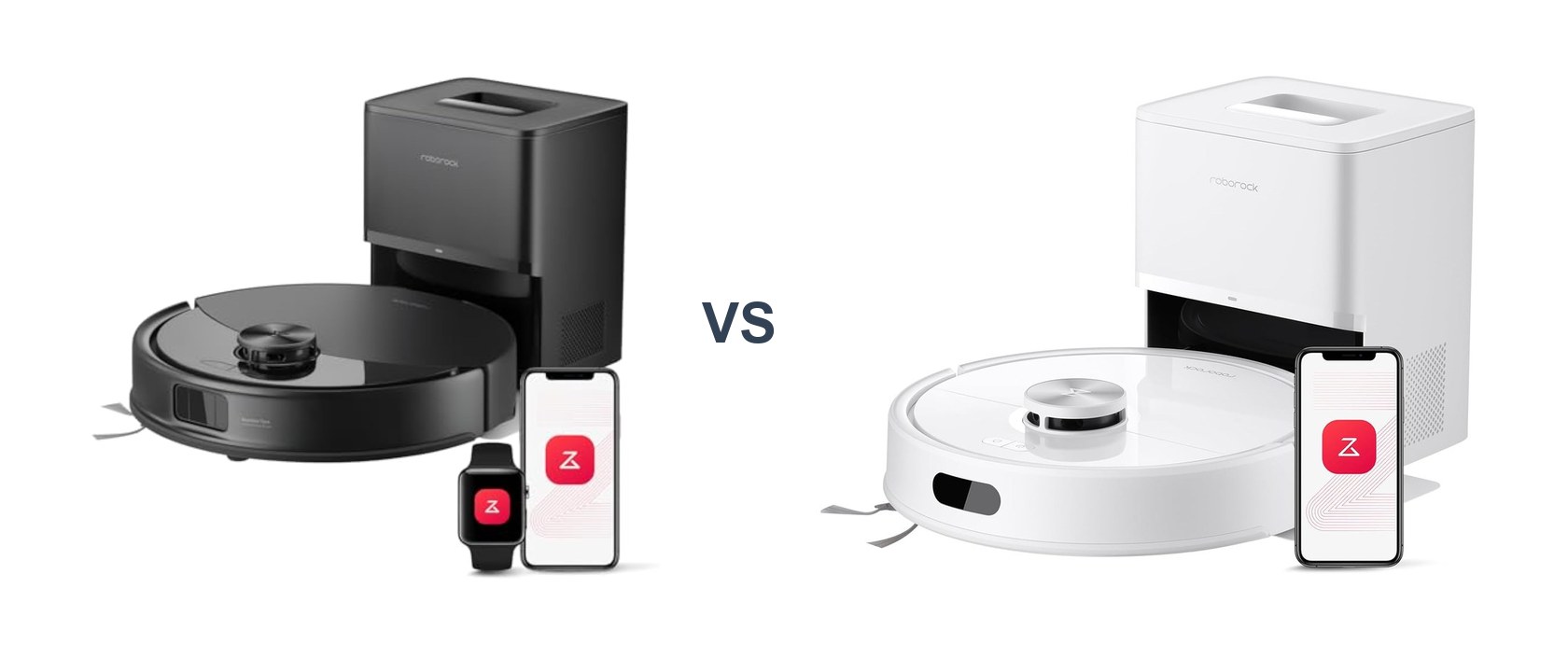
roborock Q10 S5+
- VibraRise 2.0 sonic mop scrubs up to 3,000/min and lifts 8 mm over carpet
- ReactiveTech structured-light obstacle avoidance — sees what the Q7 cannot
- Dual anti-tangle brush hardware (JawScrapers Comb main + anti-tangle side)
- Same 10,000 Pa suction and 2.7 L self-empty dock as the Q7 M5+
- Avoidance misses cables, socks, and small toys; jams can wipe the saved map
- Younger review base (~1,456 ratings) with some first-weeks failure reports
roborock Q7 M5+
- Wirecutter top pick with a 16,000+ rating track record
- Identical 10,000 Pa suction — independent labs measured top-of-class sealed suction
- Same LiDAR multi-level mapping and the price tier's best app
- Longest reliability database in roborock's value line
- Zero obstacle avoidance of any kind — clear the floor every run
- Drag-pad mop never lifts over carpet; wet rugs are a real risk
- Hair wrap measured slightly worse than category average
Quick picks
The Q10 S5+ is the Q7 M5+ with its two worst gaps patched — a sonic mop that lifts and obstacle avoidance the Q7 simply lacks — on the same suction platform and dock. The Q7 M5+ remains the pick only if a long, well-documented reliability history matters more to you than those two upgrades.
These are the two roborock value-line robots most buyers cross-shop, and the comparison is unusually clean because they share a platform: same 10,000 Pa suction motor, same 2.7-liter self-empty dock concept, same PreciSense LiDAR navigation, same app. Everything that differs between them is the answer to one question — what did roborock fix in the newer machine, and is that what your floors need? For the full individual walkthroughs, read our roborock Q10 S5+ review and roborock Q7 M5+ review.
The short version
The Q7 M5+ is the established pick: a Wirecutter top pick whose cleaning performance independent testing ranked against robots costing several times as much, backed by a sixteen-thousand-rating customer database. Its two documented failures are structural: the mop is a passive drag pad that never lifts over carpet, and the robot has no obstacle avoidance of any kind — cords, socks, and toys must be cleared before every single run.
The Q10 S5+ is the direct answer to both. Its VibraRise 2.0 mop vibrates at up to 3,000 scrubs per minute and lifts itself 8 mm clear when carpet is detected, and its ReactiveTech structured-light system at least attempts to see obstacles the Q7 would have plowed into. The suction, dock, LiDAR, and app are the same platform underneath.
So the decision tree is short. If your home is mostly hard floors, rarely wet-mopped, and kept tidy enough that avoidance does not matter, the Q7 M5+ does the same job. If you have rugs you do not want soaked, floor clutter you cannot fully control, or you want the mopping to actually scrub, the Q10 S5+ is the one that addresses those specific problems.
Spec comparison
| roborock Q10 S5+ | roborock Q7 M5+ | |
|---|---|---|
| Suction | 10,000 Pa HyperForce | 10,000 Pa HyperForce |
| Obstacle avoidance | ReactiveTech structured light | None |
| Mopping | VibraRise 2.0 sonic, up to 3,000 scrubs/min | Passive drag pad, three water levels |
| Mop lift on carpet | Yes, up to 8 mm, ultrasonic-triggered | Never lifts |
| Carpet handling | Ultrasonic detection + auto suction boost | App-set carpet boost |
| Anti-tangle | JawScrapers Comb main + anti-tangle side brush | Dual anti-tangle (side brush tested below average) |
| Self-empty dock | 2.7 L bag; up to 7 weeks (roborock) / 70 days (listing) | 2.7 L bag; interval described differently by four sources |
| Navigation | PreciSense LiDAR, up to 4 maps | PreciSense LiDAR, up to 4 maps |
| App | Schedules, no-go zones, off-peak charging, child lock | Same platform — the price tier’s most capable app |
| Battery | 5,200 mAh, up to 150 min (manufacturer testing) | Comparable class runtime |
| Amazon rating | 4.0 / 5 (~1,456 ratings) | 3.9 / 5 (16,000+ ratings) |
| Wi-Fi | 2.4 GHz only | 2.4 GHz only |
| Positioning | Upgraded from the Q8 Max+ generation | Wirecutter top pick |
Where the Q10 S5+ wins: the two fixes
The mop that lifts. This is the biggest real-world difference between the two machines, and it is not subtle. The Q7 M5+’s pad drags at floor level across everything — third-party testing measured it using roughly double the category-average water, and a wet rug is a documented risk in any mixed-floor home that runs mopping unattended. The Q10 S5+’s VibraRise 2.0 pad lifts 8 mm when the ultrasonic carpet sensor fires, which removes the wet-rug failure mode and adds genuine agitation: dual-zone vibration at up to 3,000 scrubs per minute converts the pad from a wet cloth into a scrubber that handles fresh spills and daily grime.
Be precise about what “better mopping” means here, because both robots’ mopping is maintenance-grade. The Q10’s sonic pad still will not dig dried stains out of grout lines — that requires the roller-mop machines a tier above both of them. What it does is make daily mopping passes worth running: visibly cleaner hard floors, no soaked rugs, no mid-run hardware swaps.
The avoidance that exists. The Q7 M5+ has no obstacle detection at all — it will drive into, over, and through cords, socks, and toys, and every owner guide for it starts with “clear the floor first.” The Q10 S5+’s ReactiveTech changes the category of the problem rather than eliminating it: independent testing scored the structured-light system well below the camera-equipped leaders (it misses thin cables and small objects), but it reliably navigates around the larger clutter — shoes, backpacks, furniture legs — that strands the Q7 entirely.
The practical margin matters more than the score. On the Q7, a forgotten charging cable is a guaranteed tangle-stall. On the Q10, the same cable is a coin flip the structured light usually loses but sometimes catches — and a caught cable is a jam, and a side-brush jam on this generation occasionally triggers a map wipe that costs you your no-go zones. Neither robot is the pick for a home that will not do a pre-run pickup; the Q10 just fails more gracefully when the pickup was imperfect.
Where the Q7 M5+ wins: the track record
Everything else being equal — and the cleaning platform largely is — the Q7 M5+ carries something the Q10 S5+ cannot: evidence. Sixteen thousand-plus ratings against the Q10’s roughly 1,456, a Wirecutter top-pick verdict based on hands-on testing that found it missing fewer spots than robots costing several times as much, and a reliability complaint pattern that is documented, known, and priced into its reputation. Independent labs measured its sealed suction among the highest ever recorded in its price class, so the shared 10,000 Pa figure is not marketing inflation on either machine.
The Q10 S5+’s younger record is genuinely thinner rather than just smaller: a minority of early buyers report first-weeks failures — LiDAR faults, cliff sensor errors, Wi-Fi problems — which is the classic signature of a new production run. It may settle into Q7-level dependability, but right now nobody can prove that, and the honest position is to treat the return window as a functional test period if you buy it.
One more symmetry worth noting: both machines share the Q line’s weak points, so they cancel out in this comparison. Both docks are loud during emptying bursts. Both pair with 2.4 GHz Wi-Fi only. Both dust bags are a recurring consumable. Both apps are the same excellent platform. Do not let either marketing page differentiate on those — they are the same product decisions.
Battery, noise, and daily ownership
Runtime is a wash in practice: both carry class-comparable batteries, both are rated in the same general range by their manufacturers, and both lose meaningful runtime in max-suction carpet mode. The dock behavior is likewise shared: a loud 15-to-25-second emptying burst on each, schedulable away from sleep hours on both, and a high-pitched component that some units of both generations emit while docked.
Setup friction is identical — 2.4 GHz-only pairing with the same router workaround (temporarily disable the 5 GHz band during setup) — and the app experience is byte-for-byte the same platform: per-room suction, no-go zones, multi-floor maps, schedules, and voice control through Alexa and Google Home.
Which should you buy
Buy the roborock Q10 S5+ if:
- Your home mixes hard floors with rugs you actually want protected from the mop — the lift mechanism alone decides this for mixed-floor homes
- You want the mopping to scrub rather than wipe, and fresh-spill and daily-grime performance matters more than grout-deep cleaning
- Your floors have some clutter you cannot fully eliminate, and “usually avoids the backpack” beats “guaranteed tangle” — with the honest caveat that cables and socks still need pickup
- You are upgrading from a Q7/Q8-generation machine and its drag mop and blind navigation are exactly your pain points
Buy the roborock Q7 M5+ if:
- Proven dependability is the priority: a sixteen-thousand-rating track record, a Wirecutter top-pick verdict, and a known, documented complaint pattern
- Your home is mostly hard floors, rarely mopped, and kept tidy — in that configuration, the Q10’s two upgrades buy you almost nothing
- You prefer the established production run with the settled reliability profile over a new release with early-failure reports in its data
The one-line decision. If a rug has ever been damaged by a robot mop, or a cable has ever stalled your robot, the Q10 S5+ is the machine built to fix your exact problem. If neither has happened to you — or your floors are picked up and bare anyway — the Q7 M5+ remains the value benchmark, with the longest evidence file in roborock’s value line.
FAQ
Do both robots have the same suction? Yes — 10,000 Pa on both, and independent testing of the Q7 platform measured sealed suction among the highest recorded in this price class. The Q10’s advantage is not suction; it is the ultrasonic carpet trigger that automates the boost-and-lift handoff.
Is the Q10 S5+’s obstacle avoidance good enough to skip floor pickup? No. It handles larger objects the Q7 would hit, but independent testing and owner reports agree that cables, socks, and small toys still defeat it — and a side-brush jam on the Q10 can occasionally wipe the saved map. Pre-run pickup remains part of ownership on both machines.
Which one is safer for rugs? The Q10 S5+, decisively — its mop lifts up to 8 mm over carpet, while the Q7’s pad never lifts and testing measured it using roughly double the category-average water.
Is the Q7 M5+ more reliable? Its record is longer and better documented: 16,000+ ratings versus the Q10’s ~1,456, plus a Wirecutter top-pick verdict. The Q10 has some first-weeks failure reports typical of a new production run. Neither has a spotless reliability profile — the difference is how much history backs each machine.
Do they use the same dust bags and app? The dock concept and 2.7 L bag capacity are the same, and the app is the identical platform — same schedules, maps, no-go zones, and voice control. Both docks empty with a loud burst, and both robots pair with 2.4 GHz Wi-Fi only.
Both robots were assessed from their Amazon retail listings (ASIN B0DWXBCQVP and B0DWX6B2KT), roborock’s own product documentation, and third-party reviews and independent testing summaries. Product images are the manufacturer’s official images, not photos taken by us. We have not performed instrumented laboratory testing; suction, runtime, scrub-rate, and dock-interval figures are manufacturer claims or third-party reports, labeled as such. Neither manufacturer reviewed or influenced this comparison.
Last updated: October 19, 2026