
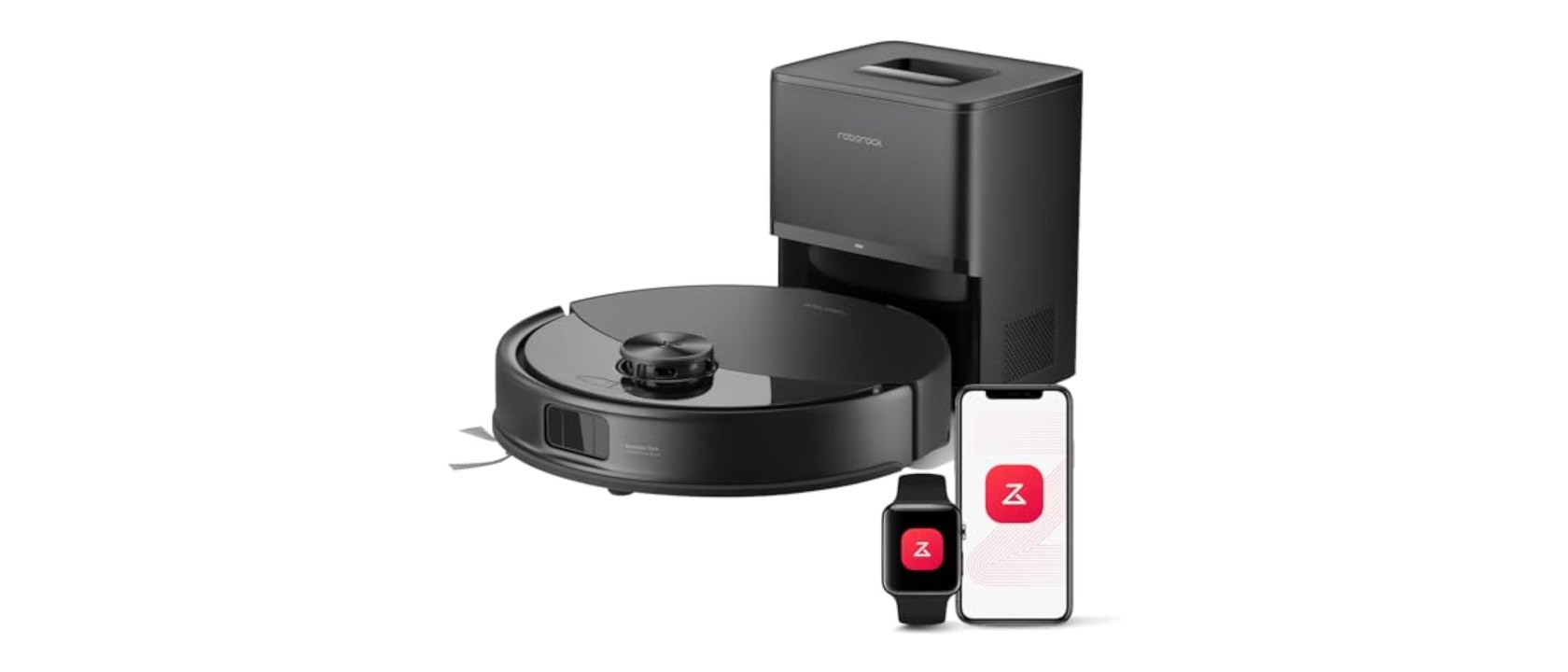
The verdict
The Q10 S5+ fixes the two loudest complaints about roborock's cheaper robots — the lift-less drag mop and the zero obstacle avoidance — and keeps the 10,000 Pa suction, LiDAR mapping, and self-empty dock that made them worth buying. The trade: avoidance is structured-light rather than camera-grade, the dock announces itself, and early quality control has noise in the data, so buy inside a return window and keep the floors picked up.
Pros
- 10,000 Pa HyperForce suction at the top of the mid-price tier, with automatic carpet boost that pulls embedded hair and dander from medium-pile rugs rather than skimming them
- VibraRise 2.0 is a genuine mopping upgrade over drag-pad designs — dual-zone sonic vibration rated up to 3,000 scrubs per minute, and the mop lifts automatically on carpet so wet rugs stop being a risk
- Dual Anti-Tangle hardware: a JawScrapers Comb main brush plus a purpose-built anti-tangle side brush, a real fix for the hair-wrap problem that plagues this price class
- RockDock Plus self-empty dock with a 2.7 L sealed bag — weeks between bag changes for most households, with the dock pulling fine dust without clogging
- PreciSense LiDAR navigation with multi-level mapping that stores up to four floor plans, plus no-go zones owners consistently report being respected
- Ultrasonic carpet detection that raises the mop and boosts suction without you configuring anything
- A 5,200 mAh battery rated up to 150 minutes per manufacturer testing — large homes finish on one charge
- Deep app: schedules, per-room suction, no-go zones, off-peak charging, child lock, and voice control through Alexa and Google Home
Cons
- ReactiveTech obstacle avoidance is structured-light, not camera AI, and independent testing scored it weak on exactly the hazards that matter: cords, socks, and pet toys can still be snagged, and owners report side-brush jams that occasionally wipe the saved map and no-go zones, forcing a full remap. Do a five-minute floor pickup before scheduled runs, and if a jam corrupts the map, delete it in the app and run a fresh mapping pass
- The self-empty dock is loud — a 15-to-25-second burst owners describe as a shop vac, several noting it startles pets and wakes light sleepers — and a minority of early buyers report first-weeks failures (LiDAR, cliff sensor, Wi-Fi). Schedule emptying away from sleep hours, and stress-test every function inside the retailer return window
Best for
- Pet owners on mostly hard floors with low-to-medium pile rugs who want real sonic mopping plus weeks of hands-free vacuuming
- Multi-level homes that can use the four-map library and floor recognition
- Buyers who want flagship-adjacent cleaning behavior — suction, LiDAR, mop lift, carpet boost — without the flagship price tier
Not ideal for
- Homes full of cables, socks, and clutter left on the floor — avoidance here is better than nothing but not trustworthy enough to skip pickup
- Households with wide-grout or textured tile that need genuine deep wet-cleaning; this pad maintains, it does not scrub grout
- Anyone who cannot tolerate a loud dock burst and wants near-silent scheduled emptying at night
roborock Q10 S5+ Review: 10,000Pa Suction, Sonic Mopping, and the Fine Print
The short answer: the Q10 S5+ is roborock’s answer to the two criticisms that followed its cheaper robots for years. The Q7 line’s mop was a drag-pad that never lifted over carpet, and neither robot could see a charging cable. The Q10 S5+ fixes both: VibraRise 2.0 sonic mopping scrubs at up to 3,000 vibrations per minute and lifts itself clear of carpet, and ReactiveTech obstacle avoidance at least attempts to see what the older robots ignored outright. Around those fixes sits the familiar roborock value formula — 10,000 Pa suction, PreciSense LiDAR with four-floor mapping, and a RockDock Plus self-empty station with a 2.7-liter sealed bag.
The fine print is where the honest review lives. Obstacle avoidance here is structured-light, not the camera-based AI of roborock’s flagships, and independent testing scored it weak against the hazards that actually strand robots: thin cables, socks, and small pet toys. The dock’s emptying burst is genuinely loud. The manufacturer says the dust bag lasts up to seven weeks; the Amazon listing headline says up to 70 days — a small but telling inconsistency we unpack below. And a minority of early owners report failures in the first weeks of ownership. None of these disqualify the robot; all of them shape how you should buy it — picked-up floors, smart scheduling, and a return window you actually use.
Rating: 4.2 / 5
What the Q10 S5+ is actually built for
The Q10 S5+ slots into roborock’s lineup as the upgrade path from the Q8 Max+ generation, and its design brief is visible in which features got upgraded and which did not. The suction motor, the LiDAR navigation, the self-empty dock, and the app are carried over from the proven formula. What changed is the two systems that generated the most owner complaints on cheaper models: mopping and obstacle awareness.
That brief tells you who this is for. It is for the household that already believes in robot vacuums — the pet-hair, mixed-floor, want-to-empty-the-dock-monthly household — but has been waiting for a mid-price machine that will not soak a rug and will not chew through a phone charger left on the floor. It is not a flagship: there is no camera, no pet-waste recognition, no mop-washing dock. It is the mid-tier with its two worst gaps patched.
The listing sits at 4.0 stars across roughly 1,456 ratings at the time of writing — a younger review base than the Q7 line’s sixteen-thousand-plus, which cuts both ways: less reliability history, but also a review population that bought the fixes and mostly confirms them.
roborock Q10 S5+ specifications
| Specification | roborock Q10 S5+ |
|---|---|
| Suction | 10,000 Pa HyperForce, auto-boost on carpet |
| Mopping | VibraRise 2.0 sonic vibration, up to 3,000 scrubs/min, auto-lifts up to 8 mm on carpet |
| Obstacle avoidance | ReactiveTech structured light |
| Navigation | PreciSense LiDAR, multi-level mapping (up to 4 maps) |
| Carpet detection | Ultrasonic, drives mop lift and suction boost |
| Self-empty dock | RockDock Plus, 2.7 L sealed bag; up to 7 weeks per roborock, up to 70 days per the Amazon listing |
| Battery | 5,200 mAh, up to 150 min (manufacturer internal testing) |
| Robot dimensions | 13.9 × 13.9 × 3.9 in |
| Dock dimensions | 8.3 × 7.0 × 10.2 in |
| Connectivity | 2.4 GHz Wi-Fi only; Alexa and Google Home voice control |
| Filter | Washable |
| Amazon rating | 4.0 / 5, ~1,456 ratings (at time of writing) |
| Positioning | Upgraded from the Q8 Max+ generation |
One specification note before anything else, because it recurs across this product family: the self-empty interval. roborock’s own product page states up to seven weeks between bag changes; the Amazon listing’s headline and description state up to 70 days. Those are different numbers — 70 days is ten weeks, and the gap between the company’s site and its own listing headline is exactly the kind of thing this site exists to flag. The honest reading: both figures are manufacturer claims based on internal testing under specific assumptions, real-world owners of pet households report several weeks per bag rather than either figure, and you should plan your consumables budget around four to eight weeks depending on shedding volume, not around either headline.
Suction: the spec that anchors the price tier
The 10,000 Pa HyperForce figure is the same number roborock puts on the Q7 M5+, and it is not marketing inflation in the way vacuum peak numbers often are — independent testing of the Q7 platform measured sealed suction among the highest recorded in this price class, and the Q10 S5+ shares the platform’s motor and airflow design. What the number translates to in daily use, per the consistent pattern across owner reports: embedded hair and dander come out of medium-pile carpet rather than being skimmed off the surface, sand and crumbs come up along baseboards and in floorboard gaps on the first pass, and the automatic carpet boost — driven by the ultrasonic carpet sensor — raises suction exactly when the robot transitions onto rug.
The behavior worth understanding is the coupling. On hard floors, the robot runs quieter in balanced modes and the extra suction matters less. On carpet, the ultrasonic detection triggers both the suction boost and the mop lift in one action, which is why the carpet transition is this machine’s signature move: it arrives at the rug, gets louder, and lifts its wet pad in the same second. Owners reviewing the family consistently single out this automatic handoff as the feature that makes mixed-floor homes practical without app babysitting.
VibraRise 2.0: the mop that finally earns its place on the chassis
The Q7 generation’s mop was a passive pad the robot dragged behind it — functional for dust, useless for anything dried, and a genuine hazard to rugs because it never lifted. VibraRise 2.0 addresses both failures. The pad now vibrates in dual zones at up to 3,000 scrubs per minute, which converts the mop from a wet cloth into an agitating scrubber, and the module lifts up to 8 mm when carpet is detected, which removes the wet-rug failure mode entirely.
Set expectations correctly and the system delivers. Third-party reviewers consistently describe the mopping as maintenance-grade: fresh spills, daily grime, and dust film come up well; dried sticky messes and grout lines do not, because the pad lacks the downward pressure of a dedicated scrubber. One recurring owner note is that water flow is conservative — streak-free on sealed hardwood and tile, but occasionally leaving light drying marks on large-format tile if the flow is left at minimum. The practical framing: this is the best mopping behavior available at this price tier short of the spinning-roller machines a class above, and it is still not a replacement for a periodic manual mop on textured floors.
The lift mechanism also matters beyond carpet safety. Because the pad raises automatically, you can run vacuum-only rooms and mop-only rooms in a single session through the app, and the robot will handle the transitions without you swapping hardware mid-run. The mop module remains detachable if you never want it mounted at all — one of the quiet advantages of roborock’s approach over integrated designs.
Dual Anti-Tangle: the fix that testing says is partial
The JawScrapers Comb main brush and the redesigned anti-tangle side brush are roborock’s answer to the hair-wrap complaints that followed the cheaper line, and the honest summary of the evidence is that the main brush benefits are real while the side brush remains the residual problem. Owner reports describe noticeably less hair wound around the main brush than on older models, particularly with long human hair and pet fur on hard floors.
The caveat is that independent testing of the platform family measured hair wrap on the side brush as still slightly worse than the category average despite the anti-tangle branding, and owner reports describe side-brush jams from cords, socks, and rug fringes. The jam itself is recoverable — the robot faults and waits — but a documented owner complaint about this generation is worse than the jam: some owners report that a side-brush stall triggers the robot to wipe its saved map, taking no-go zones and room labels with it and forcing a full remapping run. The mitigation is unglamorous and effective: pre-run pickup of the specific items that jam side brushes, and if a map does corrupt, delete it in the app and run one fresh mapping pass rather than troubleshooting piecemeal.
Navigation and app: the mature roborock formula
PreciSense LiDAR is the reason roborock robots clean in straight, systematic lines instead of the random-walk patterns of camera-less budget machines. The Q10 S5+ scans 360 degrees, builds a detailed map on early runs, and stores up to four floor plans with recognition of which floor it is on — the feature that makes multi-level homes practical without carrying the robot up and down and re-mapping each time. Owners consistently report no-go zones being respected, including around pet beds and cable clusters, and the app adds smart no-go zone suggestions when the LiDAR detects tricky spots like under-chair clearances.
The app is the same one that tops this price tier on the Q7 platform, and its depth is a genuine differentiator rather than checkbox software: per-room suction and water settings, schedules, customized cleaning sequences, temporary spot re-cleaning mid-run, DEEP+ slow-mop mode for stubborn areas, off-peak charging to exploit time-of-use electricity rates, a child lock, and voice control through Alexa and Google Home. One environmental constraint repeats across the brand and belongs in every setup plan: the robot pairs with 2.4 GHz Wi-Fi only, and the single most common setup complaint is the robot refusing a dual-band router until the 5 GHz band is temporarily disabled during pairing.
The RockDock Plus: weeks of not thinking about dust
The self-empty dock is the feature that converts a good robot vacuum into a low-attention appliance. After each run, the dock pulls the bin’s contents into a 2.7-liter sealed bag; owners report the dock extracting fine dust effectively without clogging and the sealed bag containing odor, which matters in small homes. Third-party reviewers of the family describe typical bag life in pet households at several weeks, which is shorter than the manufacturer’s headline but still transforms the maintenance cadence from every-run to every-month-or-so.
The two honest caveats are noise and consumables. The emptying cycle is a 15-to-25-second burst that owner reports across multiple forums describe in uniformly unflattering terms — a shop-vac-grade blast loud enough to startle pets and wake light sleepers, with one reviewer noting a high-pitched component to the whirr some units emit while docked. This is schedulable: set emptying to happen midday rather than at 2 a.m., and the issue largely evaporates. The dust bags themselves are a recurring purchase alongside filters and side brushes — budget for a consumables line item in the low hundreds of dollars per year for a busy pet household, which is standard for the dock-equipped tier and cheaper than the flagship docks’ all-in consumable kits.
Obstacle avoidance: better than nothing, not a substitute for pickup
ReactiveTech is the Q10 S5+’s newest claim and the one most worth deflating to accurate size. It uses structured light — projected patterns the robot reads to detect objects — which is a genuine upgrade over the Q7 line’s complete lack of avoidance: independent reviewers confirm it navigates around shoes, backpacks, and furniture legs that would have been plowed into on older models.
The limitation is equally documented. Structured light without camera-grade AI processing struggles with low-profile, thin objects: phone chargers, stray socks, dangling pet toys, and rug fringe are the recurring kryptonite across owner reports, and one independent reviewer scored the system’s avoidance performance well below the category’s camera-equipped leaders. The practical translation is unchanged from cheaper roborocks, just with more margin: a five-minute floor pickup before scheduled runs remains part of the ownership contract, and households that cannot maintain that habit — young kids, clutter-prone floors — should either budget for the camera-based tier above or accept rescues and the occasional map wipe.
Battery, noise, and daily logistics
The 5,200 mAh battery is rated up to 150 minutes per roborock’s internal testing, with third-party coverage estimates for the family in the same general range depending on suction mode and floor type — long enough that even larger homes complete on one charge in most configurations, with the robot returning to dock and resuming when needed. Note that the max-suction carpet mode costs runtime meaningfully; balanced mode is where the headline figure lives.
Running noise follows the same pattern: balanced mode sits in the mid-60s dB region per owner measurements — a box-fan hum that permits conversation and television in the same room — while max mode is upright-vacuum loud. The dock burst, as covered above, is the one noise event that requires scheduling rather than tolerance. Setup is quick by consensus: quick mapping runs finish fast, and the moisture-proof mat included in the box solves the dock-on-hardwood splash question before it is asked.
What owners actually report
The 4.0-star average across roughly 1,456 ratings is younger and thinner than the Q7 line’s database, and the themes divide cleanly. The positive cluster: pet hair pickup across floor types, the carpet handoff (boost plus mop lift) as the standout behavior, easy setup and quick mapping, and long runtime covering larger homes on one charge. The complaint cluster mirrors the cons above with one addition: a minority of buyers report units failing within the first weeks — LiDAR faults, cliff sensor errors, and Wi-Fi connectivity problems — alongside the expected dock noise and cable-snag reports. Reliability variance in a young production run is the single best argument for treating the retailer return window as a functional test period rather than a formality: run the robot daily, exercise the dock, the mapping, and the app features within it, and any early-life defect will usually surface inside that window.
Who should buy it
- Pet owners on predominantly hard floors with low-to-medium pile rugs — the sonic mop plus lift and the suction platform are built for exactly this mix
- Multi-level homes that will use the four-map library and floor recognition
- Households upgrading from the Q7/Q8 generation whose pain points were the drag mop and zero avoidance
- Anyone who wants flagship cleaning behavior without flagship pricing, and will keep the floor picked up in exchange
If those four describe your home, you can check the current Q10 S5+ listing and configuration on Amazon — worth confirming which dock variant is in the box before you commit.
Who should skip it
- Clutter-heavy homes that will not do pre-run pickup — the avoidance is structured-light, and the map-wipe jam reports are the consequence
- Wide-grout and textured-stone floors that need real wet scrubbing; this pad maintains but does not deep-clean, and the roller-mop machines a tier above are the right tool
- Light sleepers who cannot schedule the dock away from sleep hours, or buyers who want a long reliability track record before committing — the Q7 M5+’s sixteen-thousand-rating history is the conservative pick
FAQ
Is the dust bag really good for seven weeks? The manufacturer’s site says up to seven weeks; the Amazon listing headline says up to 70 days — ten weeks. Both are internal-test figures. Real-world pet households report several weeks per bag. Plan consumables around four to eight weeks depending on shedding.
Can it avoid cables and socks? Partially. ReactiveTech handles larger objects — shoes, backpacks, furniture legs — but thin cables, socks, and small toys defeat it in both independent testing and owner reports, and side-brush jams from these items occasionally trigger map wipes. Do the five-minute pickup.
Will it soak my rugs? This is the fix the Q10 S5+ exists to deliver: the VibraRise 2.0 pad lifts up to 8 mm when ultrasonic sensors detect carpet. For thick high-pile rugs, set a no-mop zone in the app as a precaution.
Does it work with 5 GHz Wi-Fi? No — 2.4 GHz only, which is the brand’s most common setup complaint. Temporarily disable the 5 GHz band during pairing, then re-enable.
How loud is it? The robot runs in the mid-60s dB on balanced modes — conversation-permissible. The dock’s emptying burst is the loud event: a 15-to-25-second shop-vac-grade blast. Schedule emptying away from sleep hours.
How does it differ from the Q7 M5+? Same suction class, same dock concept, same app — plus obstacle avoidance the Q7 lacks entirely, a sonic vibrating mop that lifts over carpet instead of a drag pad that never lifts, and the dual anti-tangle brush hardware. We compare them in detail in our Q10 S5+ vs Q7 M5+ comparison.
This review is based on the Amazon retail listing for ASIN B0DWXBCQVP, roborock’s own product pages and documentation, and third-party reviews, independent testing summaries, and category roundups of the Q10 S5 platform. Product images are the manufacturer’s official product images from the retail listing, not photos taken by us. We have not performed instrumented laboratory testing, and nothing here should be read as a measured result. Suction, runtime, scrub-rate, dock-interval, and noise figures are manufacturer claims or third-party reports, labeled as such wherever they appear. Owner sentiment reflects documented reviews and forum reports rather than our own survey. Specifications and availability change frequently — always confirm current details on the retailer page before purchasing.
Last updated: October 19, 2026
More from TechWithAll
- roborock Q10 S5+ vs Q7 M5+ comparison — Same suction, same dock, two different robots: where the upgrade money actually goes.
- roborock Q7 M5+ review — The Wirecutter top pick with the sixteen-thousand-rating track record.
- PetPivot Open Top review — The app-free automatic litter box for senior and globe-averse cats.
Browse the full home category.