
The verdict
The most safety-redundant open-top automatic litter box we have found at a budget price, and the only one in its class that needs no app, no subscription, and no proprietary litter — priced in exchange for a monthly teardown ritual and a hard pass on very small cats.
Pros
- Seven pairs of infrared sensors plus a touch-sensitive safety pedal and a mechanical rotation limiter — a three-layer redundant safety stack, where most budget automatic boxes run a single sensor array
- Completely app-free: no WiFi pairing, no account, no subscription, and no firmware update standing between you and a clean litter box — a three-button panel runs everything
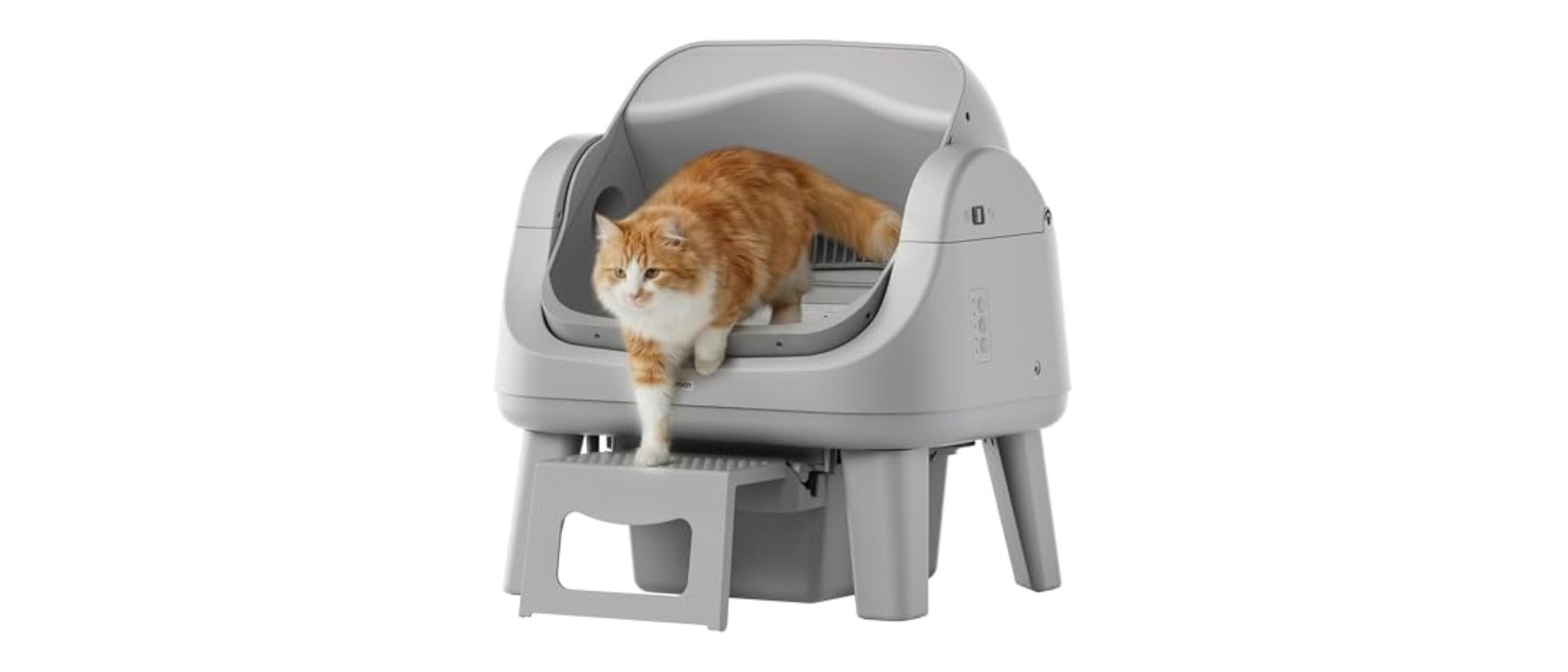
- Open-top design with an included access step, so senior cats, stiff-jointed cats, and cats that refuse enclosed globes can walk in instead of climbing through a portal
- A built-in clumping delay lets litter solidify before the drum rotates, which is the specific design choice that fights pancaking (clumps welded to the drum floor) and smearing (waste streaked along the walls)
- Runs on ordinary bentonite or mineral clumping litter — no proprietary consumable, unlike cartridge-based systems that lock you into brand-specific trays
- Tool-free modular teardown: the drum and waste drawer detach in seconds for the monthly deep clean, and the included litter mat, liners, and scoop mean the setup is complete on day one
- 1-year manufacturer warranty, and the listing carries Climate Pledge Friendly certification for verified recycled content (GRS, ≥50%)
Cons
- The rotating sift leaves residue this design cannot fully avoid — clumps and litter stick to the drum's back wall and the sensor cavity gathers dust, so owners keep a hand scoop on top of the unit and plan a monthly teardown. Do it in that order: rinse the drum and waste drawer, wipe the powered base with a damp cloth only, and never hose the electronics
- Weight- and infrared-based safety sets an implicit floor on cat size: kittens and very small cats are not good candidates, and multi-cat homes should expect to empty the drawer every 5–7 days. Introduce the box unplugged first, with the auto cycle off, until every cat in the house has used it calmly
Best for
- Owners of senior or mobility-limited cats who need a low, stepped entry rather than a porthole into a rotating globe
- Multi-cat households (two to three adult cats) that want automated scooping without another app, account, or subscription in their lives
- Anyone burnt by cartridge-based systems — if you want automation that runs on the same clumping litter you already buy, this is the category's most open design
Not ideal for
- Kittens, cats under roughly 8–10 lb, or households planning to automate litter for a young cat — weight-based detection is not the right safety model for a two-pound kitten
- People who want remote monitoring, health tracking, or app notifications; there is no connectivity here at all, by design
- Homes that cannot commit to a monthly deep clean — this is a machine you maintain, not a machine you ignore
PetPivot Open Top Self-Cleaning Cat Litter Box Review: App-Free Auto Clean
The short answer: the PetPivot Open Top is built on a bet that most automatic litter boxes get the priority order wrong — that safety redundancy and mechanical simplicity matter more to a cat household than another connected app. The hardware backs that bet up with the deepest sensor array we have found in this price class: seven pairs of infrared sensors watching the drum, a touch-sensitive pedal that interrupts rotation on contact, and a mechanical limiter that physically restricts how the drum can turn. There is no app, no WiFi pairing, no account, and no subscription — a three-button panel and a power adapter are the entire interface. It runs on the same clumping litter you already buy, and the whole drum detaches without tools for the monthly deep clean.
The trade is written into the design. A rotating sift can never leave the drum perfectly clean, so clumps stick to the back wall and you will keep a hand scoop on top of the unit anyway. Weight-based detection is the wrong safety model for a two-pound kitten. And this is a machine you maintain — a monthly teardown is part of the deal, done in the right order so the electronics never meet a hose. If those trades sit fine with you, the numbers in this category point here. If you want health tracking on your phone or you are shopping for a kitten, read the “who should skip it” section first.
Rating: 4.3 / 5
What this litter box is actually built for
PetPivot’s open-top automatic box is aimed at a specific and, frankly, underserved cat: the senior or mobility-limited one. The listing says it directly — an easy-access step for senior cats — and the included package list backs it up with a dedicated step, four support legs that set the drum at a manageable height, and a litter mat to catch what the low entry inevitably tracks. A cat with stiff joints does not want to jump through a porthole into a rotating globe. It wants to walk up a ramp into a basin it can see out of. That is this machine’s whole shape.
The second audience is the household that has already been burned by connected pet hardware. PetPivot’s own positioning is blunt about it: no app downloads, no subscriptions, no connectivity concerns. Every automatic box that pairs with WiFi has a failure mode where the app logs you out, the firmware update stalls, or the cloud service is down on the one morning the drawer is full. This box cannot have any of those failures. Three buttons on the panel, an indicator, and a power switch are the entire user interface. For older owners, for rentals where the WiFi is unreliable, and for anyone whose smart home enthusiasm died somewhere around the third required account, that is not a missing feature — it is the feature.
The third audience is the multi-cat home of two to three adult cats. The open basin means there is no queue at a single small portal, and PetPivot’s own FAQ recommends it for multi-cat households, with the honest caveat that more cats means checking the waste drawer more often. Amazon’s listing data supports the real-world traction: the box launched in February 2026 and has climbed to a top-three rank in the self-cleaning litter box category, with a 4.2-star average across roughly 430 ratings and a steady run of more than a thousand units bought in a week. Those are marketplace figures, not our measurements, but a sample that size three months after launch is no longer an early-adopter fluke.
Specs at a glance
| Specification | PetPivot Open Top Self-Cleaning Litter Box |
|---|---|
| ASIN / model | B0GL7Q6YXZ |
| Dimensions (L × W × H) | 21.06 × 15.75 × 21.85 in (53.5 × 40 × 55.5 cm) |
| Unit weight | 20.6 lb (9.3 kg) |
| Material | Polypropylene (PP) |
| Color (this listing) | Dark Grey |
| Safety system | 7 pairs of infrared sensors + touch-sensitive safety pedal + mechanical rotation limiter |
| Controls | Three-button panel — no app, no WiFi, no subscription |
| Cleaning trigger | Infrared and weight detection, with a built-in clumping delay before rotation |
| Litter type | Bentonite / mineral clumping litter; avoid crystal, pellet, and non-clumping |
| Noise | Manufacturer lists a low-30s dB figure (35 dB claimed); third-party roundups report 32–38 dB |
| Waste drawer | Sealed drawer with disposable liners (20-count roll included) |
| In the box | Main unit, waste container, liner roll, power adapter, litter scoop, 4 support legs, litter mat, manuals |
| Warranty | 1 year manufacturer warranty |
| Certification | Climate Pledge Friendly — GRS certified, ≥50% recycled content (Bureau Veritas) |
Specifications from the Amazon listing and PetPivot’s own product pages. Figures PetPivot publishes — noise, waste capacity — are manufacturer claims, and we flag them as such wherever they appear below.
How the safety system is actually layered
The listing’s headline number — seven pairs of safety sensors — deserves a precise explanation, because it is the most differentiated hardware in this price class and also the most misunderstood.
Seven pairs means fourteen infrared emitter/detector points arranged around the drum, not seven standalone motion detectors. Pairing matters: an emitter and its matching detector form a beam, and the system knows a beam is broken the instant something crosses it. A single-sided reflective sensor, which is what most budget boxes use, has to infer presence from a bounced signal and is far more sensitive to dust, dark fur, and odd angles. Fourteen beam points give the control board a dense picture of what is inside the drum, which is why the box can afford the behavior it actually has: pause the instant anything crosses a beam, resume from where it stopped once the drum is clear.
The touch-sensitive pedal is the second, independent layer. It is a physical contact surface — the step area at the entry — that interrupts the cycle on direct contact regardless of what the infrared array thinks. The two systems fail differently: dust and hair degrade optics over months, while a contact pedal keeps working until it physically breaks. Having both means the common failure of one layer is the rare failure of the other.
The mechanical limiter is the third layer, and it is the one that matters most in the worst case. It physically restricts the drum’s rotation so the mechanism cannot complete a full sweep against a fixed obstruction. Software safety — a pause command from a sensor — can itself fail; a mechanical stop cannot be talked out of by a firmware bug. Three layers that fail in different ways is genuine redundancy engineering, and it is the reason we rate the safety story here above every other budget open-top box we have reviewed. PetPivot’s own marketing calls this a triple-layer redundant system, and for once the marketing language maps cleanly onto the hardware.
One honest caveat belongs here. PetPivot’s site and its Amazon listing describe the sensor counts slightly differently across pages — the Amazon unit emphasizes the seven infrared pairs, while the brand’s own product pages describe three- and four-layer protection schemes that fold the pedal and limiter into the count. The hardware story is consistent; the marketing arithmetic is not. Judge it by the three mechanisms, not the number in the headline.
The cleaning cycle: what the clumping delay actually does
Automatic sifting boxes live or die on a problem the spec sheets rarely name: the interval between the cat leaving and the drum turning.
Scoop too early and the clump is still soft — it tears, smears against the drum wall, or gets shredded into fragments too small for the screen to catch, and you end up picking waste crumbs out of clean litter by hand. Scoop too late and odor has already spread. The failure modes even have names among owners: pancaking, where a wet clump welds itself to the drum floor and tears in half when the screen passes; and smearing, where waste paints a stripe along the rotating wall that every subsequent pass grinds in deeper.
PetPivot’s answer is a built-in clumping delay — the unit waits for litter to fully solidify before rotation begins. Third-party reviews of the product line put the delay at around sixty seconds, which matches the rhythm most clumping litters actually need in a shallow open basin: long enough for the bentonite to grab the moisture and firm up, short enough that odor does not have time to escape an open top. Once the cycle runs, the drum rotates, the screen lifts clean litter and lets it fall back, and clumps ride the rotation over the lip into the sealed waste drawer below.
Two practical consequences follow, and both favor this design. First, the delay is why owners report less pancaking here than on boxes that rotate on a fixed short timer — the timer never has to guess how fast your particular litter sets. Second, because the drum only turns after the clump is firm, the sift actually separates cleanly, which is where the litter savings come from: less good litter gets discarded with the waste, and owners consistently report the box using measurably less litter than their old manual routine.
The open top plays a role here too, and it cuts both ways. The upside: an open basin releases moisture instead of trapping it, so clumps firm up faster than they would in a sealed globe, and humidity — the enemy of clumping — never builds up inside the machine. The downside is the entry: a low open front is exactly where litter leaves the system on paws. We come back to that in the maintenance section, because the included mat is not an accessory here, it is part of the system.
App-free is a design decision, not a missing feature
It is worth being precise about what “no app” costs and what it buys, because the category’s premium products have trained buyers to assume connected equals better.
What the app on premium boxes actually does: schedules cleaning windows, counts visits, weighs the cat, notifies you when the drawer is full, and lets you trigger a cycle remotely. Those are real features, and a household that travels and monitors an elderly cat’s weight legitimately needs them.
What this box does instead: cleans after every use, on a delay, forever, with three buttons to adjust the delay and trigger a manual cycle. The visit log and the weight chart are gone — but so are the WiFi dropout, the mandatory account, the server that goes down, the firmware update that bricks the schedule, and the subscription that some brands now attach to the health features. PetPivot’s own support pages make the failure model explicit in a different context: a unit that believes a cat is still inside — usually because a dusty sensor keeps a beam broken — will cycle indefinitely, and the fix is a dry cloth and a reset. Every box in this category has a version of that failure. The difference is that fixing this one requires no app, no support ticket, and no network.
The deeper point is fit. A litter box is the one appliance in the house that has to work during a power-company outage, a router reboot, and the week you are too busy to update anything. A box whose entire intelligence lives in its own control board, with no dependency outside the wall socket, is the right engineering for that job. Buyers who want usage analytics should buy the connected boxes — seriously, that is what they are for. Buyers who want the scooping to stop should look here.
Open top versus enclosed globe
The automatic litter box market has split into two physical philosophies, and the split is worth understanding before you buy either.
Enclosed globes — the large rotating spheres most people picture when they hear “automatic litter box” — hide the waste mechanism, contain odor well, and look tidier. They also demand a lot from the cat: entry through a single portal, a rotating floor beneath the paws, a dark interior, and for many models, a listed maximum cat weight that rules out Maine Coons and large males. Cats with anxiety, seniors, and large breeds are the documented casualties of that design; behavioral guidance for litter box avoidance has consistently favored open, visible, low-stress entry for exactly those cats.
The open-top philosophy inverts every one of those choices. Entry is a wide basin with a step, the cat can see out at all times, there is no portal to feel trapped in, and there are no enclosed resonating surfaces — which is one reason open-top units run quiet. You can see the litter level, the clump quality, and — not trivially — your cat’s output, which is how most households actually catch urinary problems early. PetPivot’s open-top entrée measures roughly 16 by 15 inches per third-party roundups of the line, sized for large cats, and the brand’s own gallery shows a 14-pound cat using the unit with room to turn around.
The costs are equally concrete. An open basin releases more litter dust and tracking than an enclosed system, though the low entry — easier for the cat — scatters more than a high-sided open pan would; the included mat catches most but not all of it. Odor control depends on the sealed drawer and its carbon filter rather than on a lid, which works well when the drawer is emptied on schedule and degrades quickly when it is not. And the mechanism, sitting open under the basin rim, is exposed to the dust that enclosed units keep sealed away — which is why the sensor cavity cleaning in the maintenance section is not optional. Every one of those costs is manageable with habits the next section lays out. None of them are optional.
Litter compatibility: what works and what does not
This box runs on ordinary clumping litter, and that single sentence is most of its operating cost advantage.
The system is engineered for bentonite and mineral-based clumping litters — the standard clay litters that dominate American grocery and pet-store shelves. Firm-clumping clay is what the sift is tuned for: clumps that set quickly, hold together through rotation, and ride the screen cleanly into the drawer. There is no proprietary cartridge, no branded refill, no subscription litter. The drawer takes disposable liners, and a 20-count roll ships in the box; owners report that ordinary drawstring kitchen bags fit the drawer just as well, which removes the last recurring brand dependency.
The exclusions matter as much as the inclusions, and the manufacturer plus third-party reviews agree on the list. Non-clumping litter has nothing for the screen to sift — it passes straight through. Crystal and silica litters do not clump at all and can damage the mechanism. Wood pellets and pellet-style litters rattle through the screen unsorted and grind loudly against the drum. Lightweight “super-soft” clumping litters form loose clumps that tear during rotation and leave residue — the direct cause of the pancaking the clumping delay is designed to prevent. Plant-based litters sit in a gray zone: they clump loosely enough that PetPivot’s own FAQ warns they may need more frequent drawer cleaning.
One habit protects all of this: keep the fill between the minimum and maximum lines. Overfilled drums grind granules into the track and gear area — the single most common cause of a suddenly loud unit, per PetPivot’s own noise troubleshooting guide — and underfilled drums let clumps reach the floor and stick. The fill line is printed inside the basin; treat it as hardware, not a suggestion.
Living with it: daily, weekly, and monthly
This is the section that decides whether you will be happy with the box, because the machine’s convenience is real but not absolute — and the maintenance it does need has an order of operations that matters. If you would rather check the current listing details before committing, you can see the PetPivot Open Top on Amazon.
Daily: nothing. The cycle runs after each visit. You glance at the drawer’s fill window in passing, the way you would glance at a dishwasher’s status light. That is the whole daily routine, and it is the reason owners with two and three cats describe the box as the end of a chore rather than a new one.
Every one to two weeks: empty the drawer. PetPivot’s own FAQ puts the interval at 7–14 days for a single cat; multi-cat homes should plan on every 5–7 days. Lift the sealed drawer out by its handle, tie off the liner, drop in a fresh one, reseat the drawer until it clicks. A misaligned or overfull drawer is the second most common cause of noise and cycle faults, so the reseating matters as much as the emptying.
Monthly: the teardown. The drum, waste drawer, and basin components detach without tools — the modular quick-release design is specifically built so the deep clean does not become a project. The routine that owners and the manufacturer’s own guidance converge on: take the drum and plastic components outside, hose them down, let them dry fully. Wipe the base — the part with the electronics and the motor — with a damp cloth only, and never put it under water. Wipe the sensor eyes with a dry cloth; optics that gather a month of clay dust are the root of most phantom-cycle faults. Be gentle around the sensor array, full stop. One long-term owner’s account of a knockoff unit’s corroded sensor is a reminder of what moisture near the optics costs.
When something sounds wrong, diagnose before you disassemble. PetPivot’s own maintenance blog is unusually candid about the failure vocabulary, and it is worth internalizing: grinding or harsh scraping usually means trapped litter granules in the track; repeated clicking means a loose panel, an unseated drawer, or a wedged clump; squeaking during rotation points to bearing or gear wear that tends to appear after a year or more of service; thumping means the litter is above the fill line or the floor is uneven; and a motor that strains, stalls, or reverses means stop using the unit and inspect. The honest summary from owners: the box gets slightly less quiet as it ages, and the sound changes are diagnostic information, not defects. A thin mat under the base and six inches of clearance from the wall meaningfully cut what you hear.
How it compares
Three comparison points anchor this category, and the PetPivot earns its place against each on specific, checkable grounds. We compare structures and published specifications only — no links to competing products, and their prices change often enough that we leave the arithmetic to you.
Against the premium enclosed globes (Litter-Robot class). The premium systems offer larger capacity, app ecosystems with health tracking, and a longer track record; nothing here disputes that. What the PetPivot offers back is a fundamentally easier entry for the cats those globes exclude — seniors, anxious cats, and large breeds that do not fit a porthole — plus safety redundancy that matches or exceeds the premium sensor arrays, and no subscription attached to the features that matter. The physical trade is capacity per cycle: the globe designs process a bigger waste drawer less often. The practical trade is connected versus self-contained.
Against cartridge-based systems (PetSafe ScoopFree class). This is the comparison where the litter economics decide everything. Cartridge systems automate the waste side but lock the litter side to proprietary crystal trays that must be bought on subscription rhythm — the consumable cost never ends, and the litter itself (silica) is the type cats most often reject. The PetPivot inverts that: more frequent drawer emptying, but any clumping litter from any brand at any price point, with ordinary kitchen bags as liners if you choose. Over a two-cat year, the litter line item alone typically decides this comparison.
Against other budget open-top boxes. This is the crowded field — several budget-priced open-top automatics now ship with app control and large sensor counts on paper. Against them, the PetPivot’s differentiators are the ones you can verify in the returns rate and the review average: a three-month-old listing already top-three in category with a 4.2 average across roughly 430 ratings, a third-party-documented reputation for responsive warranty service — replacement parts shipped quickly within the warranty period, per multiple roundup reports — and a clumping-delay cycle that the budget competition mostly omits in favor of fixed short timers. The field’s common weaknesses — sensor failures, size limits for large cats — are exactly the two areas where this unit’s hardware is deepest.
What owners report long-term
Three months of marketplace reviews is short by appliance standards, but the patterns are already consistent enough to quote, and they align with the brand’s longer-running product line.
The multi-cat evidence is the strongest. One verified owner runs three adult cats — all ten pounds or more — on two of these units, having downsized from four manual boxes, and reports no trouble with any of the cats entering, exiting, or being caught mid-cycle. That is the exact deployment this machine is built for, working as designed.
The honest long-term notes cluster around two themes. First, noise: the machines start very quiet and become less so over months of service — consistent with the gear and bearing wear PetPivot’s own troubleshooting pages describe as normal aging, and manageable by keeping the track clean and the fill line respected. Second, the manual scoop: multiple owners specifically advise keeping it, not because the automation fails but because knocking dried litter off the drum’s back wall by hand is simply faster than waiting for the next cycle to do it imperfectly. That is a fair description of what rotating sifting is, and it is why our cons list treats the hand scoop as part of the ownership contract rather than a defect.
The adaptation advice repeats across owners and matches the manufacturer’s FAQ: introduce the box unplugged, let the cat investigate it with treats nearby, and switch the automatic cycle on only after the cat has used it calmly — a process that can take weeks with a cautious cat. Households that rush the transition are the ones that report refusals; households that stage it report near-universal acceptance, including by cats that had refused enclosed globes.
Service gets specific praise: multiple independent roundups note PetPivot replacing defective parts quickly within the warranty period, which is unusual enough at this price tier to count as a purchase reason rather than a footnote.
Who should buy the PetPivot Open Top
- Senior-cat and mobility households. The stepped entry, the open sightlines, and the walk-in basin are purpose-built for the cat who can no longer jump into a globe — and for the owner who no longer wants to scoop four times a day.
- Two-to-three adult cat homes that hate apps. Every automatic box here has a drawer to empty on schedule; this is the one whose failure modes never require your phone.
- Houses with one clumping litter they already trust. If your cat likes a standard bentonite litter, this machine runs on it indefinitely with no consumable beyond liners — and not even those, if you use kitchen bags.
- Buyers who value verifiable redundancy. Three independent safety layers that fail in different ways is engineering you can check in the spec sheet, not marketing you have to trust.
- Anyone replacing a failed premium unit. A meaningful share of this box’s early reviews come from owners whose connected machines stopped cycling; this is the de-escalation pick that keeps the automation and drops the dependencies.
Who should skip it
- Kitten households, and homes with cats under roughly 8–10 lb. Weight- and beam-based safety assumes a cat big enough to break beams and load the pedal. Multiple long-term owners say it directly: not for kittens or really small cats. Automate when the cat is grown.
- Remote-monitoring needs. If you travel and want visit counts, weight trends, and app alerts for a cat with a medical condition, buy the connected class of machines — that is their strength, and this box deliberately has none of it.
- Households that will not do the monthly teardown. The drum must come out and be hosed, the base must be wiped and never soaked, the sensor eyes need a dry cloth. Skipping that routine is how every box in this category turns into a complaint. If the ritual will not happen, buy a large manual box and a good mat instead.
- Crystal- or pellet-litter households by preference. If your cat has settled on silica or pellets for good reasons — asthma, tracking aversions — this machine’s sift is not designed for them, and no clumping-delay logic fixes that.
How to choose an automatic litter box: a short checklist
If you are comparing across brands, these five questions cut through most of the marketing:
- What happens if the cat re-enters mid-cycle? The answer should name at least two independent detection layers. One is not enough.
- What does the litter cost over a year? Divide the consumable story into two parts — waste liners and litter itself. A box that needs proprietary cartridges on either line will out-earn its purchase price in consumables within a year or two.
- What is the service story? Check whether the brand ships replacement parts, not just replacements, and how the warranty is honored in practice.
- Does the entry match the cat? Senior, large, and anxious cats need a low open entry; a porthole globe is a rejection risk for exactly those cats.
- What maintenance does the manual actually require? Every rotating box needs periodic teardown. If the marketing says “self-cleaning” without a maintenance schedule, the schedule exists anyway — find it before you buy.
Frequently asked questions
Will the cleaning cycle start while my cat is inside? No. The seven infrared sensor pairs and the touch pedal both pause the cycle the moment a cat crosses a beam or touches the entry, and the cycle resumes from where it stopped after the drum is clear. The mechanical limiter additionally restricts rotation against any fixed obstruction.
Does it need special litter? No — that is one of its main advantages. It is engineered for bentonite and mineral-based clumping litters, the standard type sold everywhere. Avoid crystal, silica, pellet, and non-clumping litters, and keep lightweight soft-clumping litters to a minimum: they form loose clumps that tear during rotation.
How often do I empty the waste drawer? PetPivot’s own guidance: every 7–14 days for one cat. Two to three cats: plan on every 5–7 days. The drawer is sealed, lifts out by the handle, and takes the included liners — or ordinary drawstring kitchen bags, which owners report fit fine.
Is it actually quiet? PetPivot lists a figure in the mid-30s dB, and third-party roundups of the line report between 32 and 38 dB — around the level of a whisper. Owners confirm it is quiet enough to run at night. The fair caveat: like any geared appliance it becomes slightly less quiet with age, and trapped granules or an overfull drawer are the usual causes of a sudden change.
Can kittens use it? Not recommended, and this is one place the owner community is unanimous. The safety system keys off weight and beam-crossing, which a small kitten cannot reliably trigger. Most guidance, including long-term owners’, is to automate once the cat is adult-sized, and to introduce the box unplugged first at any age.
How hard is setup? Fifteen to twenty minutes per third-party reviews: attach the four support legs, seat the waste drawer, add the liner, fill litter to the line, press the litter-added button. No app, no account, no pairing. Everything needed ships in the box, including the mat and a liner roll.
What warranty comes with it? A one-year manufacturer warranty covering defects under normal use. Independent roundups report PetPivot handling warranty claims through its site and Amazon and shipping replacement parts quickly — which matters more at this price tier than the warranty’s length on paper.
How is this different from the expensive rotating globes? The entry and the connectivity. Globes use a single portal into an enclosed rotating sphere and pair with apps; this box uses a wide open basin with a step and has no connectivity at all. Globes hold more waste per cycle and offer health tracking; this box is easier for senior, large, and anxious cats to enter, has a deeper sensor array, and runs on any clumping litter with no subscription. If you are weighing the two philosophies directly, we put this box head-to-head with the leading mid-price globe in our PETKIT PuraMax 2 vs PetPivot Open Top comparison.
This review is based on the Amazon retail listing for ASIN B0GL7Q6YXZ, PetPivot’s own product pages and FAQ documentation, the manufacturer’s published maintenance and noise-troubleshooting guidance, and third-party reviews and category roundups of the PetPivot open-top line. Product images are the manufacturer’s official product images from the retail listing, not photos taken by us. We have not performed instrumented laboratory testing, and nothing here should be read as a measured result. Noise, capacity, and delay figures are manufacturer claims or third-party reports, labeled as such wherever they appear. Cat-size guidance reflects documented owner reports rather than an official minimum-weight specification from PetPivot. Specifications and availability change frequently — always confirm current details on the retailer page before purchasing.
Last updated: October 18, 2026
More from TechWithAll
- PETKIT PuraMax 2 vs PetPivot Open Top comparison — This box head-to-head against the smart-globe alternative: odor containment, telemetry, and which cat suits each design.
- PETKIT PuraMax 2 review — The app-connected, sealed-bin rotating globe, if you decide you do want health tracking after all.
- Momcozy KleanPal Pro review — The all-in-one bottle washer, sterilizer, and dryer for heavy feeding routines.
- roborock Q7 M+ review — Wirecutter top pick with 10,000 Pa suction and a self-empty base.
- Levoit LVAC-200 review — Lightweight cordless vacuum built for hard floors and quick cleanups.
- VEVOR 21-inch lawn sweeper review — Light, steel-framed cleanup for dry-leaf season on small yards.
Browse the full home category.