
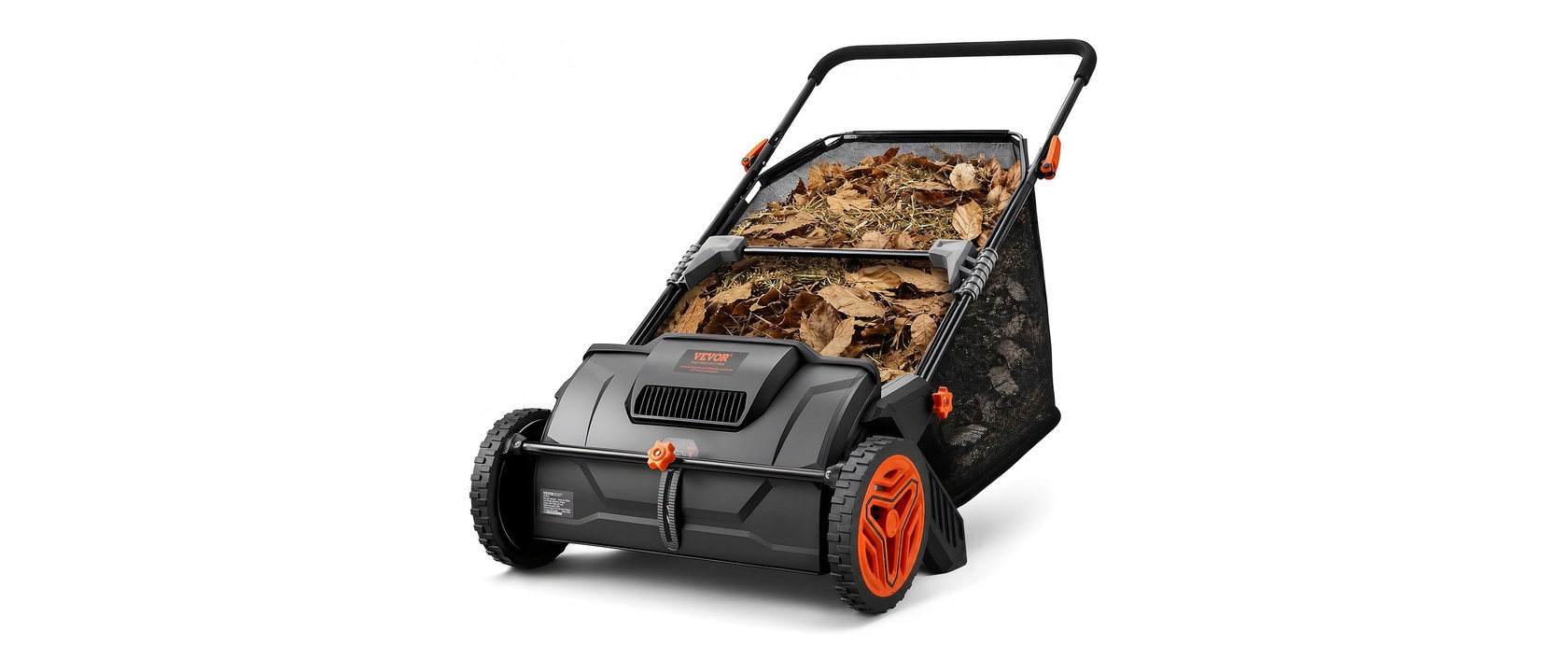
The verdict
A light, steel-framed 21-inch sweeper that makes dry-leaf season on a small yard dramatically faster than raking — as long as you accept a small hopper, two brushes, and dry weather.
Pros
- 14.3 lb — roughly 10 lb lighter than the 26-inch Agri-Fab 45-0218, which is the difference between an easy push and a workout once the hopper starts filling
- 3.5 cu ft hopper is the largest among the 21-inch push sweepers in this comparison
- Steel frame, against the plastic housing that owners most often criticize on the Agri-Fab
- 5:1 brush-to-wheel ratio — a figure most competitors do not publish, and the same design logic tow-behind sweepers use
- Tool-free brush-height knob with a height scale printed next to it, so the setting is repeatable instead of guesswork
- Quick-clip assembly on both sides; the frame folds and the support feet let it lean against a wall without tipping
- No fuel, no cord, no battery, no engine maintenance — the brushes are driven entirely by the wheels
Cons
- Dry debris only. Wet or matted leaves stick to the brushes and pack into the hopper throat. Wait a day or two after rain before sweeping, or blow small wet piles open first
- The 3.5 cu ft bag empties often during peak leaf-fall weeks — expect several trips to the compost pile on a heavily treed lot. Splitting the yard into two passes makes the stopping rhythm manageable
Best for
- Small yards under a quarter acre where raking clippings and leaves is the recurring chore
- Driveways, patios, and artificial turf, where the adjustable brush height and light frame are at their best
- Sheds and garages short on floor space — the folded frame leans on a wall on its support feet
Not ideal for
- Properties over half an acre — a 26-inch push sweeper or a tow-behind model covers ground materially faster
- Households whose main enemy is pine needles, acorns, or wet leaves; those need a rake or a vacuum, not brushes
- Anyone who already owns a riding mower — a tow-behind sweeper attached to it will out-collect any push model
VEVOR 21-Inch Push Lawn Sweeper Review: Light, Steel-Framed, and Built for Dry Leaves
The short answer: the VEVOR 21-inch push sweeper is built on a simple bet — that a small yard does not need a bigger machine, it needs a lighter one. At 14.3 pounds with a steel frame, a 3.5 cubic-foot hopper, and a 5:1 brush-to-wheel ratio, it carries the largest bag and one of the sturdiest frames in the 21-inch class, and it asks nothing of you but pushing: no fuel, no battery, no cord. The trade is written into the category itself. Two brushes rather than four, a hopper you will empty often in peak leaf-fall, and a hard dependency on dry weather — sweep wet leaves and you will spend more time unclogging than collecting. For a quarter-acre lot with seasonal leaf drop, those are good trades. For anything larger, they are not, and the 26-inch and tow-behind alternatives below explain why.
Rating: 4.0 / 5
What this sweeper is actually built for
A push lawn sweeper occupies a specific gap in the yard-tool lineup. A rake costs nothing and collects everything, slowly. A riding-mower tow-behind sweeper clears an acre quickly, but it is useless if you do not own a tractor. The push sweeper sits between: human-powered, so it works on any lot you can walk, but wheel-driven, so the brushes do the lifting instead of your arms and back.
VEVOR’s 21-inch model is aimed at the small end of that gap. The official specification puts the sweeping width at 21 inches, the hopper at 3.5 cubic feet, and the whole machine at 14.3 pounds — and the company rates its pickup at 80% of debris in a single pass. That 80% figure is a manufacturer claim, and it appears nearly verbatim across VEVOR’s whole sweeper range, from 21 inches to tow-behind, so treat it as the design target rather than a measured result. Published roundup testing of push sweepers in general — across brands — lands in a similar band for dry leaves on flat lawns, with pickup dropping sharply on wet or dense material.
The design brief, in other words: a small, regularly maintained yard — the kind where mowing day leaves clippings, fall leaves a few inches deep, and the driveway collects both. VEVOR’s own product photos show the sweeper doing exactly that, and the 21-inch width is sized to pavements and garden paths as much as to turf.
Specs at a glance
| Specification | VEVOR Push Lawn Sweeper 21” |
|---|---|
| Model number | S19-001A |
| Sweeping width | 21 in / 53.5 cm |
| Hopper capacity | 3.5 cu ft / 0.1 m³, non-woven mesh bag |
| Brushes | 2 spinning brushes, thickened |
| Brush-to-wheel ratio | 5:1 |
| Wheel size | 9.8 in / 25 cm |
| Brush height adjustment | Tool-free hand knob, with height scale |
| Frame | Thickened steel (iron), painted finish |
| Bag attachment | Quick-release clips on both sides |
| Storage | Frame folds; bottom support feet for leaning against a wall |
| Product size (L × W × H) | 44.1 × 26.4 × 35.4 in (112 × 67 × 90 cm) |
| Weight | 14.3 lb / 6.5 kg |
| Materials | Iron, PP, PVC, polyester |
| Power source | None — brushes driven by wheel rotation |
| Warranty | Not published on the listing |
Specifications are from VEVOR’s official product page. Confirm current details on the retailer page before buying.
How it compares
| VEVOR 21” | Earthwise LSW70021 | Scotts LSW70026S | Agri-Fab 45-0218 | |
|---|---|---|---|---|
| Sweep width | 21 in | 21 in | 26 in | 26 in |
| Hopper | 3.5 cu ft | 2.6 bushel (≈3.2 cu ft) | 3.6 bushel (≈4.5 cu ft) | 7 cu ft |
| Brushes | 2 | 4 | 4 | 4 |
| Brush-to-wheel ratio | 5:1 | Not published | Not published | Not published |
| Weight | 14.3 lb | About 14 lb | Not published | 25 lb |
| Frame | Steel | Not published | Not published | Plastic housing |
| Height adjustment | Tool-free knob + scale | Adjustable | Adjustable | Tool-free, multiple positions |
| Storage | Folds, leans on support feet | Folds flat | Not published | Collapsible hopper |
| Warranty | Not published | Not published | Not published | 3-year limited |
Competitor figures are from each brand’s official product pages and published roundup testing as of October 2026. Bushel-to-cubic-foot figures are approximate conversions.
Four things in that table are worth dwelling on, because they are the whole decision.
It is the light machine here. The VEVOR and the Earthwise weigh around 14 pounds; the Agri-Fab 26-inch weighs 25. Ten pounds sounds trivial until you have pushed a sweeper through a season — it is the difference between swinging the machine around a flower bed and planning your turns around it. If your yard is small, the lighter class is simply more pleasant, and pleasant tools get used.
The steel frame is the quiet argument against the bigger brand. Agri-Fab’s 45-0218 is the established name in push sweepers, and its three-year warranty is the best in this comparison. But its plastic frame is the single most common criticism in owner feedback — flexing hopper supports after a couple of seasons. The VEVOR’s thickened steel frame is the specification that most directly answers that complaint, at a machine that also weighs ten pounds less.
The 5:1 brush ratio is the spec most competitors do not print. The brushes turn five revolutions for every wheel revolution, which is what makes a human-push sweeper work at walking speed: the brush tips move fast enough to flick debris up into the hopper. Tow-behind sweepers compete on exactly this number. VEVOR is the only brand in this table that publishes it, and it is the reason the two-brush design is not automatically the weakest sweeper here.
The hopper is the smallest, and that is arithmetic, not opinion. The Agri-Fab’s 7 cubic feet is double the VEVOR’s 3.5. On a heavily treed lot in October, the big machine stops to empty half as often. Whether that matters depends entirely on the size of your yard — which is the entire point of choosing 21 inches in the first place.
If that set of trades fits your yard, check the VEVOR 21-inch sweeper’s current Amazon listing.
The sweep: two brushes and a 5:1 ratio
The obvious question about a two-brush sweeper is whether two is enough. The honest answer is that brush count matters less than brush speed and ground contact — and the VEVOR’s specification addresses both directly. The brushes are thickened and densified, which the manufacturer says prevents deformation and keeps the bristles in contact with the ground; the 5:1 ratio means they spin five times per wheel revolution, so at a brisk walking pace the brush tips are moving several times faster than you are.
The tool-free height knob is the control that ties it together, and the height scale printed beside it is more useful than it sounds. Sweepers work when the brush tips penetrate the grass surface just barely — the standard guidance across brands, including Agri-Fab’s own manual, is roughly half an inch of penetration. Set deeper, the brushes dig into turf and drag; set higher, they skim over the debris they are meant to lift. A scale turns that adjustment from guesswork into a repeatable setting, which matters because you will re-set it as you move between lawn, driveway, and patio.
VEVOR rates one-pass pickup at 80% of debris. Published testing of push sweepers generally supports the ballpark on dry leaves over flat ground, with a second pass lifting most of what the first missed. The practical expectation for this class: one pass gets most of it on a dry lawn, and a second pass at a slightly lower setting cleans up the stragglers — which is still dramatically faster than raking the same area.
Weight and handling: what 14.3 pounds buys you
Fourteen pounds is light for a wheeled yard tool, and the handling follows from it. The machine turns in its own footprint, which is what makes a 21-inch sweeper work on a small, bed-dense lot where a 26-inch frame would force awkward three-point turns. The ergonomic handle and the large 9.8-inch wheels keep it stable over uneven ground, and the balanced frame stays planted even with the hopper part-full.
The weight also has a second, less obvious effect: it lowers the barrier to using the machine at all. A quarter-acre cleanup with a rake is an afternoon; with a light sweeper it is a series of short, low-effort passes that do not need to be scheduled. Tools that are easy to start get used before the leaves mat down — and sweeping dry leaves promptly is, as the next section explains, the whole game.
The hopper: what 3.5 cubic feet means in practice
The bag is non-woven mesh, attaches to the frame with quick clips on both sides, and releases in seconds when full — VEVOR’s own description of the emptying process is accurate: unclip, dump, reclip. The 3.5 cubic feet is the largest in the 21-inch class in this comparison, but it is still the small end of the category, and it is worth converting into a rhythm: on a lightly treed lot, a full-yard sweep might need one or two empties. In peak leaf-fall under heavy cover, expect several.
The bag’s capacity is also the machine’s main structural concession. A fuller bag shifts weight toward the rear and makes the sweeper more eager to tip back over its handle on an incline — empty it before it is packed solid and the handling stays light.
One storage detail earns specific mention, because it is rare at this end of the market: the frame folds, and the bottom support feet are positioned so the folded machine leans against a wall without tipping. For garage and shed owners, the VEVOR stores in the footprint of a folded chair rather than a lawn tractor.
Practical notes before your first sweep
Wait for dry — genuinely dry. Every limit in this review sharpens when the leaves are wet: brushes stick, debris packs into the hopper throat, and pickup drops from most-of-it to some-of-it. After rain, give the yard a day of sun before sweeping, or blow the wet piles open with a leaf blower first. The sweeper will still fill the bag faster than the rake would — but on its own schedule, not yours.
Set the brush height by the scale, then test on a patch. Start with roughly half an inch of penetration on grass, run a short test strip, and adjust one notch at a time — if the machine starts pulling turf or stalling on bumps, the brushes are set too deep. On pavement and artificial turf, raise the brushes until they just kiss the surface; the light frame and small wheels make the VEVOR notably good on flat hard surfaces.
Who should buy it
- Small-lot homeowners — under a quarter acre — who mow weekly and want clippings and leaves gone without an afternoon of raking.
- Driveway, patio, and artificial-turf owners. The adjustable height and light push weight make hard, flat surfaces the machine’s best environment.
- Anyone short on storage. The folding frame and support feet turn this into a wall-leaner, not a floor occupant.
Who should skip it
- Half-acre-plus properties. The math flips: a 26-inch push sweeper or a tow-behind model behind your tractor covers ground far faster, and the VEVOR’s small hopper becomes the bottleneck.
- Pine-needle, acorn, and wet-leaf households. Brushes lift light, dry, loose debris. Dense needles and heavy acorns need a vacuum or a rake; fighting the wrong debris with this machine will frustrate you.
- Riding-mower owners. If you already own a tractor, a tow-behind sweeper with a dump-from-seat handle out-collects any push machine — the push design is for people without one.
How to choose a push lawn sweeper
Four questions separate the models in this category faster than any feature list.
How big is your yard, honestly? Under a quarter acre, 21 inches is the right class — lighter, cheaper, easier to store. Over half an acre, step up to 26 inches or go tow-behind. Buying the small sweeper for a big yard buys frustration.
Steel or plastic frame? The frame carries a full hopper across bumpy ground all season. Plastic is lighter and cheaper; steel survives the seasons. Agri-Fab’s owner feedback shows what plastic frames do after two or three years.
Is the brush height adjustment repeatable? A knob with a scale beats a knob without one. You will move between surfaces often, and a repeatable setting is the difference between a two-minute adjustment and a five-minute fiddle.
What drives the brushes? All push sweepers are wheel-driven, but the ratio is rarely published — and a published 5:1 tells you the manufacturer engineered the drivetrain rather than assuming it.
FAQ
Do push lawn sweepers actually work? Yes, with a scope. Published testing and owner experience agree they lift most dry leaves and grass clippings in one or two passes on flat ground. They are materially faster than raking. They struggle with wet, matted, or heavy debris, and they are not vacuums — nothing gets sucked, debris is flicked upward by brushes.
Can a lawn sweeper pick up wet leaves, pine needles, or acorns? Poorly, in all three cases. Wet leaves stick and clog; pine needles and acorns are dense enough that brushes skip them. Those jobs belong to a rake or a leaf vacuum. Sweeping after the yard has dried is the single biggest performance factor.
Is a sweeper better than a leaf blower? They do different jobs. A blower moves debris somewhere else; a sweeper collects it into a bag for composting or disposal. If your end goal is a pile at the curb, blow. If it is a full bag you can carry away, sweep.
What size yard is a 21-inch sweeper right for? Roughly a quarter acre or less, or any size yard where the actual sweeping targets are driveways, paths, and patios. Beyond a half acre of turf, the 21-inch path width and the 3.5 cu ft hopper both become the limiting factor.
Does it work on artificial turf and pavement? Yes, and these are among its best surfaces — the brush height raises until the bristles just contact the surface, the small wheels roll easily, and there is no turf to damage. Several owners of synthetic lawns use sweepers like this one precisely because rake tines and vacuum suction are wrong for turf.
How does the brush height setting work? Turn the front knob by hand to raise or lower the brushes — no tools — and use the printed scale to note the setting. The rule of thumb across brands is about half an inch of penetration into grass; deeper digs and drags, shallower misses the debris.
This review is based on VEVOR’s official product page and specification sheet, the Amazon retail listing, and published lawn-sweeper roundup testing from multiple independent outlets. Product images are the manufacturer’s official product images from the retail listing, not photos taken by us. We have not performed instrumented or field testing, and nothing here should be read as a measured result; the one-pass pickup figure is the manufacturer’s own claim. Specifications and availability change frequently — always confirm current details on the retailer page before purchasing.
Last updated: October 14, 2026
More from TechWithAll
- Levoit LVAC-200 review — Lightweight cordless vacuum built for hard floors and quick cleanups.
- COSORI TurboBlaze review — Six-quart air fryer with five fan speeds and a true 450°F broil.
- roborock Q7 M+ review — Wirecutter top pick with 10,000 Pa suction and a self-empty base.
Browse the full home category.