
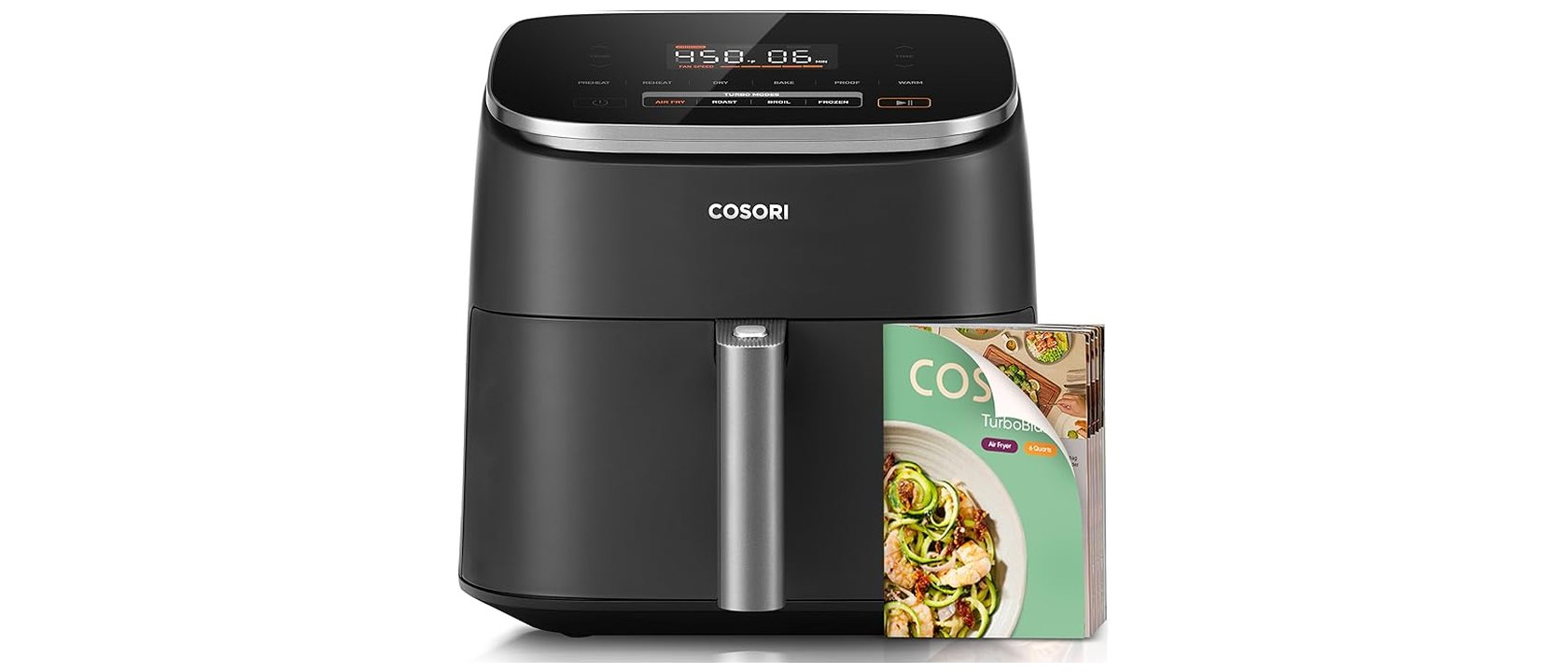
The verdict
A genuinely fast, genuinely versatile six-quart fryer: five fan speeds tuned per function, a true 450°F broil, proof and dehydrate modes, and a two-year warranty. Pick the function and it handles the airflow for you.
Pros
- COSORI's first basket air fryer with a DC motor, and the five fan speeds it enables are the real reason to pick it over COSORI's older models
- Cooks up to 46 percent faster than COSORI's previous AC-motor generation, per COSORI's own comparison against its CP168 (Pro Gen 2)
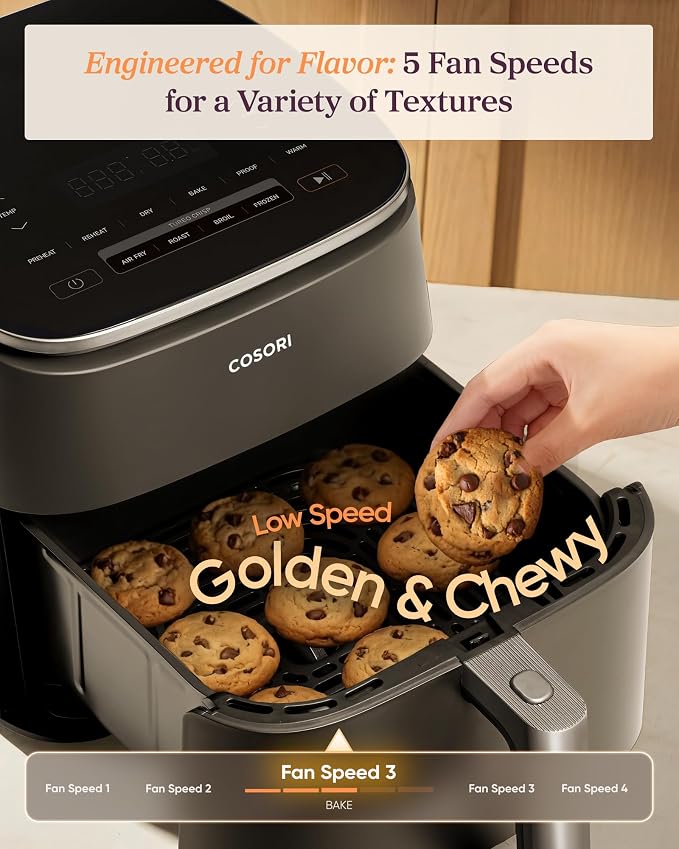
- Broil reaches 450 degrees Fahrenheit, a ceiling the Instant Vortex Plus does not match
- Bake, Proof, and Dry run at the low fan speeds a fixed-fan fryer cannot reach, so it doubles as a small second oven
- A separate Preheat button with a two-to-four-minute automatic cycle, at 400 degrees by default
- Square six-quart basket with an unusually large cooking surface, plus a dishwasher-safe crisper plate
- A 4.8-star average across more than 20,000 Amazon ratings, and over 600,000 units sold worldwide per COSORI
- Two-year limited warranty, double the one-year term of every machine in its comparison set
Cons
- Fan speed is assigned to each function rather than chosen manually, so you cannot pair a high temperature with a gentler airflow
- Temperature dips when food goes in and takes a moment to recover, so an early check helps on longer bakes
Best for
- Households of three to five people that want one appliance to air fry, roast, bake, and reheat
- Anyone who wants to proof dough or dehydrate fruit without buying a second appliance, which is what the low fan speeds are for
- Small kitchens replacing the wall oven for weeknight cooking
- Buyers who specifically want the PFAS-free claim, and are happy to give the seller a quick confirmation message before ordering
Not ideal for
- Cooks who want manual control over airflow. You get the function's fan speed and nothing else
- Households that need two foods at two different temperatures at once, which is dual-basket territory
- Anyone who wants a shake reminder or app control, neither of which the standard model has
- Precision bakers who need a rock-steady temperature hold for the whole bake
COSORI TurboBlaze 6.0-Quart Air Fryer Review: What Five Fan Speeds Actually Change
The short answer: the TurboBlaze is the first COSORI basket fryer built around a DC motor, and that motor is the entire story. It is what lets the machine hold five different fan speeds instead of one, and those extra speeds are why this fryer can proof dough at 90 degrees and dehydrate at 135 — jobs a fixed-fan basket fryer simply cannot do. It is also fast, unusually roomy for a six-quart basket, and backed by the longest warranty in its class. The one design choice to know up front: fan speed is assigned to each function rather than chosen manually — pick the job, and the machine picks the airflow for it.
Rating: 4.4 / 5
What the TurboBlaze is actually built for
Most basket air fryers on the market are one-trick machines. They blow hot air at a single speed, and every function on the dial — fry, roast, bake, reheat — is really the same function with a different timer.
The TurboBlaze is COSORI’s attempt to break that pattern. It is the company’s first air fryer to use a DC motor instead of the AC motor that powers the rest of its lineup, and DC motors can be run at variable speeds. COSORI uses that to ship five distinct fan speeds, each permanently assigned to a cooking function.
That is a real engineering difference, and it shows up in COSORI’s headline claim that the DC motor cooks “up to 46 percent faster” than its older AC-motor fryers. The comparison, per the listing’s own note, is against COSORI’s CP168 (also sold as the Pro Gen 2) — so read it as a generational jump over the COSORI it replaced, which is exactly what it is.
The Amazon listing for this model shows a 4.8-star average across more than 20,000 ratings as of October 2026, a sample large enough that the score reflects a real product rather than early-adopter goodwill. COSORI also states on its own site that more than 600,000 TurboBlaze fryers have been sold worldwide.
One thing to sort out before you order: COSORI sells a “Smart” version of this fryer with app connectivity under the same TurboBlaze name. This review covers the standard model, CAF-DC601-KUS, which has no app.
Specs at a glance
| Specification | COSORI TurboBlaze |
|---|---|
| Model number | CAF-DC601-KUS |
| Capacity | 6 qt / 5.7 L (COSORI rates it for 3 to 5 people) |
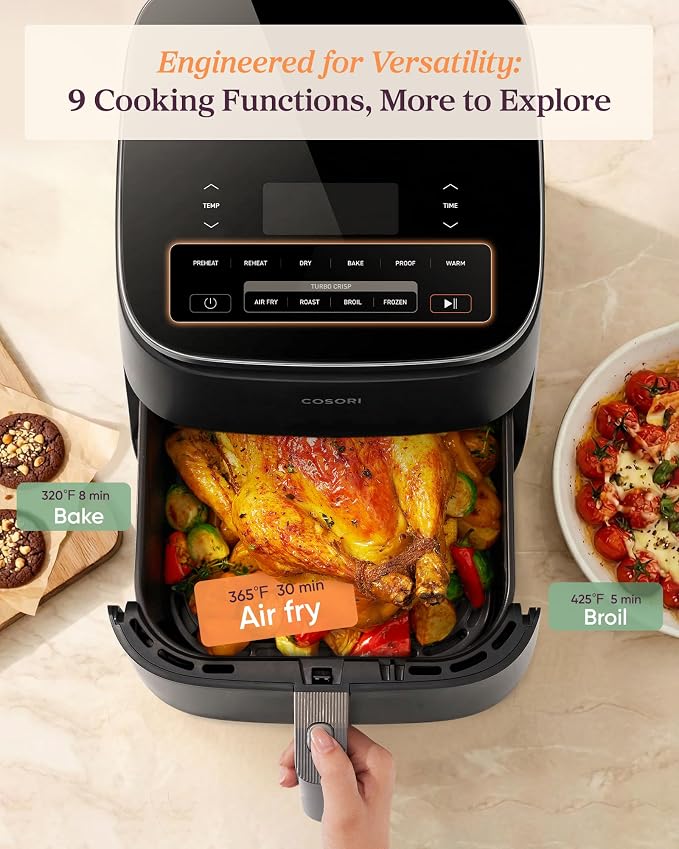
| Cooking functions | Nine: Air Fry, Roast, Bake, Broil, Dry, Frozen, Proof, Reheat, Keep Warm |
| Separate modes | Preheat |
| Temperature range | 90°F to 450°F overall, narrowed per function (see the chart below) |
| Time range | 1 minute to 24 hours, depending on function |
| Selectable fan speeds | Five, assigned to functions and not user-adjustable |
| Claimed fan output | Up to 3,600 rpm, per the retail listing |
| Rated power | 1,725 W, 120 V |
| Dimensions | 11.8 W x 14.4 D x 11.9 H in, including the handle |
| Weight | 13.2 lb / 6 kg |
| Basket | Square, aluminum with a nonstick coating |
| Dishwasher safe | Basket and crisper plate |
| Safety features | Basket release button, auto-pause when the basket is removed, overheat protection, idle shutoff after 30 minutes |
| Warranty | Two-year limited |
Specifications are from COSORI’s published product page and the user manual bundled with the unit. Confirm current details on the retailer page before buying.
The five fan speeds, mapped
This is the table to bookmark, and it is the one almost no other write-up includes. It comes straight from the cooking chart in COSORI’s own manual.
| Function | Default temp | Default time | Temp range | Time range | Fan speed |
|---|---|---|---|---|---|
| Turbo Modes | |||||
| Air Fry | 385°F | 10 min | 300–450°F | 1–60 min | 5 |
| Roast | 425°F | 12 min | 350–450°F | 1–60 min | 5 |
| Broil | 450°F | 5 min | 425–450°F | 1–30 min | 5 |
| Frozen | 390°F | 14 min | 300–450°F | 1–30 min | 5 |
| Other functions | |||||
| Reheat | 390°F | 5 min | 300–425°F | 1–60 min | 4 |
| Bake | 330°F | 20 min | 260–400°F | 1–60 min | 3 |
| Keep Warm | 170°F | 30 min | — | 1–60 min | 2 |
| Dry (Dehydrate) | 135°F | 6 hr | 100–200°F | 1–24 hr | 1 |
| Proof | 90°F | 1 hr | 90–110°F | 1–12 hr | 1 |
| Preheat | 400°F | 4 min, auto | 170–450°F | — | 4 |
Source: the cooking chart in the COSORI TurboBlaze user manual. Press and hold TEMP and the up arrow together for three seconds to switch the display between Fahrenheit and Celsius.
Read that table again, because three things in it matter more than the rest of this page.
The four Turbo Modes all run at speed 5. Air Fry, Roast, Broil, and Frozen are the modes marketed as Turbo, and every one of them uses the maximum fan speed. The manual states plainly that Turbo Modes “quickly cook food using the highest fan speed.” So when you tap Air Fry, you are not choosing an airflow level. You are choosing the hottest, fastest blast the machine can produce.
The slower speeds exist, but they belong to other functions. Bake runs at speed 3, Keep Warm at 2, and Dry and Proof at the lowest speed. If you want a gentler fan, the only way to get one is to pick a different function — and that function will also bring its own temperature window with it.
The five speeds are assigned, not chosen. COSORI’s listing notes that the fan speeds “correspond with the 9 cooking functions” and are “not customizable.” In day-to-day use this keeps things simple: select the job, and the machine applies the airflow that suits it. If you ever want a gentler fan at a high temperature, that combination is not on offer — the practical notes section below has the details.
How the TurboBlaze compares
| COSORI TurboBlaze | Ninja AF161 Max XL | Instant Vortex Plus 6QT | Ninja Foodi DZ401 | |
|---|---|---|---|---|
| Capacity | 6 qt | 5.5 qt | 6 qt | 10 qt (2 x 5 qt) |
| Cooking functions | 9, plus Preheat | 7 | 6, plus 6 custom presets | 6 |
| Temperature range | 90–450°F, narrowed per function | 105–450°F | 95–400°F | Up to 450°F |
| Selectable fan speeds | 5, fixed per function | None published | None published | None published |
| Rated power | 1,725 W | 1,750 W | 1,700 W | 1,690 W |
| Baskets | One | One | One | Two, independent |
| Coating wording | Listing says PFAS-free ceramic; manual says “nonstick coating” | Ceramic-coated nonstick | Nonstick | Listing says 100% PFAS-free nonstick |
| See-through lid or window | No | No | Yes, ClearCook window with an internal light | No |
| Weight | 13.2 lb | 11.7 lb | 11.35 lb | 19.8 lb |
| Warranty | 2 years limited | 1 year limited | 1 year limited | 1 year limited |
Competitor figures are taken from each brand’s official product pages as of October 2026. The Ninja AF161 is sold as the Max XL; the Instant machine is the Vortex Plus 6QT ClearCook; the Ninja DZ401 is the 10-quart Foodi DualZone two-basket model. Where a brand does not publish a figure, the table says so rather than estimating.
Three rows in that table decide most buying questions.
Fan speeds are the TurboBlaze’s exclusive feature, and the row is nearly empty for everyone else. None of the three competitors publishes selectable fan speeds. That is not a rounding error in the marketing — it is the actual technical difference, and it is why this fryer can proof and dehydrate while the others largely cannot.
The temperature row is worth a pause, too. Broil on the TurboBlaze reaches the machine’s full 450°F, where the Instant Vortex Plus tops out at 400°F. That extra 50 degrees is the difference between browned chicken skin and blistered, rendered skin, and it is why Broil mode here is more useful than the token broil setting on most basket fryers.
Two baskets cost you weight and counter space. The DZ401 solves a problem the TurboBlaze does not even attempt: cooking two foods at two temperatures. The trade is 19.8 pounds against 13.2, and roughly 17 inches of width against 11.8. If your weeknights involve a protein and a side at different temperatures, the single-basket TurboBlaze will make you cook them in sequence.
The coating row is explained in its own section below.
What independent testing found
We have not put this unit on a bench, so everything in this section is attributed to outlets that did, with their methodology stated where they published it.
RTINGS evaluated the TurboBlaze on its test bench and scored it 8.0 for air frying, 8.0 for cooking speed, 7.8 for both frying performance and large-batch cooking, 7.7 for capacity, and 7.5 for size. Its measured capacity was 6.3 quarts — slightly more than the nominal six. The publication’s summary is that the fryer “has a very good frying performance,” with a basket surface area large enough to spread food in a single layer, and that it “cooks food quickly.” The one caveat in its results is temperature hold — the fryer takes a moment to climb back to temperature after food goes in, so longer cooks reward an early check. It also found the preheat slow but effective.
Tom’s Guide ran a full test cycle — potato and sweet potato wedges, roasted peppers and zucchini, frozen nuggets, sausage and bacon, and a whole 3.9-pound chicken — and gave the fryer its Editor’s Choice. Its tester reported that the potato and sweet potato wedges came out crisp all the way through and the vegetables were “lightly charred,” while the chicken, cooked breast-side down for 30 minutes then flipped for a final 30, came out “beautifully moist without drying out, and the skin was crispy.” She also reported being “impressed with the lack of lingering odor left in the house,” and found cleanup easy: “even when roasting a chicken, I was able to clean the basket with hot suds without soaking.” Her one practical complaint was the absence of a shake reminder, a feature some other COSORI models include.
Top Ten Reviews reached a conclusion that is worth quoting because it captures the whole machine: the fryer is “a stellar basket-style option,” and “its biggest weakness is also one of its main strengths — its strong cooking power makes it easy to overcook food if you don’t adjust for it.” In practical terms, recipe timings written for older, weaker basket fryers will run hot here. Shorten your first attempt on an unfamiliar recipe rather than trusting an inherited cook time.
On noise, plan for normal air-fryer levels. COSORI’s listing quotes an operating figure of “less than 53dB”; the independent measurement, by Tom’s Guide with a phone decibel meter, was 68 dB at the highest fan speed — in the same range as the tester’s own electric range at 62 dB, and typical of a full-size air fryer at full power. The practical read: the TurboBlaze is a powerful machine and it sounds like one, especially on the Turbo Modes; the quieter low-speed functions such as Bake and Proof are where it settles down.
Practical notes before your first cook
Fan speed follows the function. Air Fry always runs at speed 5, Bake at speed 3, and so on. If a delicate bake needs a high temperature with a gentle airflow, that combination is not on offer — Bake’s 400°F ceiling is the trade for its quieter fan. The flip side is that you never have to wonder which speed to pick, which is half the reason the machine is easy to live with.
Give long bakes an early check. Bench testing by RTINGS found the fryer takes a moment to return to temperature after food goes in. For frozen food and wings — short, forgiving cooks — you will never notice. For a 20-minute bake, glance in five minutes early the first time and you will know exactly how your unit behaves.
Two crisper-plate habits from the manual. Seat the plate firmly before cooking: the manual cautions that a hot plate can lift out if you invert the basket after cooking, and recommends tongs and a heat-safe surface when removing it. And because the centre opening is generous, keep very small items — a handful of peas, say — away from the middle or give them a shake halfway through so nothing slips through to the drip tray.
About the PFAS-free ceramic coating
The listing describes the basket and crisper plate as having a “premium ceramic coating that is nonstick, durable, and heat-resistant,” and elsewhere a “PFAS-free, nonstick ceramic coating.”
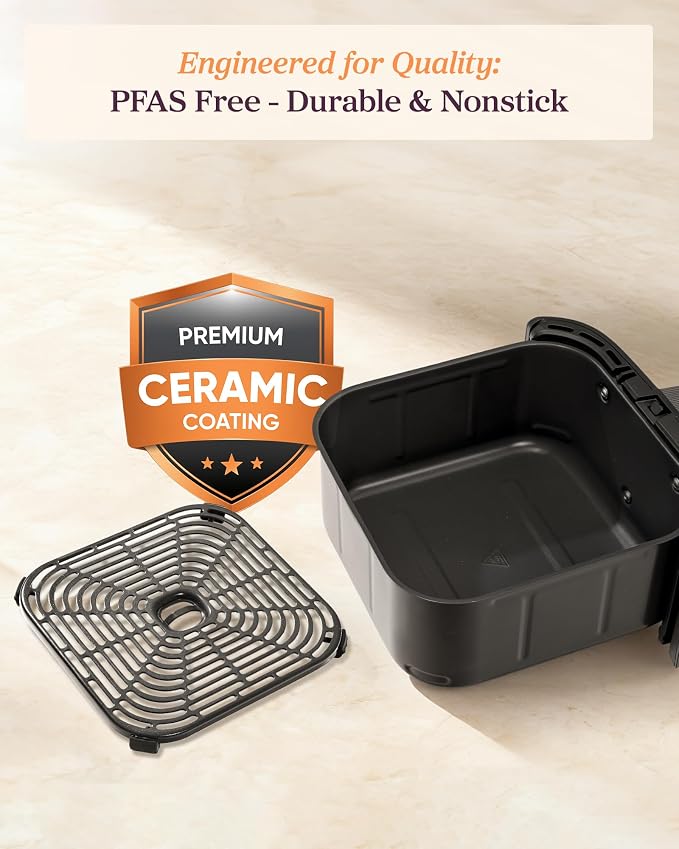
Two other documents are worth a glance alongside the listing. COSORI’s user manual describes the basket and crisper plate as “aluminum metal with nonstick coating,” without naming a coating type, and RTINGS’ bench records list this model’s nonstick coating as PTFE. None of that needs to complicate the purchase: if PFAS-free food contact is part of why you are buying, take a minute to confirm the coating for your specific unit with the seller before ordering, and check the manual in the box when it arrives. For everyone else, the care instructions are the same either way — no metal utensils, no abrasive scrubbers, and the nonstick surface will hold up.
Living with it: preheat, safety, and cleaning
The TurboBlaze’s day-to-day behaviour is documented in the manual, and a few details are worth knowing before the first cook.
Preheat is a button, not an automatic step. Air Fry does not preheat on its own. Tapping PREHEAT starts a cycle that defaults to 400°F and adjusts its own duration by temperature, generally running two to four minutes. The manual recommends preheating before adding food. RTINGS found the preheat slow but effective.
It pauses itself, in two different ways. Tapping the pause button stops heating and blinks the display until you resume; left alone, the fryer shuts off entirely after 30 minutes of inactivity. Pulling the basket out mid-cook is a separate safety path: the machine pauses automatically and the display turns off temporarily, then resumes on your previous settings when you slide the basket back. In practice you can shake or turn food without touching the controls, but you lose the display while the basket is out.
Three safety notes matter in a household with children or a tight countertop. The basket cannot be pulled out unless the release button on the handle is pressed, which prevents accidental spills of hot contents. The machine shuts off if it overheats. And the manual is unusually direct about ventilation: leave five inches, or 13 centimetres, of space behind and above the unit, and enough room in front to remove the basket. An air fryer tucked into a closed cabinet run will not work properly.
Cleaning is straightforward, with one material caveat. The basket and crisper plate are dishwasher safe, and the manual says to clean them after every use. For stubborn grease it recommends a paste of baking soda and water rather than abrasive cleaners. Because the basket is aluminum with a nonstick layer, treat it accordingly: no metal utensils, no abrasive scrubbing pads. Tom’s Guide’s tester found the basket cleaned up with hot suds alone after roasting a whole chicken, without soaking.
Cooking tips the manual gives that most owners discover by accident. Do not overfill — the manual notes that overfilling causes uneven cooking, and warns that overfilling plus excessive oil is a fire hazard. Keep added oil to two tablespoons maximum. For raw potato fries, soak the cut fries in water for 15 minutes to remove starch, dry them, then add half a tablespoon to a tablespoon of oil. High-fat foods collect drippings under the crisper plate; pour those out after cooking to avoid smoke. And if you marinate in liquid, pat the food dry first, because wet marinade spatters and smokes.
Error codes are worth knowing. E04 means the unit has been plugged into a 220–240 V outlet, and the fix is simply to use a 120 V outlet. E01, E21, E02, and E22 point to hardware faults that require COSORI support.
Who should buy the COSORI TurboBlaze
- Households of three to five, cooking one dish at a time. The six-quart square basket has more usable surface than most of its rivals, which is what stops food from steaming in a pile, and RTINGS measured it slightly larger than the nominal figure.
- Anyone who wants to proof, dehydrate, or keep warm. This is the clearest advantage of the DC motor. Proof at 90 to 110°F, Dry at 100 to 200°F for up to 24 hours, Keep Warm at 170°F — a fixed-fan basket fryer cannot do the first two at all.
- Small kitchens leaning on the fryer instead of the oven. A whole 3.9-pound chicken, roasted peppers, and a tray of cookies are all documented as working, and the 450°F Broil ceiling covers the jobs most basket fryers do badly.
- Buyers who want a longer warranty than the category norm. Two years limited against one year on every machine in the comparison table.
- Anyone who wants the PFAS-free claim. It is stated on the listing, and a one-line confirmation with the seller before ordering settles it for your specific unit.
Who should skip it
- Cooks who want to choose the airflow themselves. The five speeds are assigned to functions, not selectable — if you want independent fan control, look elsewhere.
- Households cooking two things at once at different temperatures. That is a dual-basket job; the TurboBlaze will have you cooking in sequence.
- Precision bakers who need a rock-steady hold for a long, delicate bake. Bake mode works well, but given the temperature-recovery behaviour bench testing found, give those bakes an early glance.
How to choose a basket air fryer: a short checklist
If you are weighing the TurboBlaze against the Ninja and Instant machines in the table above, this is the order of checks that predicts whether you will be happy.
- Decide on one basket or two, before anything else. Two foods at two temperatures is the single biggest fork in this category, and no amount of fan-speed cleverness substitutes for a second basket.
- Check the real floor of the air-fry range, not the headline. A wide advertised range often comes from a proofing or dehydrating mode at the bottom. Find the lowest temperature the actual frying function will hold, and judge the machine on that.
- Ask whether fan speed is selectable or assigned. “Five fan speeds” can mean five levels you choose, or five presets you inherit. They are very different products.
- Read the temperature ranges per function. Bake, Roast, and Broil often have narrower windows than the headline range suggests, and the narrowest one usually tells you what the machine is really for.
- Match basket surface area to the number of people, not just the quart figure. Six quarts in a deep, narrow basket feeds fewer people than six quarts in a wide, square one.
- Check the clearance requirement. Around five inches behind and above is common, and it rules out a sealed cabinet shelf.
- Compare warranty length. Motors and heating elements are what fail. Two years against one is a meaningful difference in how much the maker is willing to stand behind.
- If a specific claim — a PFAS-free coating, for example — is driving your decision, confirm it with the seller for your unit before ordering.
Frequently asked questions
Is the COSORI TurboBlaze worth buying? For households of three to five that cook one dish at a time and want the extra functions, yes. It has the longest warranty in its comparison set, a true 450°F ceiling, a large basket, and independent testers rate its frying performance well. It is the wrong machine if you need two cooking zones or want to control airflow yourself.
Can you adjust the fan speed on the COSORI TurboBlaze? No. COSORI’s listing states the fan speeds correspond to the cooking functions and are not customizable, and the manual’s cooking chart confirms it: Air Fry, Roast, Broil, and Frozen all run at the highest speed, Bake at speed 3, Keep Warm at 2, and Dry and Proof at the lowest. The only way to get a gentler fan is to choose a different function.
Does the COSORI TurboBlaze need preheating? The manual recommends it and provides a dedicated Preheat button, defaulting to 400°F with a cycle that adjusts its own length by temperature — usually two to four minutes. Air Fry does not preheat on its own. RTINGS found the preheat slow but effective.
How do I confirm the coating before buying? The listing describes a PFAS-free ceramic coating; the manual describes the basket and crisper plate as aluminum with a nonstick coating without naming the type, and RTINGS’ bench records list PTFE for this model. If PFAS-free food contact matters to you, ask the seller to confirm the coating on your specific unit, and check the manual in the box when it arrives.
How do you clean the COSORI TurboBlaze? The basket and crisper plate are dishwasher safe, and the manual advises cleaning them after every use. For stubborn grease, use a baking soda and water paste rather than abrasive cleaners, and avoid metal utensils because the basket is aluminum with a nonstick layer. Never immerse the main unit in water.
Why is my food burning in the COSORI TurboBlaze? Most likely because the recipe was written for a weaker fryer. Top Ten Reviews found the airflow strong enough to overcook food when timings are not adjusted. Shorten the time on an unfamiliar recipe and check early on your first attempt.
What does error code E04 mean? The unit has been plugged into a 220–240 V outlet. The TurboBlaze is a 120 V appliance, so use a standard North American outlet. Other codes — E01, E21, E02, E22 — indicate faults that require COSORI support.
How long is the warranty? Two years limited, provided by Arovast Corporation. Support is available at support@cosori.com or 1-888-402-1684.
What is in the box? The air fryer, one crisper plate, a user manual, and a recipe book. COSORI notes the recipe book ships inside the packaging, so check the box before discarding it.
About this review
This review is based on the manufacturer’s published product page, the user manual bundled with the unit, and published testing from independent outlets including RTINGS, Tom’s Guide, Top Ten Reviews, and Kitchenware Compare. Product images are the manufacturer’s official product images from the retail listing, not photos taken by us. We have not performed instrumented laboratory testing, and nothing here should be read as a measured result. Specifications and availability change frequently, so confirm current details on the retailer page before purchasing.
Last updated: October 5, 2026
More from TechWithAll
- roborock Q7 M+ review — Wirecutter top pick with 10,000 Pa suction and a self-empty base.
- Levoit LVAC-200 review — Lightweight cordless vacuum built for hard floors and quick cleanups.
Browse the full home category.