
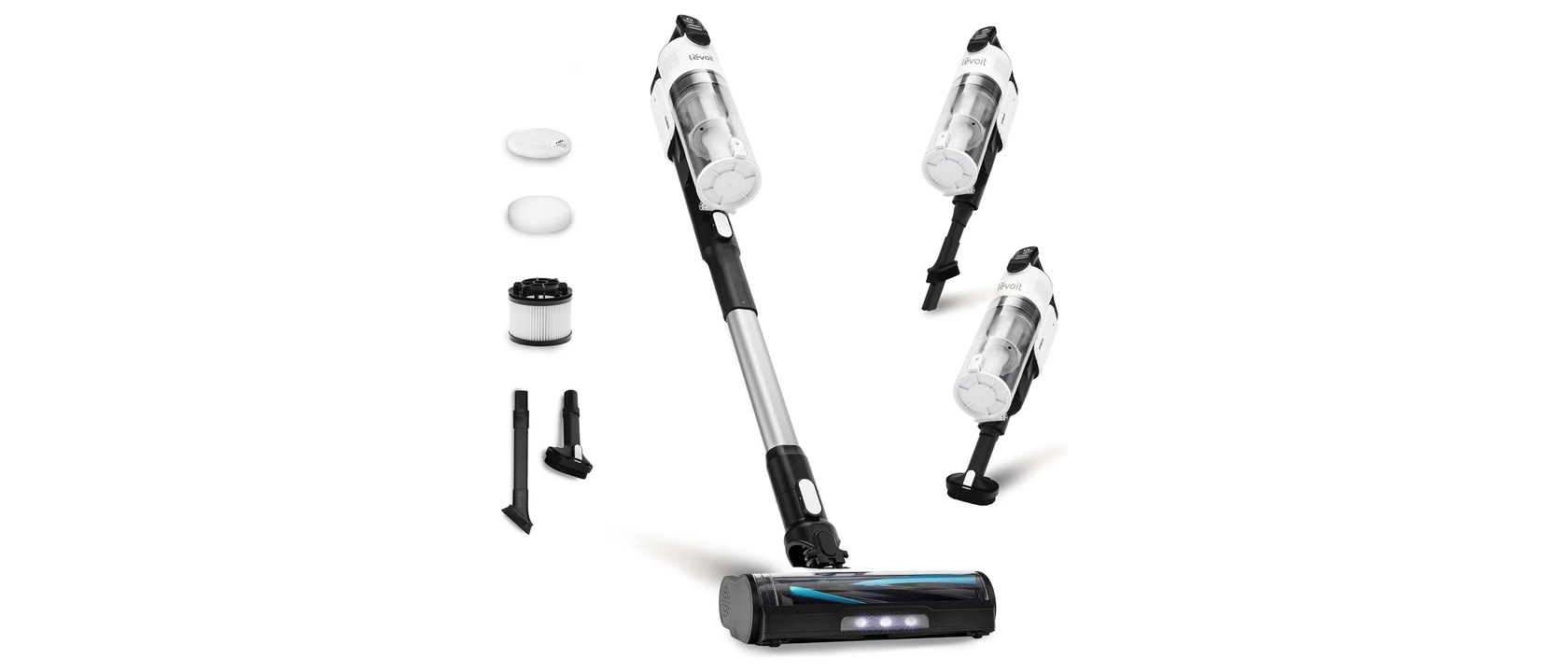
The verdict
An easy recommendation for hard-floor and low-pile homes that clean in short bursts, and the wrong tool if deep carpet is your main surface.
Pros
- Largest dustbin in its comparison set at 0.75 L, so fewer trips to the trash
- Only 3.2 lb as a handheld, with active hair-removal combs that cleared a 14-inch hair test
- Lies 180 degrees flat and stands upright on its own, no wall mount required
- Detachable 22.2 V battery, so a spare doubles runtime
- Five-stage sealed filtration independently rated among the best at this price
Cons
- 70 AW of suction will not deep-clean medium or high-pile carpet
- Turbo mode runs only 12 to 14 minutes, exactly the mode carpet demands
- The 3.2 lb figure is the handheld only; the assembled stick weighs about 6.2 lb
- Four to five hours to recharge the battery
- No auto-adjusting suction, no companion app, and no battery status display
Best for
- Apartment and hard-floor households that vacuum daily in short sessions
- Pet owners dealing with shedding hair on hard floors and low-pile rugs
- Anyone who wants a light second vacuum for stairs or quick cleanups
Not ideal for
- Homes where thick, high-pile carpet is the main surface
- Large homes that need sustained maximum power for a full session
- Anyone who wants smart features, automatic suction adjustment, or a docking station
Levoit LVAC-200 Review: The Budget Cordless Vacuum Built for Hard Floors
The short answer: the LVAC-200 is Levoit’s first cordless vacuum, from a brand that built its reputation on air purifiers, and it shows. Instead of chasing the biggest suction number, Levoit built a lightweight stick that is unusually good at the boring parts: not tangling hair, not clogging, not making you drag out the full-size vacuum for a two-minute mess. Independent testing backs that up. It also means accepting the smallest suction figure in its comparison set, a turbo mode that dies in about fourteen minutes, and a marketing weight that only tells half the story.
Rating: 4.2 / 5
What the LVAC-200 is actually built for
Levoit is one of the best-known names in budget air purifiers, and the LVAC-200 is its debut in the vacuum category. That origin matters more than it sounds. The main Amazon listing carries a rating in the 4.2 to 4.3 range across more than 12,000 ratings as of October 2026, which is a large enough sample that the score is not a fluke of early adopters.
The design brief is unusually specific.
Where most budget cordless sticks promise everything and deliver half of it, the LVAC-200 commits to three things: a body light enough to carry upstairs one-handed, an anti-tangle roller for hair, and a filtration system that does not exhaust dust back into the room — a predictable priority for a company whose main business is cleaning air. What it gives up is raw suction, and it does not hide that. The published figure is 70 air watts, which is modest against the 100-plus class from Shark and Dyson.
That trade-off is the entire review, so let’s look at it honestly.
Specs at a glance
| Specification | Levoit LVAC-200 |
|---|---|
| Model number | LSV-V201-WUS |
| Suction | 70 AW |
| Rated power | 180 W |
| Battery | 22.2 V, 2200 mAh lithium-ion, detachable |
| Runtime with floor head | 30 min (Eco) / 14 min (Turbo) |
| Runtime with attachment | 50 min (Eco) / 12 min (Turbo) |
| Charging time | 4–5 hours |
| Dustbin | 3.2 cups / 0.75 L (max) |
| Weight (body + battery) | 3.2 lb / 1.45 kg |
| Weight (fully assembled) | About 6.2 lb |
| Filtration | 5-stage, 99.9% of particles to 0.3 microns (ASTM F1977-22) |
| Power settings | Three |
| Floor head lights | Three LEDs |
| Layout | Lies 180° flat; stands upright on its own |
| Wet pickup | No — dry messes only |
| Warranty | 2-year limited |
Specifications are from the manufacturer’s published product page. Where the manufacturer and independent testers disagree, both figures are given above and discussed below. Confirm current details on the retailer page before buying.
How the LVAC-200 compares
| Levoit LVAC-200 | Shark Rocket Pet Pro | Tineco Pure One S11 | Dyson V8 Origin | |
|---|---|---|---|---|
| Suction | 70 AW | Not published (181 W motor) | 130 AW | 115 AW |
| Dustbin | 0.75 L | About 0.34 L | 0.6 L | 0.54 L |
| Claimed max runtime | 50 min | 40 min | 40 min | 40 min |
| Filtration | 5-stage, 99.9% at 0.3 microns | HEPA with sealed system | 4-stage HEPA | Whole-machine filtration |
| Charge time | 4–5 hours | 4 hours | 3 hours | 5 hours |
| Warranty | 2 years | 5 years | 2 years | 2 years |
Three things in that table are worth dwelling on, because they change how you should read the rest of this page.
The dustbin is the quiet advantage. At 0.75 L it is noticeably larger than the Tineco’s 0.6 L, the Dyson’s 0.54 L, and roughly double the Shark’s. On a light stick vacuum where you empty the bin by hand, that is not a spec-sheet footnote — it is the difference between emptying once at the end of a clean and stopping halfway through.
The runtime headline comes with a condition. Fifty minutes is the attachment-on Eco figure. With the powered floor head, Levoit’s own specification is thirty minutes on Eco and fourteen on Turbo. Every brand in this table quotes its best-case number, but Levoit’s gap between headline and floor-head reality is wider than most.
The suction figure is the lowest here, and that is the point. The LVAC-200 costs less than every machine in this comparison, and 70 air watts is where that cost shows up. Whether it matters depends almost entirely on your flooring, which is the next section.
Competitor figures are taken from each brand’s official product pages and retail listings as of October 2026. Runtime claims are not measured on a common basis — Levoit’s 50-minute figure uses an attachment on Eco, Shark’s 40-minute figure is measured at the hand vac in standard mode, and Dyson’s 40-minute figure applies to non-motorised tools. Shark publishes wattage rather than an air-watt rating, so the suction row is not a direct comparison. Treat all of these as manufacturer claims rather than measured results.
Battery life: what the 50-minute claim actually buys you
The honest answer is that the LVAC-200 has a runtime range, not a runtime number.
Levoit’s own specification breaks it down by tool and mode. With the motorised floor head, you get thirty minutes on Eco and fourteen on Turbo. Switch to the crevice or pet tool and those figures become fifty and twelve. The listing itself shows a 12-to-50-minute range, which is a refreshingly honest piece of marketing — most brands would have printed only the fifty.
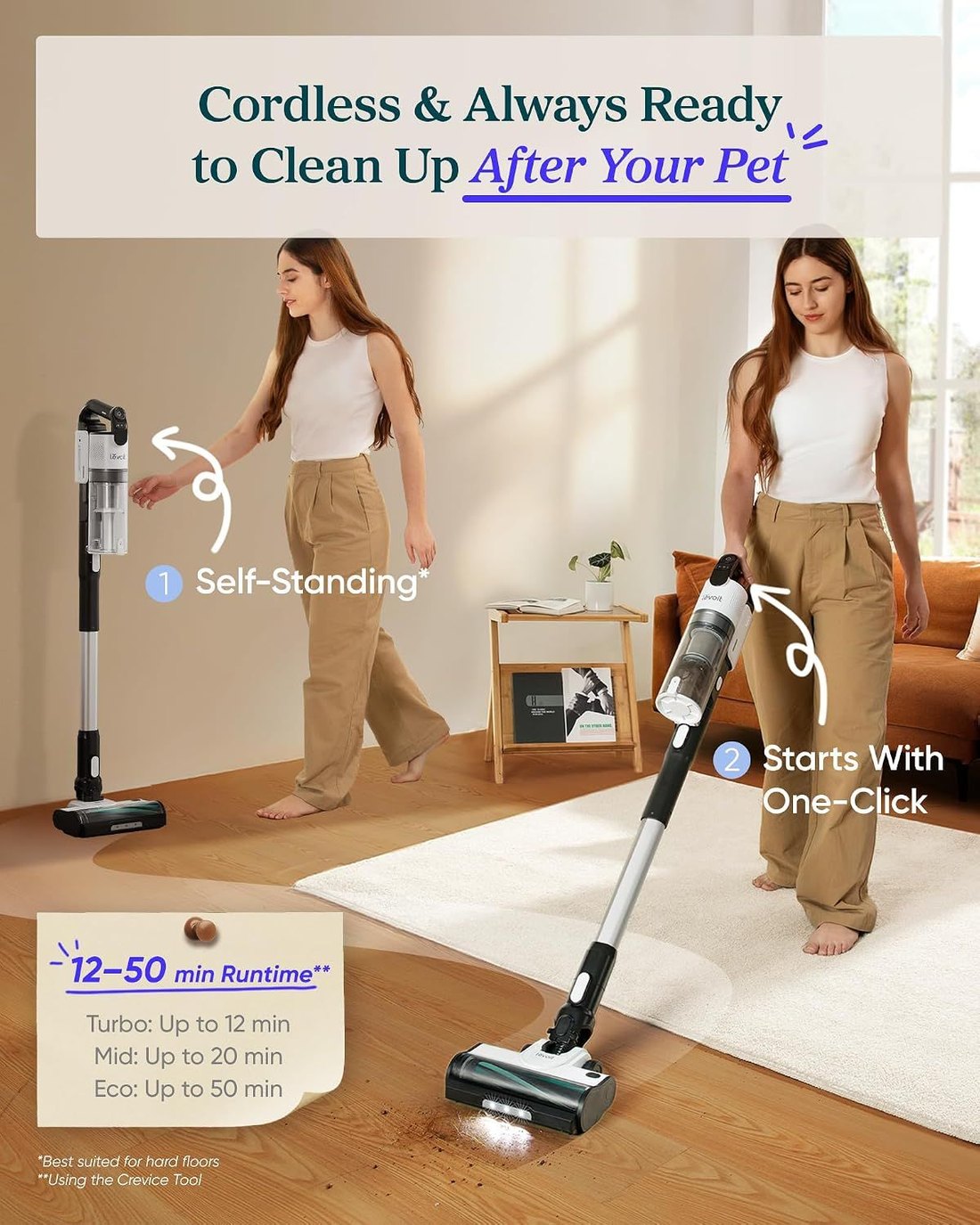
The manufacturer’s own listing graphic shows the 12-to-50-minute range, self-standing design, and one-click start. (Manufacturer product image)
Independent measurement lands in a similar place with some variation in method. TechRadar measured roughly 42 minutes on minimum power, 25 on medium, and 16 on maximum in its test setup — which actually exceeds Levoit’s floor-head Eco figure. Vacuum Wars measured a 78 dB noise level and a handle weight matching the manufacturer’s claim, and noted the battery is detachable.
The practical translation is straightforward. If you live in an apartment and clean hard floors on Eco, thirty minutes covers a lot of floor. If your cleaning style is “hit the carpet on Turbo until it looks right,” you are going to be recharging mid-session, and the four-to-five-hour recharge time makes that painful.
Which leads to the single most useful feature here: the battery detaches. Levoit sells a spare, and a second battery roughly doubles your working time without waiting for a charge. If your home is bigger than a one-bedroom, price that spare into your decision before you buy rather than after.
If that trade-off works for your home, this is the model to compare against — see the Levoit LVAC-200 range on Amazon.
Weight: what 3.2 pounds actually means
This is the specification most likely to mislead you, so it deserves its own section.
Levoit’s product page and marketing graphics state a weight of 3.2 lb / 1.45 kg. That figure is real — Vacuum Wars independently measured the handle at 1444 grams, which matches — but read the label carefully: it is the weight of the vacuum body plus battery, meaning the handheld configuration without the wand and floor head.
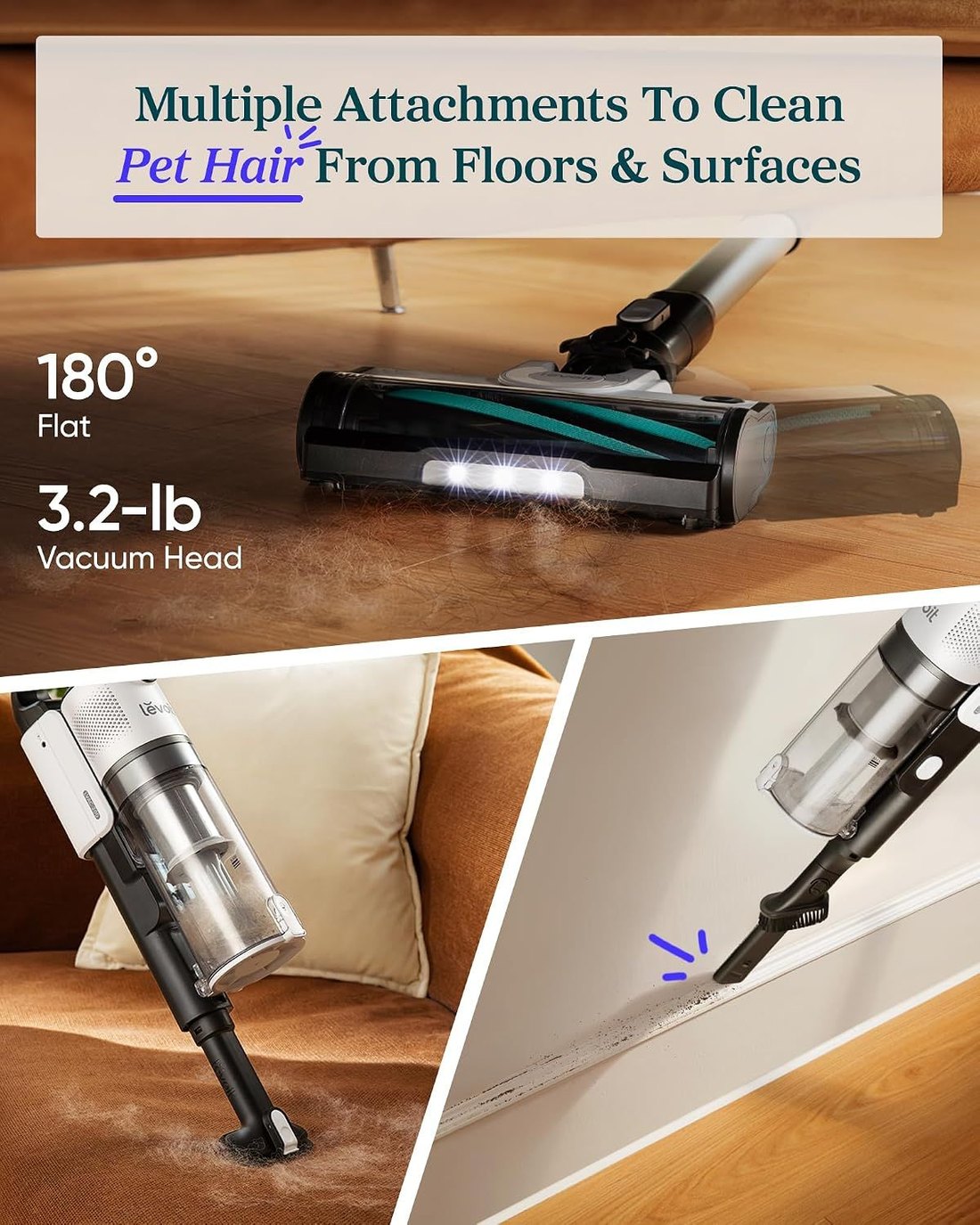
The manufacturer’s own graphic spells it out: 3.2 lb refers to the vacuum head and body. The wand adds more. (Manufacturer product image)
The fully assembled stick is a different number. Amazon’s listing and TechRadar’s review both put it at about 6.2 pounds. That is still light for a cordless stick — the Shark Rocket Pet Pro lists at 7.17 lb — but it is nearly double the figure in the headline, and if you were picturing a 3.2-pound vacuum, you should recalibrate before ordering.
None of this makes the LVAC-200 heavy. It makes the marketing imprecise, and you deserve to know which number describes the thing you will actually be pushing around.
Suction and floor type: what independent testing found
Here is where the review gets interesting, because the two best-known independent testers do not fully agree.
TechGearLab runs standardised lab trials and ranked the LVAC-200 12th of 21 cordless vacuums, with an overall score of 63. In its debris trials the vacuum removed an average of 86 percent of debris on low-pile carpet — a figure TechGearLab notes beats machines costing considerably more — but only 42 percent on high-pile carpet, which is essentially the field average. Its written verdict was that the LVAC-200 “shines on low-pile carpets” while tending to “push around larger debris on hard surfaces.”
Vacuum Wars, which bought the unit and tested it over several weeks, reached the opposite conclusion on that last point. Its review states the floor head handled “large and even some extra-large debris very well, which is pretty unique” on hard floors, with no snowplowing or clogging, and scored the vacuum above average in carpet deep-clean testing. It named the LVAC-200 its Best Budget cordless vacuum, with an overall score of 3.24 against a class average of 2.53.
TechRadar split the difference: strong fine-dust pickup, but larger debris could require slower passes, and pickup in reverse was weak across floor types.
So who is right? Probably all of them, in different conditions. The consistent pattern across all three is this:
- Hard floors with dust, hair, crumbs, and everyday grit: genuinely good, and better than the 70 AW figure suggests.
- Low-pile rugs: the strongest part of this vacuum’s performance, and the reason it won a budget award.
- High-pile or shag carpet: the hard ceiling. Turbo mode helps, but fourteen minutes of Turbo does not cover a large carpeted home.
- Large debris on hard floors: the one point the testers genuinely disagree on. If your messes are mostly cereal-scale spills, this is the spec to be cautious about.
The honest summary: this is a hard-floor and low-pile specialist. Nobody independent claims otherwise, including Levoit, whose own listing recommends it for hard floors and rugs first.
The anti-tangle roller: the feature that earns its keep
Hair wrap is the failure mode that turns a cheap cordless vacuum into a frustrating one. You spend ten minutes cleaning and twenty minutes cutting hair off the brush with scissors.
The LVAC-200 attacks this with active hair-removal combs inside the brush housing — a design that pulls long hair off the roller as it spins rather than letting it wind up. In Vacuum Wars’ 14-inch hair evaluation, the system performed exceptionally, and the outlet calls the feature uncommon at this price.
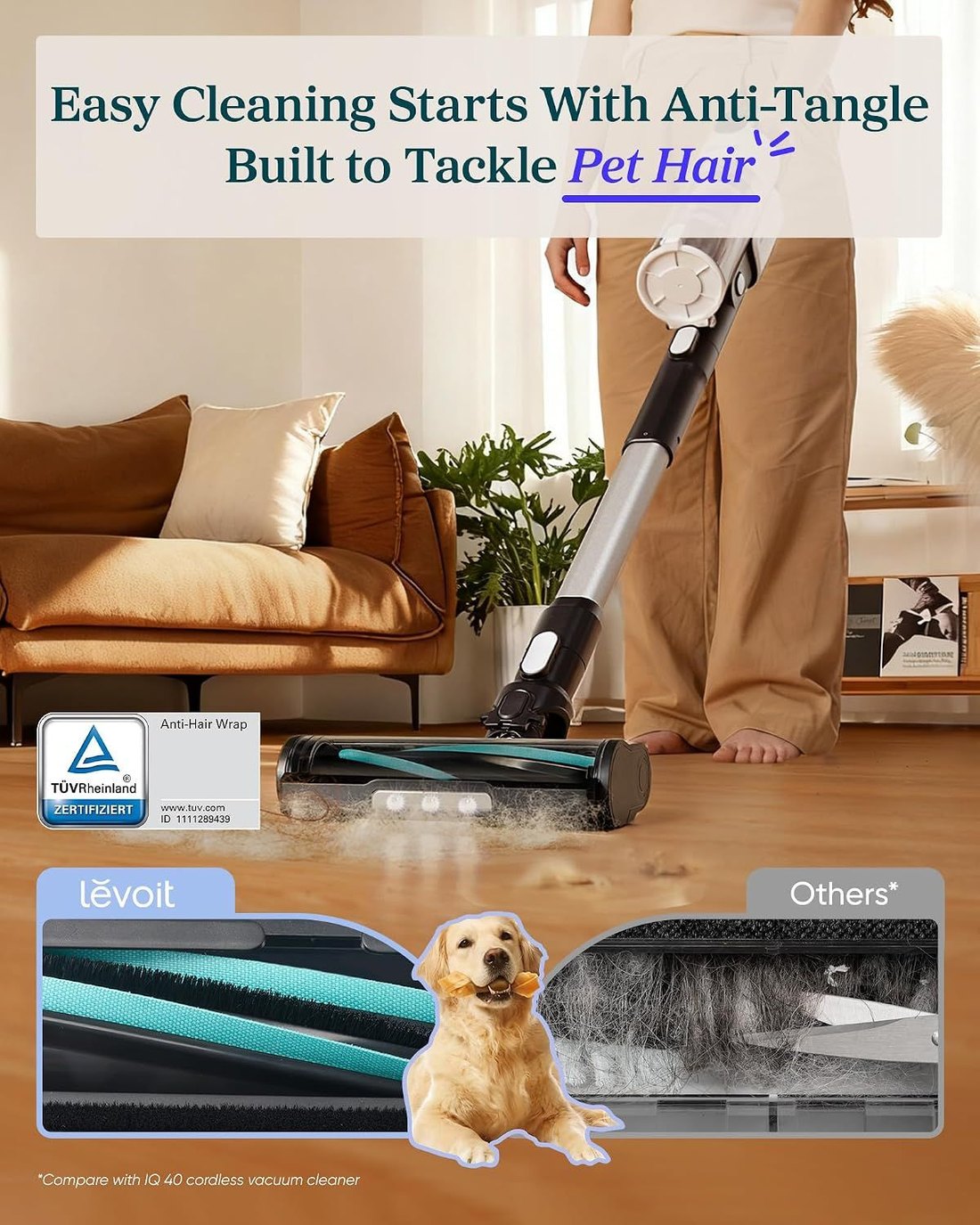
The manufacturer’s anti-tangle brushroll graphic. The combs sit inside the brush housing and strip hair from the roller as it turns. (Manufacturer product image)
Two practical notes. First, “tangle-resistant” is not “tangle-proof” — long hair will still need clearing eventually, just far less often. Second, the roller itself detaches and is washable, which turns the inevitable maintenance from a scissors job into a rinse.
For households with shedding pets or long-haired humans, this is arguably the single best reason to pick this vacuum over a rival with a higher suction number and a standard brushroll.
Filtration: why Levoit does not call it HEPA
This is a detail most reviews get wrong, and it matters if allergies are part of your decision.
The LVAC-200 uses a five-stage sealed filtration system that Levoit says captures 99.9 percent of particles as small as 0.3 microns, tested to the ASTM F1977-22 standard. That is a genuinely strong claim for a budget cordless vacuum, and both Vacuum Wars and TechGearLab rated the filtration well above what usually ships at this price — TechGearLab gave it an 8.0, tied with its ease-of-use score as the vacuum’s best result.
Here is the part to get right: Levoit does not describe this filter as HEPA, and you should not either. On Levoit’s own product page, the comparison table reserves “HEPA filter” for the step-up LVAC-300. The LVAC-200 gets “5-stage.” That is not an oversight — true HEPA is defined as capturing 99.97 percent of particles at 0.3 microns, and the LVAC-200’s 99.9 percent sits just under that line.
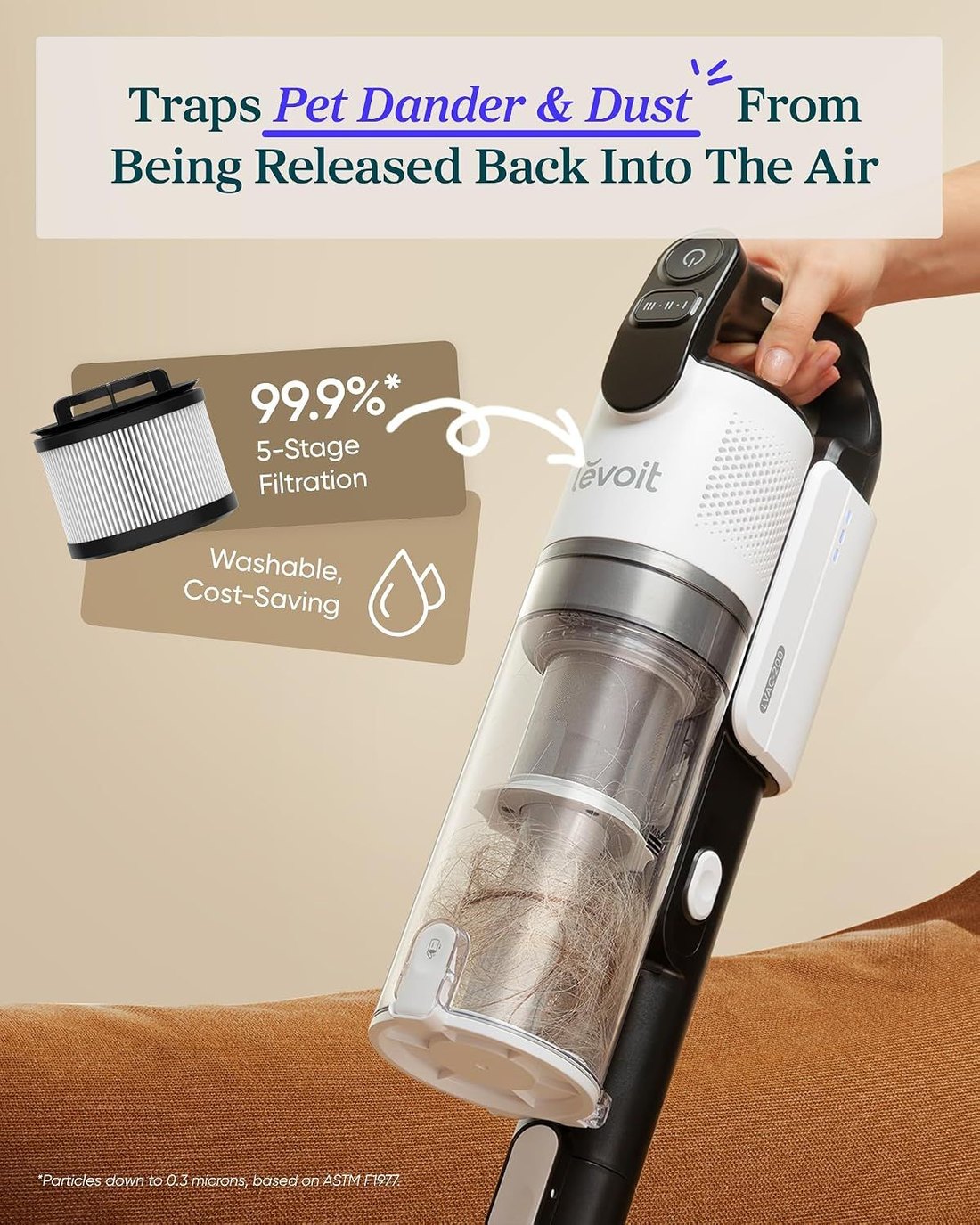
The manufacturer’s filtration graphic. Note the figure is 99.9 percent, not the 99.97 percent that defines HEPA. (Manufacturer product image)
Some third-party write-ups describe the LVAC-200 as having HEPA filtration. Levoit’s own documentation does not, and on a claim this specific, the manufacturer’s wording is the one to trust. If genuine certified HEPA matters to you, the LVAC-300 or the Tineco in the comparison table are the better matches.
Practical maintenance: the filter is washable, Levoit recommends washing it monthly and replacing it every three months, and genuine replacements are sold directly.
Everyday use and maintenance
Three design choices make this vacuum easier to live with than its spec sheet suggests.
It stands up on its own. Most cordless sticks in this bracket need a wall mount or a docking station, and topple over the moment you let go. The LVAC-200 has a freestanding base, so you can pause mid-clean without hunting for a wall. The Tineco in the comparison table explicitly cannot do this, and Shark’s own reviewers describe the Rocket Pet Pro as top-heavy.
The bin empties with one click. Combined with the 0.75 L capacity, this is the feature that makes the vacuum feel smaller in daily use than it is. Fewer stops, less contact with the dust.
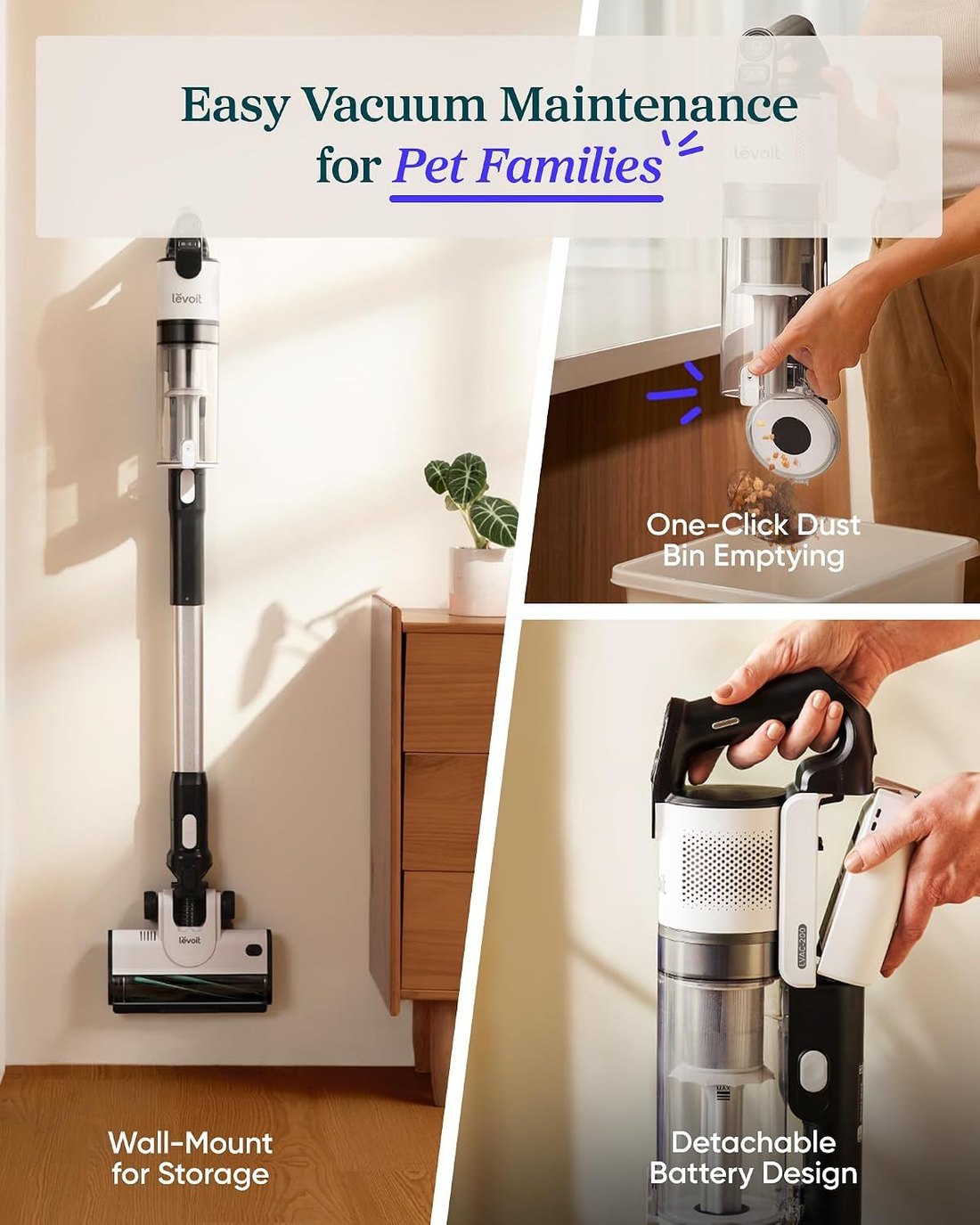
One-click bin emptying, wall-mount storage, and the detachable battery. (Manufacturer product image)
The battery and filter are both serviceable. A detachable battery means a user-replaceable part rather than a sealed failure point. Washable filters and a washable roller mean the running costs are genuinely low — the main recurring cost is a replacement filter every three months, which is cheap insurance compared with replacing a whole sealed unit.
One thing to be clear about before buying: this is a dry-mess vacuum. Levoit states plainly that it should not be used on wet spills or liquids. If you want a wet/dry machine, this is not it.
Where the LVAC-200 falls short
Turbo mode is a fifteen-minute tool. Fourteen minutes on Turbo with the floor head, twelve with an attachment, per Levoit’s own figures. That is enough for a badly soiled rug or a specific corner. It is not enough to clean a carpeted home in Turbo, and the four-to-five-hour recharge means you cannot just top up and continue. If your home is large and carpeted, this is the limitation that will actually bite.
No automatic suction adjustment. The step-up machines in this comparison — the Tineco with its iLoop dust sensor, or any Dyson with auto mode — increase power on their own when they hit debris. The LVAC-200 has three fixed speeds and a button. You decide when to switch, which means you will either clean at lower power than you need or burn battery at higher power than the floor requires.
No display and no app. There is no screen showing remaining battery, no indicator beyond the power LEDs, and no companion app. At this price that is a reasonable omission, but it is worth knowing that you are guessing at remaining runtime rather than reading it.
Who should buy the Levoit LVAC-200
- Apartment and hard-floor households. This is the exact use case it was designed for, and both independent testing labs scored it above average there. Thirty minutes of Eco on hard floors covers a lot of apartment.
- Pet owners with hard floors or low-pile rugs. The anti-tangle combs and the sealed filtration are the two features that matter most for hair, and both tested well.
- Anyone who wants a light second vacuum. At 6.2 pounds assembled with a self-standing base, it is an easy upstairs or quick-cleanup machine alongside a main vacuum.
- Buyers who value low running costs. Washable filter, washable roller, detachable battery, no bags to buy.
Who should skip the LVAC-200
- Homes with thick or high-pile carpet. TechGearLab’s 42 percent high-pile result is the field average, not a strength, and reaching for Turbo to compensate runs the battery down in minutes.
- Large homes on a single charge. If you cannot finish in thirty Eco-minutes and you do not want to buy a spare battery, look at a machine with a longer floor-head runtime.
- Anyone who wants smart features. No auto-suction, no app, no display, no dock. The Tineco is the better match in this comparison.
- Wet-mess households. Dry use only — Levoit is explicit about this.
- Shoppers who want a long warranty. Two years against Shark’s five. If warranty length is how you judge build confidence, the math is not close.
If your home matches the first list better than the second, this is one of the strongest budget picks currently on the market — check the Levoit LVAC-200 on Amazon.
How to choose a budget cordless vacuum: a short checklist
If you are comparing the LVAC-200 against its rivals, this is the order of checks that actually predicts satisfaction.
- Match the suction class to your flooring first. Air watts are a rough proxy: hard floors and low-pile rugs are forgiving, high-pile carpet is not. Buying a 70 AW vacuum for a shag-carpeted house is the single most common mistake in this category.
- Read the runtime figure’s fine print. Ask which tool and which mode produce the headline number. A fifty-minute claim measured with an attachment on Eco tells you very little about cleaning carpet with the floor head.
- Weigh the assembled vacuum, not the handheld. Manufacturers quote the lightest configuration. Check the listing’s item weight for the real number.
- Check the dustbin capacity. On a handheld-empty machine this drives how often you stop. Below about half a litre, expect to empty mid-clean.
- Look for a sealed system, not just a filter. A good filter exhausting unfiltered air past the motor defeats itself. Both of these matter for allergy households.
- Confirm it stands on its own or budget for the mount. It sounds trivial until you have kicked over a top-heavy stick vacuum for the tenth time.
- Check the warranty length. Cordless vacuums have batteries and motors, and both fail. A five-year warranty and a two-year warranty are very different bets at similar prices.
Frequently asked questions
How long does the Levoit LVAC-200 battery actually last? It depends on the tool and mode. Levoit’s official figures are thirty minutes on Eco with the floor head and fourteen on Turbo, or fifty and twelve minutes respectively with the crevice or pet tool. The “up to 50 minutes” headline refers to the attachment-on-Eco case.
Is the Levoit LVAC-200 good for pet hair? On hard floors and low-pile rugs, yes — the anti-tangle roller with hair-removal combs is its strongest feature, and it performed well in independent hair-wrap testing. On thick carpet with heavy embedded hair, it is the wrong tool; TechGearLab scored its pet-hair performance mid-pack.
Can the LVAC-200 clean carpet? Low-pile carpet, well — TechGearLab measured 86 percent debris removal there, beating more expensive machines. High-pile carpet is its weakest area at 42 percent, roughly the field average. For shag or dense carpet, look at a higher-suction machine.
Is the LVAC-200’s filter a HEPA filter? No, and Levoit does not claim it is. The five-stage system is rated to capture 99.9 percent of particles down to 0.3 microns, just under the 99.97 percent that defines HEPA. Levoit reserves the HEPA label for its step-up LVAC-300 model. Some third-party articles describe it as HEPA; the manufacturer’s own documentation does not.
Why does it say 3.2 pounds when other sites say over 6 pounds? Both are correct for different configurations. Levoit’s 3.2 lb is the vacuum body plus battery — the handheld unit. The fully assembled stick with wand and floor head weighs about 6.2 pounds, which is what Amazon’s listing and independent reviewers report.
How long does it take to recharge? Levoit specifies four to five hours. TechRadar measured a faster full charge in its testing, but plan around the manufacturer’s figure. The battery is detachable, and Levoit sells a spare that doubles runtime.
Can the LVAC-200 pick up wet spills? No. Levoit states the vacuum is designed for dry messes only and should not be used on liquids. Using it on wet debris can damage the motor and the filter.
What is included in the box? The vacuum body, a long stick, a short stick, the motorised floor head, a 2-in-1 crevice tool, a 2-in-1 pet tool, a wall mount with screws and anchors, a charger, and the user manual.
View the Levoit LVAC-200 on Amazon →
About this review
This review is based on the manufacturer’s published specifications, the retail product listing, and published testing from independent outlets including Vacuum Wars, TechGearLab, and TechRadar. Product images are the manufacturer’s official product images from the retail listing, not photos taken by us. We have not performed instrumented laboratory testing, and nothing here should be read as a measured result. Where independent testers reached different conclusions, both findings are reported above rather than averaged. Specifications and availability change frequently — always confirm current details on the retailer page before purchasing.
Last updated: October 2, 2026
More from TechWithAll
- COSORI TurboBlaze review — Six-quart air fryer with five fan speeds and a true 450°F broil.
- roborock Q7 M+ review — Wirecutter top pick with 10,000 Pa suction and a self-empty base.
Browse the full home category.