
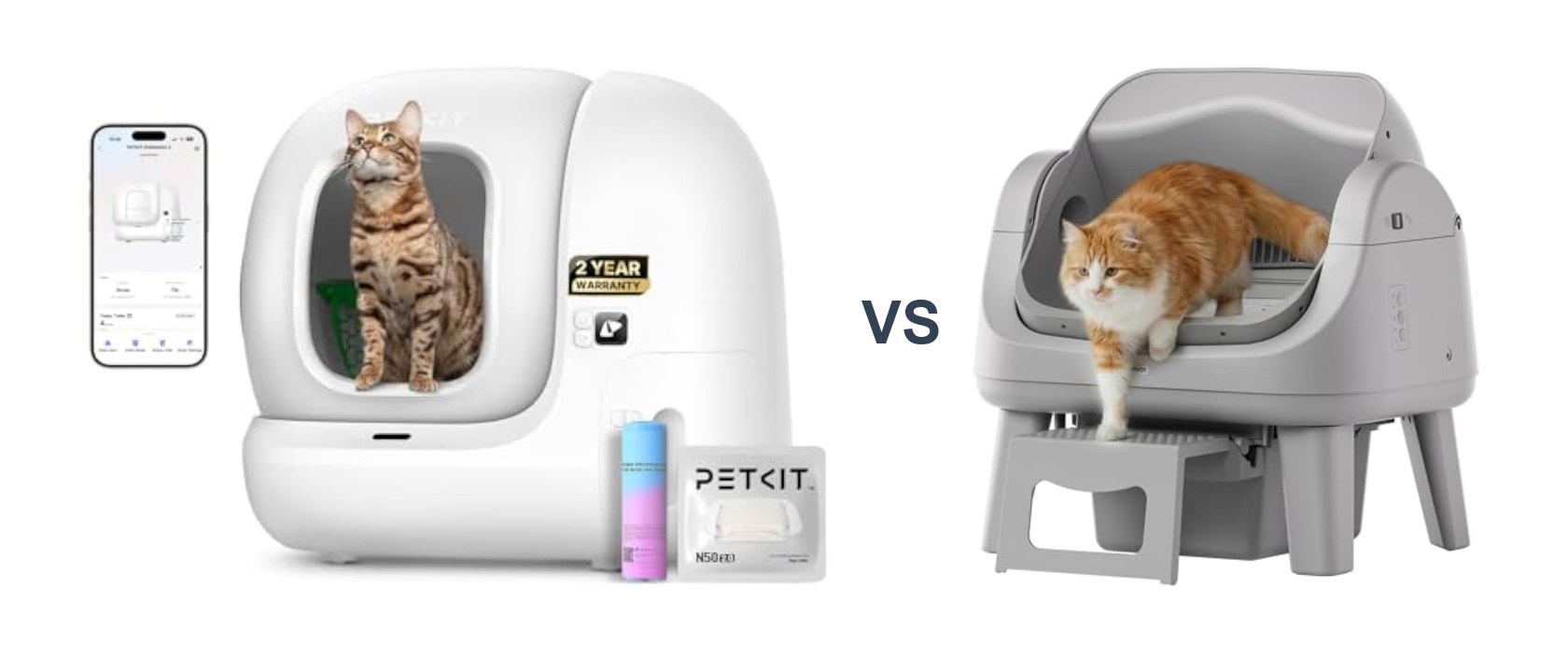
PETKIT PuraMax 2
- Sealed 7L waste bin plus N50 2.0 eliminator — the most complete odor containment in this tier
- Free app health tracking with weight, visit frequency, and duration per cat
- 76L cylinder and 7.87-inch low entrance for large and senior cats
- Rated 35 dB — independently corroborated as the quietest in its class
- Bundle listed with 2-year coverage
- 2.4 GHz Wi-Fi only, and hard floors required — carpet corrupts the weight sensors
- Mixed owner reports on parts availability and support after year one
PetPivot Open Top
- Seven pairs of infrared sensors plus a touch pedal and mechanical limiter — three-layer safety redundancy
- Completely app-free: no pairing, no account, no subscription, ever
- Open-top design with access step for senior, stiff-jointed, and globe-averse cats
- Runs on ordinary clumping litter with no proprietary consumable
- Tool-free monthly teardown
- Rotating sift leaves residue on the drum's back wall — keep a hand scoop
- Weight-based detection rules out kittens and very small cats; no health telemetry
Quick picks
For most multi-cat households the PuraMax 2 wins on the things you live with daily — sealed odor containment, quiet operation, and free health telemetry. The PetPivot Open Top is the deliberate no-tech counter-proposal, and it is the better machine for anxious cats that won't enter a globe, for owners who want no app in their lives, and for anyone burnt by connectivity-dependent appliances.
These are the two automatic litter boxes we have reviewed in full, and they represent the sharpest philosophical fork in the category: an enclosed, app-connected globe with sealed odor containment and health telemetry, versus an open-top, no-app machine with a deeper sensor array and zero consumables beyond bags. This comparison is decision-focused — if you want the full feature walkthroughs, read our PETKIT PuraMax 2 review and PetPivot Open Top review.
The short version
Both machines automate the same core job — a rotating mechanism sifts clumps into a waste container shortly after each visit — and both do it safely by weight plus infrared detection. Everything that differs follows from one design decision each company made at the start.
PETKIT built a sealed system. The PuraMax 2’s waste goes into a closed 7-liter bin with an eliminator cartridge, the whole thing runs quietly at a rated 35 dB, and the app logs every visit with weight, duration, and frequency for free. The costs: 2.4 GHz-only Wi-Fi, a hard-floor placement requirement, a monthly deep clean with more crevices, and an eliminator cartridge on a one-to-two-month replacement cadence.
PetPivot built an open system. The Open Top has no app, no account, no subscription, no pairing, and no cartridge — a three-button panel and any clumping litter you already buy, with a wide open basin and an access step so senior, large, and globe-averse cats walk in rather than climbing through a portal. The costs: no health telemetry of any kind, an open waste drawer rather than sealed containment, and a drum design that always leaves some residue you will handle with a hand scoop.
Neither approach is a lesser version of the other. They are optimized for different definitions of “hassle.”
Spec comparison
| PETKIT PuraMax 2 | PetPivot Open Top | |
|---|---|---|
| Design philosophy | Enclosed rotating globe, app-controlled | Open-top basin, physical panel |
| Safety system | 11 sensors (7 IR + 4 weight), anti-pinch geometry, entrance never closes | 7 pairs of IR sensors, touch-sensitive pedal, mechanical rotation limiter |
| Odor containment | Sealed 7L bin + N50 2.0 cartridge (≥98% ammonia claim) + optional spray | Open drawer; clumping-delay rotation |
| Waste capacity | 7L sealed bin, up to 15 days (single cat, lab claim) | Waste drawer, every 5–7 days for multi-cat homes |
| Health telemetry | Weight, visit frequency, duration per cat (free app) | None |
| Connectivity | 2.4 GHz Wi-Fi only | None, by design |
| Noise rating | 35 dB | Mid-30s dB per third-party roundups |
| Entrance | 7.87 in portal | Wide open top + access step |
| Interior | 76 L cylinder | Open basin |
| Litter | Any clumping (tofu, bentonite, mixed), two sifters included | Ordinary bentonite or mineral clumping |
| Consumables | N50 cartridge every 1–2 months; bags | Liners and bags only |
| Warranty | 1-year standard; bundle listed with 2-year coverage | 1-year manufacturer |
| Overall footprint | 24.4 × 21.2 × 21.7 in, ~22 lb | 21.1 × 15.8 × 21.9 in, ~20.6 lb |
The decision that actually matters: will your cat enter it?
This is the question that should decide the purchase before any feature comparison, because it is the one you cannot retrofit.
An enclosed globe is a portal — a cat walks into a sealed sphere through a single opening, the door geometry is necessarily snug, and the rotation happens around the cat’s usual standing position. A meaningful share of cats simply refuse this. Anxiety-prone cats, cats with bad prior experiences with covered boxes, and some large or clumsy cats balk at the geometry, and no amount of feature depth matters if the box is unused. The PuraMax 2’s entrance is among the most forgiving in the globe category — 7.87 inches, the lowest we have found in an enclosed design, with the anti-pinch structure keeping the opening clear at all times — but it is still a portal.
The PetPivot is a basin. The entire top of the drum is open, the included step gives senior and stiff-jointed cats a walk-in rather than a climb-in, and there is no enclosed volume for a nervous cat to distrust. Owner and reviewer consensus on open-top designs is consistent: cats adapt faster, often within a day or two, because the box looks and feels like the open litter box they already use.
If you already know your cat’s temperament — has it used covered boxes happily for years? — you can skip this section. If you do not know, the honest advice is that the PetPivot’s open design is the lower-adaptation-risk choice, and the PuraMax 2’s advantages need your cat to accept the globe first.
Odor: sealed containment versus open air
This is the PuraMax 2’s clearest win, and it is not close.
The PetPivot’s open top — the very feature that makes it cat-friendly — means the waste drawer and the drum interact with room air continuously between cycles. The clumping-delay rotation (letting litter solidify before the drum turns) reduces smearing and pancaking, which helps, but an open-top automatic is structurally an open litter box that cleans itself. Owners who love the PetPivot generally place it in a room where smell was already manageable; nobody buys it as an odor solution.
The PuraMax 2’s sealed 7-liter bin closes waste physically away from the room, the N50 2.0 cartridge chemically neutralizes ammonia from what’s collected, and the optional spray adds a third stage most owners disable for scent reasons but which exists. The owner record on this specific point is unusually consistent across independent reviews: phrases like “my apartment doesn’t smell like cats anymore” recur, including from converts who had given up on enclosed boxes.
If odor is your number-one pain point — small apartment, litter box in a living space, multiple cats — this single difference probably decides the comparison. Budget for the cartridge as the price of that containment: it is a genuine consumable on a one-to-two-month cadence, which the PetPivot never asks you to buy.
Safety: two deep systems, two different theories
Both companies over-invested here relative to category norms, and the honest summary is that both are safe machines with different failure theories.
The PuraMax 2 runs eleven sensors — seven infrared and four weight sensors per third-party teardowns — watching the approach zone and the interior, pausing cycles the instant a cat nears or remains inside. Its distinctive property is mechanical: the anti-pinch geometry keeps the entrance open at every rotation angle, so the door physically cannot close on a cat even in a total sensor failure. Reviewers who deliberately tried to defeat the sensors report consistent pauses.
The PetPivot runs seven pairs of infrared sensors, a touch-sensitive pedal that interrupts rotation on physical contact, and a mechanical limiter restricting how the drum can rotate — a three-layer redundant stack where most boxes at its price run a single array. Its theory of safety is redundancy: if one layer misreads, two more stand behind it.
The practical difference for a buyer is narrow. Both systems key off weight and beam-crossing, so both set an implicit floor on cat size — kittens and very small cats are not candidates for either machine, and both makers’ guidance converges on introducing the box with automation disabled until every cat has used it calmly. PETKIT adds an app-side answer for young cats (Kitten Protection Mode, which suspends auto-cleaning entirely); PetPivot’s answer is physical (unplug it). If you have a kitten, neither box is an automatic box yet.
Smart features versus no features
The PuraMax 2’s app logs every visit — weight, timestamp, duration — attributes visits to cats by weight, and alerts on a full bin, low litter, or a spent cartridge. The core telemetry is free, not paywalled, and the specific use case that justifies it is health monitoring: a documented owner account describes catching a urinary tract infection early because one cat’s visit frequency dropped in the log. For senior cats and multi-cat homes, this is genuinely useful data, and it is the single feature the PetPivot cannot approximate.
The PetPivot’s position is the mirror image: there is no app, no account, no firmware update, and no subscription, ever. A three-button panel is the entire interface. For owners burnt by connectivity-dependent appliances — or who simply do not want another paired device and another account — this is not a missing feature, it is the feature. Nothing on the PetPivot stops working because a cloud service changed, a router was replaced, or a company pivoted its app strategy.
The honest middle ground: PETKIT’s connectivity is currently stable and its core tier is free, but the app does require 2.4 GHz-only Wi-Fi (the most common setup complaint in the owner record), and multi-cat attribution is inconsistent when two cats are close in weight. If the health data matters to you, the PuraMax 2 is the only choice here. If it does not, you are paying — in money, setup friction, and monthly cartridge logistics — for something you will not use.
Noise, capacity, and daily logistics
Noise is a near-tie on paper and a slight PuraMax 2 win in practice: 35 dB rated and independently corroborated as the quietest in its class, against the PetPivot’s mid-30s figure per third-party roundups. Both are bedroom-adjacent viable; both grow slightly louder with age as grit enters the mechanism, and a sudden noise change on either machine means trapped granules or a full bin, both user-fixable.
Capacity favors PETKIT in multi-cat terms. The 76 L cylinder gives large cats room to turn, and the sealed 7 L bin supports up to 15 days between changes for a single cat per the manufacturer’s lab results — figures one- and two-cat owners broadly confirm. Three-cat households should plan on every 5–7 days for either machine; the PetPivot’s drawer is the smaller of the two containers and multi-cat owners confirm the 5–7 day rhythm in practice.
Footprint favors PetPivot modestly — it is about three inches narrower — which matters in bathrooms and small apartments. Placement constraints cut the other way: the PuraMax 2 requires a hard, level floor (carpet corrupts its weight sensors, per the manufacturer’s own prohibited-conditions guidance) and 5 cm of wall clearance, while the PetPivot has no equivalent requirement beyond standing level.
Maintenance: two different monthly rituals
Neither machine is zero-maintenance, and the honest framing is that each has one chore the other avoids.
The PuraMax 2’s cylinder, side cover, sifter, and pad detach for a monthly wash that owners report takes 20–30 minutes; the base is wipe-only, never rinsed. The rotating drum’s crevices collect litter, and several reviewers find its monthly session more fiddly than simpler designs. Add the cartridge replacement every one to two months and the semi-proprietary bag consideration (overly thick third-party bags can interfere with the bin ring).
The PetPivot’s modular teardown is tool-free and fast — drum and drawer out in seconds — but the design guarantees a residue problem the wash does not fully solve: clumps and litter stick to the drum’s back wall and the sensor cavity gathers dust, so the practical owner pattern is keeping a hand scoop on top of the unit and doing a proper monthly teardown. Its electronics rule is identical: damp cloth on the base, never a hose.
The tiebreaker is consumables. The PetPivot runs on ordinary litter and standard liners; the PuraMax 2 asks for a cartridge on a recurring clock. Over a multi-year ownership, the PetPivot is the lower-attention machine — which, given it also has no app, is a coherent philosophy rather than an accident.
Which should you buy
Buy the PETKIT PuraMax 2 if:
- Odor containment is your primary pain point — sealed bin plus cartridge is the decisive advantage, and nothing else at this price tier matches it
- You want health telemetry for free — weight trends, visit frequency, and duration per cat, with real early-warning value for senior cats
- Your household has one to three cats on hard flooring, and your cats already accept covered boxes
- You have large cats that need the 76 L interior, or senior cats that need the 7.87-inch entrance
Buy the PetPivot Open Top if:
- Your cat refuses enclosed boxes, or you are not willing to gamble on globe acceptance — the open basin is the lower-risk entry
- You have senior or mobility-limited cats that need a walk-in with a step rather than a portal
- You want zero apps, zero accounts, zero subscriptions, and zero recurring consumables beyond bags — and you accept hand-scooping the drum’s back wall as the trade
- Your placement is carpet, or your home’s Wi-Fi situation makes a 2.4 GHz-only device unwelcome
A note on the ratings. The PetPivot carries a slightly higher editorial rating in our reviews (4.3 vs 4.2) because its execution of its own simpler brief is nearly flawless and its owner-record complaint volume is lower on a younger listing. The overall pick still goes to the PuraMax 2 because it does strictly more — containment, telemetry, capacity — and because its weaknesses (setup friction, support variance) are mitigated by actions you control: a hard-floor placement, a careful 2.4 GHz pairing, and registering the bundle’s 2-year coverage the week the box arrives. For most households, the machine that does more and can be de-risked beats the machine that does less by design. If your cat is the variable, reverse that logic: the box your cat will actually enter is the only one that works at all.
FAQ
Can either box handle kittens? No, not with automation enabled. Both systems detect cats by weight and beam-crossing, which kittens cannot reliably trigger. PETKIT’s Kitten Protection Mode suspends auto-cleaning in-app; the PetPivot’s answer is to keep it unplugged until the cat is adult-sized. Both makers converge on roughly six months and a few pounds as the realistic floor.
Which is better for three or more cats? Both work, with more frequent bin emptying — every 5–7 days. The PuraMax 2’s larger sealed bin and bigger cylinder give it the edge as cat count grows, and its per-cat telemetry becomes more valuable at higher counts. The PetPivot’s open design, however, is more likely to be accepted by every cat in a multi-cat home in the first place — which is a precondition, not a feature.
Do I have to buy special litter? No, for either machine. Both run on ordinary clumping litter — bentonite, mineral, tofu, or mixed. The PuraMax 2 includes two sifters for coarse and fine granules and excludes only crystal and non-clumping litter; the PetPivot takes the same bentonite or mineral clumping litter you already buy. The PuraMax 2’s only recurring consumable is the N50 cartridge; the PetPivot’s is liners.
Which one smells less? The PuraMax 2, decisively — sealed waste containment plus an ammonia-neutralizing cartridge versus an open drawer. If the box lives in a bathroom or small apartment, this is the single most important line in the comparison.
What happens when the power or Wi-Fi goes out? Both machines keep their presets through a network outage and resume normally. The PetPivot has no network dependency at all. The PuraMax 2 needs Wi-Fi for telemetry and remote control only — cleaning continues on schedule offline — but it does need wall power, as does the PetPivot; neither is a manual box when the electricity is out.
Both boxes were assessed from their Amazon retail listings (ASIN B0DFYF2D7D and B0GL7Q6YXZ), the manufacturers’ own documentation and FAQs, and third-party reviews and category roundups. Product images are the manufacturers’ official images, not photos taken by us. We have not performed instrumented laboratory testing; noise, odor-removal, capacity, and delay figures are manufacturer claims or third-party reports, labeled as such. Neither manufacturer reviewed or influenced this comparison.
Last updated: October 18, 2026