
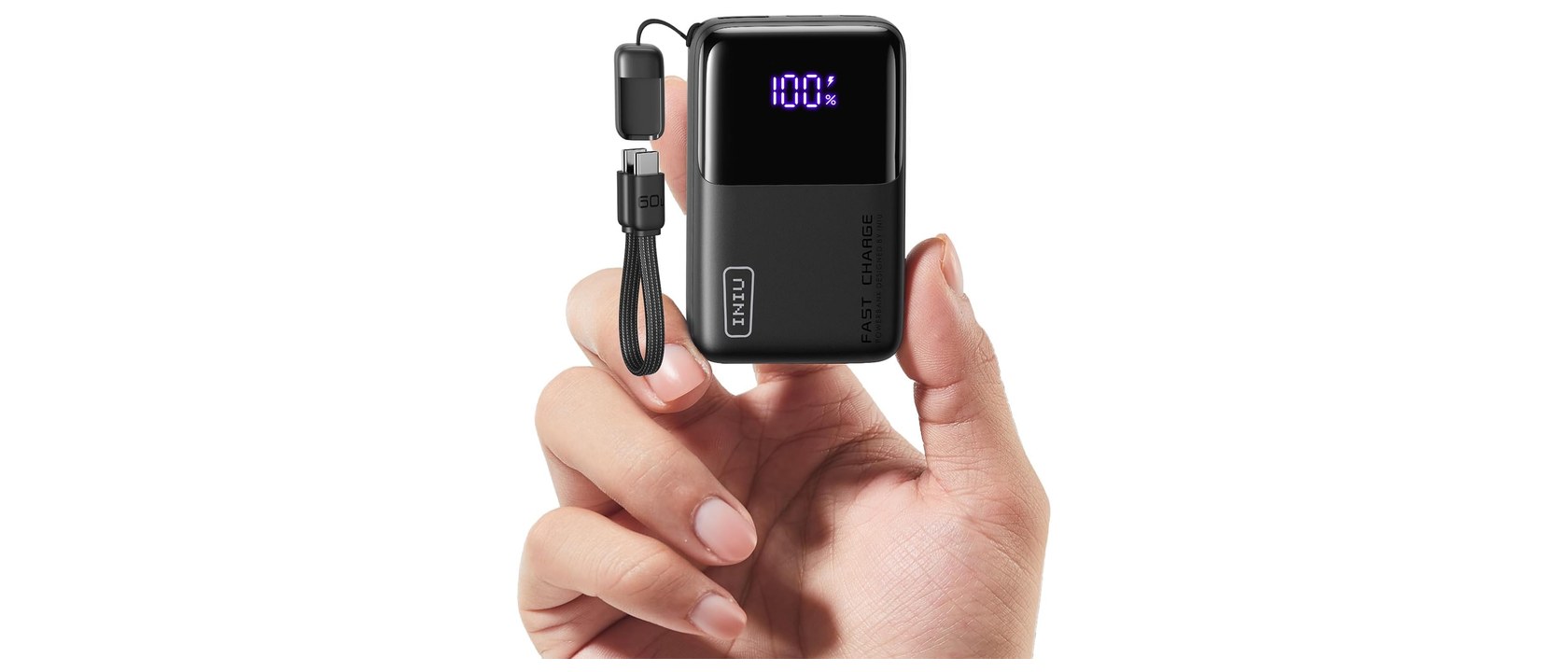
The verdict
A genuinely pocketable 10,000mAh pack with real 45W output — provided you accept a slow self-recharge and no wireless charging.
Pros
- Smallest and lightest 10,000mAh body in its comparison set — 3.3 by 2.0 by 1.0 inches, 5.6 ounces
- Real 45W USB-C output, confirmed by multiple independent testers on Samsung and Pixel phones
- Detachable lanyard cable, so a frayed cable does not retire the whole power bank
- Digital percentage readout instead of the vague four-dot LED most budget packs use
- Three-year INIU Care warranty, longer than the standard coverage on comparable Anker models
Cons
- Refills at only about 20W, so a full self-recharge takes around two hours
- No wireless charging, which several rivals at this capacity now include
- USB-A port tops out well below the USB-C ports
- Output drops sharply when more than one port is in use at once
- Rated deliverable capacity is about 6,200mAh, not the 10,000mAh on the label
Best for
- Commuters and travelers who want backup power they will actually carry every day
- Owners of fast-charging Android flagships — Samsung and Pixel phones that can draw more than 20W
- Anyone burned by a dead built-in cable before, since this one detaches and replaces
Not ideal for
- Laptop users who need sustained output; 10,000mAh is an emergency top-up for a MacBook, nothing more
- Anyone who wants wireless or MagSafe charging
- People who regularly charge two or three devices at once and need all ports running fast
INIU Mini Portable Charger (P50) Review: 45W Output in a Pocket-Size Body
The short answer: the INIU Mini is a 10,000mAh power bank that has been shrunk to roughly the footprint of a credit card, and it still pushes a genuine 45W out of its USB-C ports. Independent testers have confirmed the wattage on Samsung and Pixel phones that can actually use it. The compromises are just as real: the pack itself refills at only about 20W, there is no wireless charging, and the usable capacity is closer to 6,200mAh than the 10,000mAh printed on the case. If you want the most pocketable fast charger for a phone, this is one of the strongest options available. If you want to refuel it quickly or charge several devices at full speed, it will frustrate you.
Rating: 4.4 / 5
What the INIU Mini actually is
INIU is a charging-accessory brand that claims more than 38 million users worldwide, and power banks are its core business rather than a side line. The Mini — model number P50 on the US listing — is the company’s compact entry in the 10,000mAh class, sitting below its slimmer P55 series in size.
The design brief is easy to state: take the most common power bank capacity there is, cut the body down until it disappears into a pocket, and spend the savings on output wattage instead of battery volume. INIU says the TinyCell Pro battery cells inside make it around 45 percent smaller than a standard 10,000mAh pack. That figure comes from the manufacturer, but it is in the right ballpark — the most useful independent check comes from TODAY.com’s portable-charger roundup, whose tester called it “the smallest and lightest 10,000mAh bank in the roundup.”
The commercial picture backs the design up. As of late 2025, the US listing showed a rating around 4.5 stars from more than 600 reviews, with Amazon reporting thousands of units bought in a single month, and Tom’s Guide has placed it among its top power bank picks. This is not an obscure listing — it is one of the better-known budget chargers on Amazon, which means the interesting question is not whether it is popular but where the marketing stops and the trade-offs start.
Specs at a glance
| Specification | INIU Mini (P50) |
|---|---|
| Model number | P50 |
| Capacity | 10,000mAh (roughly 36–37 Wh); about 6,200mAh rated deliverable output |
| Max output | 45W via USB-C (PD, QC, Samsung Super Fast Charging) |
| Ports | 2 × USB-C, 1 × USB-A |
| Max input (self-recharge) | About 20W via USB-C |
| Full recharge time | About 2 hours with a 20W-or-higher charger; about 2.7 hours on 15W |
| Pass-through charging | Yes |
| Dimensions | 3.3 × 2.0 × 1.0 in |
| Weight | 5.6 oz (about 159 g) |
| Display | Digital percentage readout |
| Airline rules | Roughly 36–37 Wh — comfortably under the 100 Wh carry-on limit |
| Warranty | 3-year INIU Care |
| Colors | Black plus several pastel options; one roundup counted five |
Capacity, wattage, recharge times, pass-through support, dimensions, weight, and the warranty all come from the US retail listing and INIU’s published figures. The rated deliverable capacity is discussed in detail below.
How the INIU Mini compares
Every pack here holds 10,000mAh and every figure below comes from the manufacturer’s own product pages.
| INIU Mini (P50) | Anker Nano (10K, 45W) | Anker Nano (30W) | Baseus Picogo 45W | |
|---|---|---|---|---|
| Max single-port output | 45W | 45W | 30W | 45W |
| Ports | 2 × USB-C + 1 × USB-A | USB-C port, USB-C cable, USB-A | USB-C, USB-A, built-in cable | 3, incl. built-in cable |
| Weight | 5.6 oz (159 g) | 8.2 oz (231 g) | 7.6 oz (215 g) | About 7.1 oz (202 g) |
| Size | 3.3 × 2.0 × 1.0 in | 3.21 × 1.99 × 1.42 in | 4.09 × 2.06 × 1.02 in | 3.43 × 2.28 × 0.98 in |
| USB-C self-recharge input | About 20W | 30W | 30W | Not published |
| Standout trait | Smallest and lightest here | Retractable 70 cm cable | Color display, recycled shell | Flat, card-like shape |
Two conclusions fall out of that table.
First, on size, the INIU wins the category it is aiming at. It is roughly a quarter lighter than the 45W Anker, and thinner than all three rivals — the Anker Nano 45W packs the same wattage into a body nearly half an inch thicker. For a charger whose entire purpose is not being noticed in a pocket, that difference is the product.
Second, on refueling, the INIU is the slowest of the group where data exists. Anker’s two models accept 30W input against the INIU’s roughly 20W, which is why Anker can quote a faster refill. If you top your power bank up overnight, this does not matter at all. If you habitually recharge it in a hotel room between checkout and your flight, it does.
For buyers who refuel overnight and carry the pack daily, the size column is the one that matters — see the INIU Mini Portable Charger on Amazon.
The 45W question: what the number is actually worth
The headline spec deserves a reality check, because a 45W power bank does not charge every phone at 45W. The phone decides how much power it draws, and most phones cap out far below that figure.
Where the extra wattage is real, though, it is verifiably real. TODAY.com’s tester measured an iPhone 15 Pro reaching 50 percent in roughly 27 minutes on this pack and noted that it stayed cool while doing it. Tom’s Guide’s reviewer, who has carried one for months, reports about 20 percent restored in ten minutes on an iPhone 17 Pro — enough for a 50-to-60 percent top-up over a short coffee stop. INIU’s own listing claims a Samsung flagship going from 20 to 92 percent, or an iPhone Pro Max to 75 percent, in half an hour; treat those as the ceiling case for phones that accept maximum input.
The distinction that matters is between USB-C and everything else. The full 45W is available on the USB-C ports. The USB-A port is the legacy port, and it tops out well below the USB-C figures on INIU’s own tables. And there is a third layer: when you plug into more than one port at once, the total budget shrinks dramatically — INIU’s published tables for its closely related P55 models cap combined output at around 15W. INIU does not publish an equivalent table for the P50 on its retail listing, so treat multi-port behaviour as “slower, unquantified” rather than assuming phone-level speeds on two devices at once.
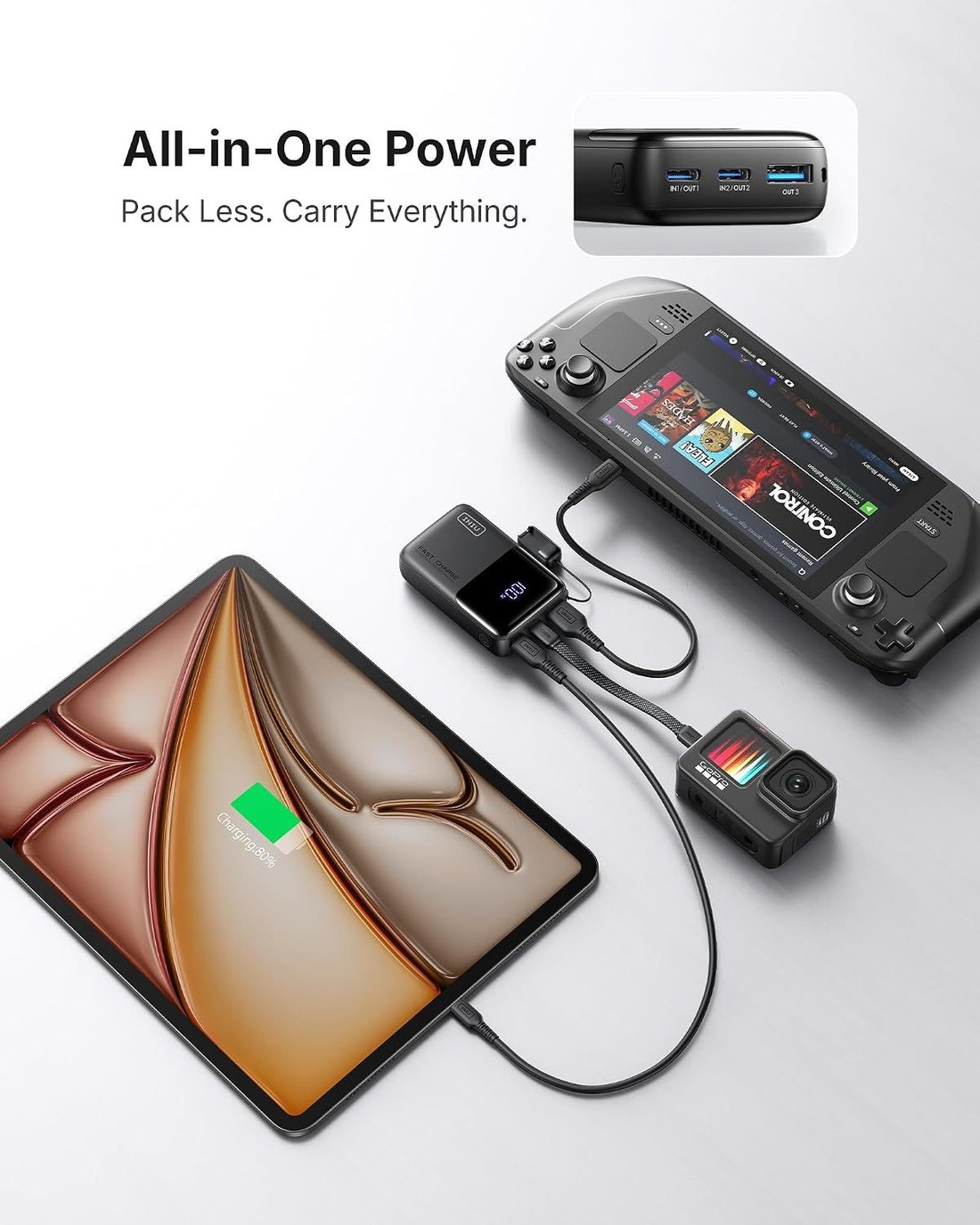
The manufacturer’s own graphic positions the pack as a multi-device hub. The fine print matters: sharing ports means sharing a much smaller power budget. (Manufacturer product image)
The laptop claim deserves its own sentence. INIU says the pack can put 42 percent into a MacBook Air in 25 minutes. That is plausible as an emergency figure — 45W is genuine MacBook-Air-class input — but a 10,000mAh pack holds roughly one usable laptop refill at best. It is a get-out-of-trouble feature, not a working-from-a-café feature.
Real capacity: the 6,200mAh figure nobody advertises
This is the single most misunderstood number in the power bank category, and the INIU Mini is a textbook case.
The 10,000mAh on the label describes the raw battery cell inside, measured at the cell’s native voltage. Converting that power to the 5V (and up to 20V) your devices actually accept loses energy as heat in the conversion circuitry. INIU’s own product literature is unusually candid about this, stating that a fully charged 10,000mAh pack typically delivers 6,000 to 7,000mAh to your devices and publishing the industry formula — rated capacity times roughly 0.65 — for estimating charges.
Independent measurement of this specific model lands at the low end of that band: reviews of the P50 put its rated deliverable output at about 6,200mAh. In practice, that means roughly two full charges for a recent iPhone or Galaxy flagship, one and a half for a large Pro Max model, and a partial top-up for an iPad. INIU’s own charts claim two charges for an iPhone 16 and 1.5 for a Samsung flagship, which is consistent with the rated figure.
None of this makes the pack unusual — every 10,000mAh power bank works this way. It makes the number worth understanding before you buy, because “10,000mAh” mentally translates to “four phone charges” for a lot of buyers, and the real answer is closer to two.
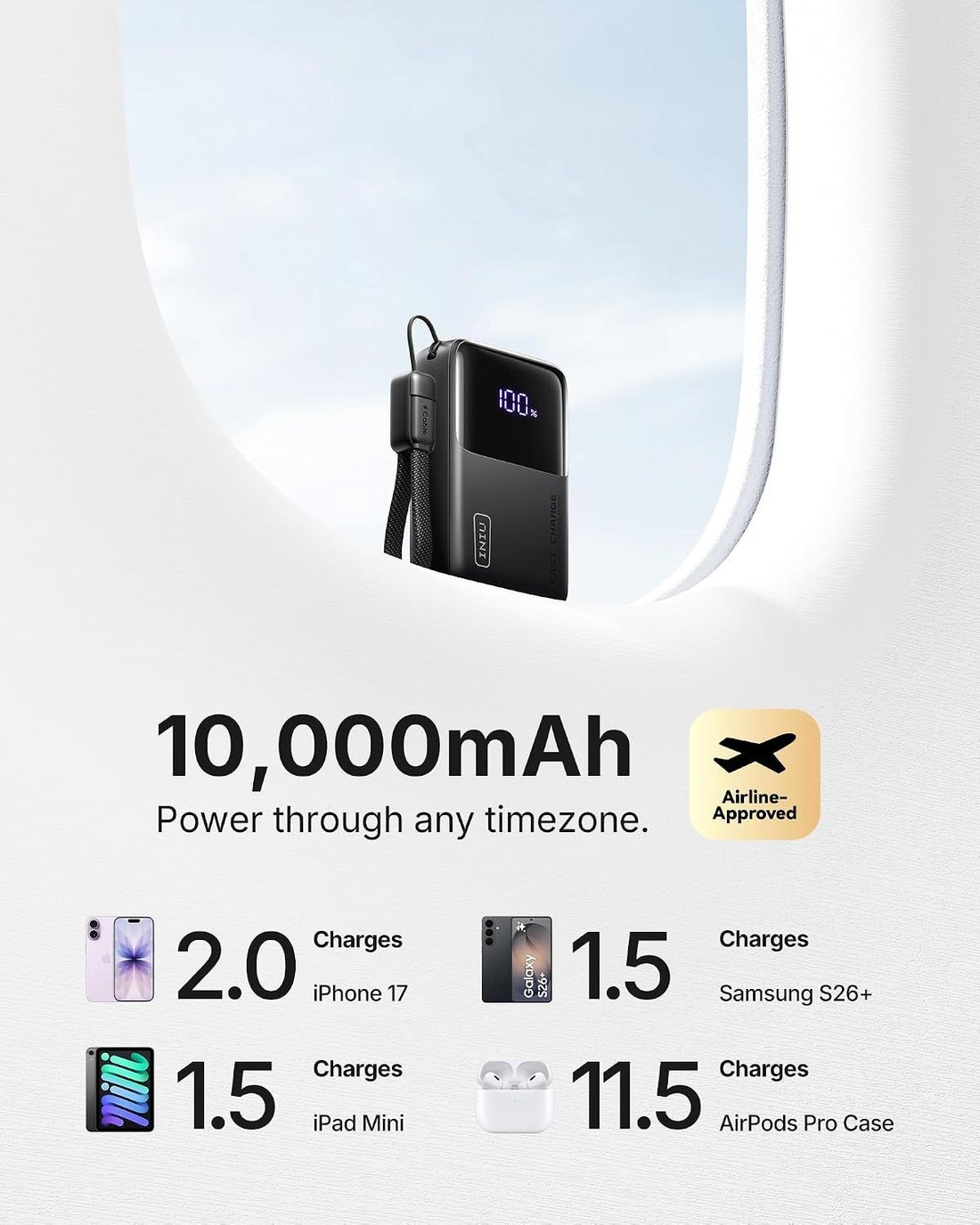
INIU’s listing graphic breaks down expected charges per device — iPhone twice, iPad Mini 1.5 times. The manufacturer is more candid about conversion loss than most of its competitors. (Manufacturer product image)
Size and weight: the part that actually wins
Specifications are where the INIU Mini earns its rating, because they check out from two independent directions.
The US listing puts the pack at 3.3 × 2.0 × 1.0 inches and 5.6 ounces. TODAY.com’s roundup lists the same weight, and its tester’s summary — genuinely pocketable rather than “pocketable for its capacity” — is the correct way to frame it. Against its direct 45W rival, the Anker Nano 10K, the INIU is about 30 percent lighter and noticeably thinner. Against generic budget 10,000mAh packs, which tend toward the size of a deck of cards, the difference is larger still.
There is a physical cost to this, and it is worth naming: energy density is not free. One review of the P50 notes it feels dense for its size, which is the polite way of saying the same energy has been packed into less volume. That shows up as a pack that is small but not flimsy — and, practically, as a battery that warms more readily during fast charging than a larger one would, which is exactly what INIU’s TempGuard 2.0 thermal monitoring is designed to manage.
The digital display is a small thing that pays off daily. A percentage readout removes the guesswork of four blinking LEDs, and on a pack you grab in a hurry, knowing whether it holds 90 percent or 15 percent before you leave the house is the difference between carrying it and leaving it in a drawer.
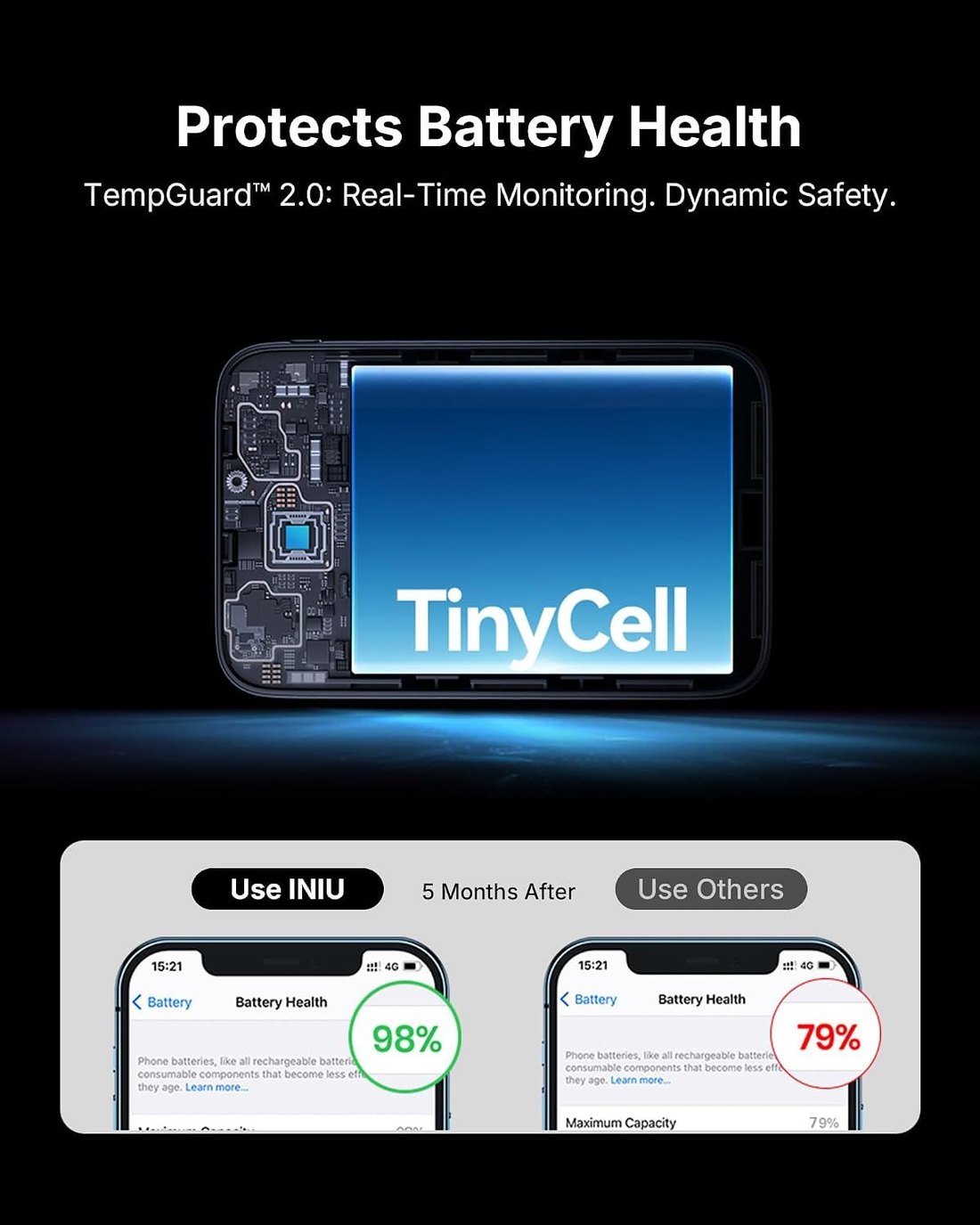
INIU attributes the compact body to its TinyCell Pro cell design and backs thermal behaviour with its TempGuard 2.0 monitoring. (Manufacturer product image)
Recharging: the honest weak spot
Here is the trade-off INIU’s marketing does not lead with: a pack that delivers 45W can only accept about 20W itself.
The listing’s own Q&A puts a full recharge at two hours with a 20W charger and closer to 2.7 hours on 15W, and INIU’s published input spec for this model tops out around the 20W mark. Real-world reports are slightly less flattering still — one buyer in a Slickdeals discussion measured the recharge tapering as the cell filled, finishing in roughly two and a half hours. Anker’s comparable 45W and 30W packs accept 30W input and refill faster as a result.
Whether this matters depends entirely on habit. If the pack lives on a nightstand charger and leaves the house full, the input ceiling is irrelevant — two hours overnight is the same as one. It bites in a specific scenario: you drained the pack during the day, you have a 90-minute window at a café between connections, and you need it full again. On this pack you will not get there; on a 30W-input rival you might get close.
There is also a battery-health argument in the INIU’s favour — slower charging is gentler on lithium cells, and one Slickdeals commenter made exactly that case. It is a fair point, but it is also the kind of argument every slow-charging product makes about itself. The honest framing is that this is a cost-saving and size-driven design choice with a side benefit, not a feature.
The lanyard cable: gimmick or genuinely good idea
The detachable USB-C lanyard is the feature most reviews single out, and it deserves the attention, because it solves two problems at once.
The first is forgetting the cable. The strap on your bag is the cable, so the failure mode of arriving with a power bank and no way to connect it simply does not exist. The second is cable wear, which is the usual death of built-in-cable power banks: when the lead frays on most packs, the whole unit becomes e-waste. Here the cable unclips, and INIU sells replacements — the company claims its nylon-braided construction outlasts standard cords by a wide margin, which is a marketing figure, but the replaceability itself is verifiable and it is the part that matters.
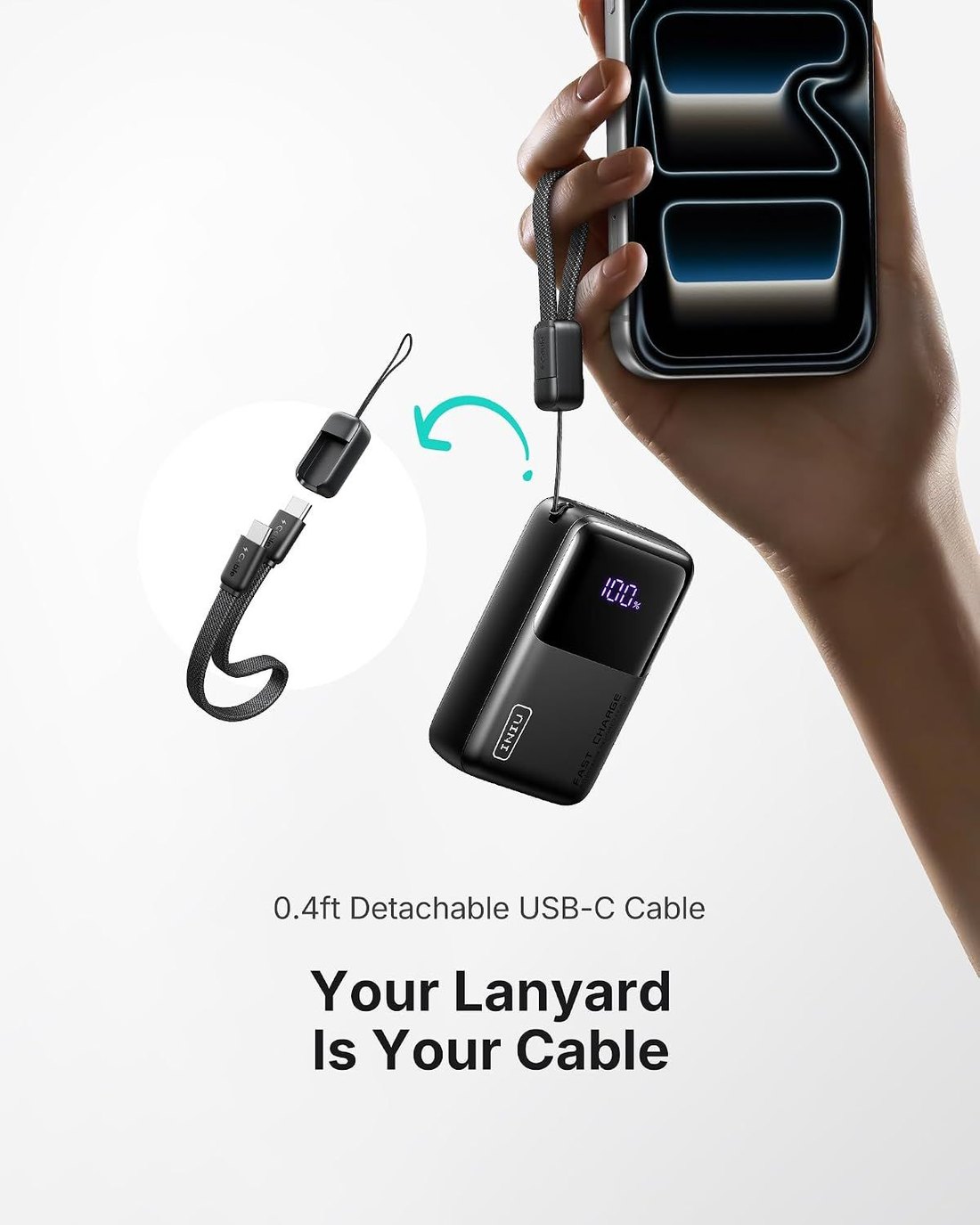
The lanyard unclips from the strap mount and works as a normal USB-C to USB-C cable, in both directions — it charges devices and recharges the pack itself. (Manufacturer product image)
The trade-off is length. Detached, it is a short cable — handy for charging a phone you are holding, awkward for charging a phone you are using on a desk. And a short braided lead clipped to a strap is not something everyone wants dangling off a bag. If that aesthetic bothers you, the feature works just as well kept in a pocket and never clipped anywhere.
Travel and flights
For a pack marketed on travel, the airline question has a clean answer.
Carry-on battery rules generally cap portable batteries at 100Wh, and this pack stores roughly 36 to 37Wh — comfortably under the limit, with a wide margin. INIU states the pack meets TSA requirements, and at this capacity it is the sort of thing security rarely looks at twice. It also supports pass-through charging, so it can top up a device while refilling itself from a wall charger — useful at airport outlets, where available sockets are always outnumbered by the people waiting for them.
One caveat worth knowing before you fly: most airlines require power banks in carry-on baggage only, never in checked luggage. That is a rule about all power banks rather than this one, but it is the single most common travel mistake with the category.
Where the INIU Mini falls short
The self-recharge ceiling. About 20W in, roughly two hours to full, and slightly slower in practice per one buyer’s measurement. Anker’s nearest rivals refill a notch faster. If your charging habit involves reviving a depleted pack in a hurry, this is the spec that will annoy you.
No wireless charging. Several competitors at this capacity — including Baseus’s magnetic PicoGo line — now offer Qi or Qi2 wireless charging on the back. The INIU is wired-only. For a pack whose selling point is minimalism, the omission is defensible; for iPhone users who like snapping a pack onto the phone, it is a real gap.
Multi-device speeds collapse. The three ports make it look like a family charger. It is not. INIU’s published tables for its related models cap combined output far below single-port figures, and while the company does not publish an equivalent table for the P50, expecting two fast charges at once is the wrong mental model.
The USB-A port is a slow lane. Accessories aside, most modern phones charge over USB-C, and the USB-A port’s ceiling is well below it. It is fine for earbuds cases and older devices; it is not a second fast port.
Who should buy the INIU Mini
- Daily commuters who want a pack that lives in a bag or jacket pocket without being noticed. This is the core audience and the design is built around them.
- Samsung and Pixel owners. Fast-charging Android flagships are the phones that can actually pull more than 20W, and this is one of the smallest packs that can serve them at full speed.
- Travelers packing light. Well under airline limits, pass-through charging, and a body that fits a jacket pocket — the travel use case is the one it was designed around.
- Anyone replacing a dead built-in-cable pack. The detachable lanyard turns the usual failure point into a consumable.
If that description fits, this is an easy recommendation in its class — check the INIU Mini Portable Charger on Amazon.
Who should skip it
- Laptop-dependent travelers. It can resuscitate a MacBook Air in an emergency, but 10,000mAh is one laptop refill at best. Anker’s and UGREEN’s higher-capacity packs exist for this.
- Wireless-charging households. No Qi, no magnets, no exception. A magnetic pack such as Baseus’s PicoGo AM52 covers that use case in the same capacity class.
- Shared-charger households. If one pack routinely serves two or three devices at once, the combined-output limits will turn “fast charger” into “patient charger.” A higher-capacity multi-port pack is the right tool.
How to choose a mini power bank: a short checklist
If you are comparing this pack against anything else in the class, these are the five specs that actually predict satisfaction.
- Rated deliverable capacity, not label capacity. Ask what the pack delivers after voltage conversion — roughly two-thirds of the label is normal. A seller who publishes this figure is being honest; one who does not is hiding the least flattering number they have.
- Input wattage, not just output. A 45W pack that refills at 20W is a pack you plan around. Check the input figure before you buy, not after.
- Weight and thickness, in that order. “Pocketable” is a claim about thickness. Two packs with the same capacity can differ by 30 percent in weight.
- Whether the built-in cable detaches. A fixed cable is a countdown timer on the whole product. A replaceable one is a consumable.
- Combined output when multiple ports are in use. Most people never check this, and it is where multi-device charging quietly dies.
Frequently asked questions
Is the INIU Mini allowed on planes? Yes. It stores roughly 36–37Wh, well under the 100Wh limit airlines apply to carry-on batteries, and INIU states it meets TSA requirements. It must go in carry-on baggage — power banks are not permitted in checked luggage on most airlines, regardless of capacity.
How many times does it charge an iPhone? INIU’s own chart claims two full charges for an iPhone 16, which lines up with the pack’s rated deliverable capacity of roughly 6,200mAh after conversion losses. Expect closer to 1.5 charges for the larger Pro Max models.
Is the 45W output real? Yes, on the USB-C ports, and independent testers have verified fast results — an iPhone 15 Pro to 50 percent in about 27 minutes in TODAY.com’s testing. The number is real, but your phone decides how much of it it can use; laptops aside, the main beneficiaries are Samsung and Pixel flagships that accept more than 20W.
Can it charge a MacBook? As an emergency top-up, yes — INIU claims 42 percent into a MacBook Air in 25 minutes. With a rated deliverable capacity around 6,200mAh, it holds roughly one partial laptop refill, so it is a rescue device rather than a work-day power source.
How long does it take to recharge the power bank itself? About two hours with a 20W-or-higher USB-C charger, and about 2.7 hours on 15W, per INIU’s listing. Real-world reports run slightly longer — around two and a half hours — because charging tapers as the battery fills.
Does it support pass-through charging? Yes. The pack can charge a connected device while recharging itself from a wall outlet, which is useful at airports and hotels where outlets are scarce.
View the INIU Mini Portable Charger on Amazon →
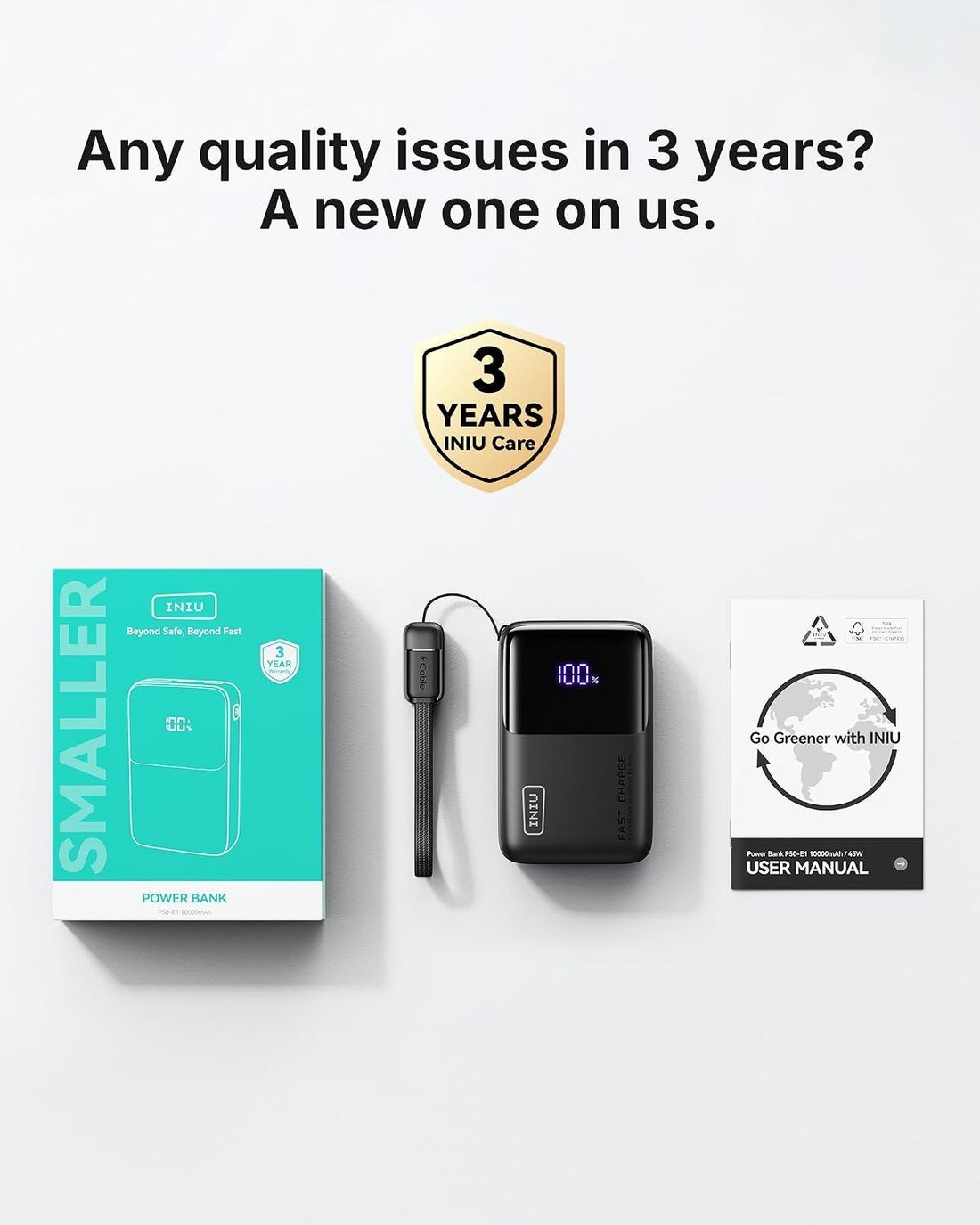
What ships in the box: the power bank, the detachable USB-C lanyard cable, and INIU’s three-year Care warranty. (Manufacturer product image)
About this review
This review is based on the manufacturer’s published specifications, the US retail listing, INIU’s official product pages for its related P55 models, and published testing from independent outlets including TODAY.com’s portable-charger roundup and Tom’s Guide. Product images are the manufacturer’s official product images from the retail listing, not photos taken by us. We have not performed instrumented laboratory testing, and nothing here should be read as a measured result. Where sources conflicted — the listing’s comparison chart and third-party reviews differ slightly on this model’s weight — the figure quoted by two independent sources is used, and ratings data is cited with its date because it changes over time. Specifications and availability change frequently — always confirm current details on the retailer page before purchasing.
Last updated: October 2, 2026
More from TechWithAll
- Anker Laptop Power Bank (25K, 165W) review — Three 100W USB-C connections and two built-in cables, for charging a laptop and a phone at the same time.
Browse the full accessories category.