
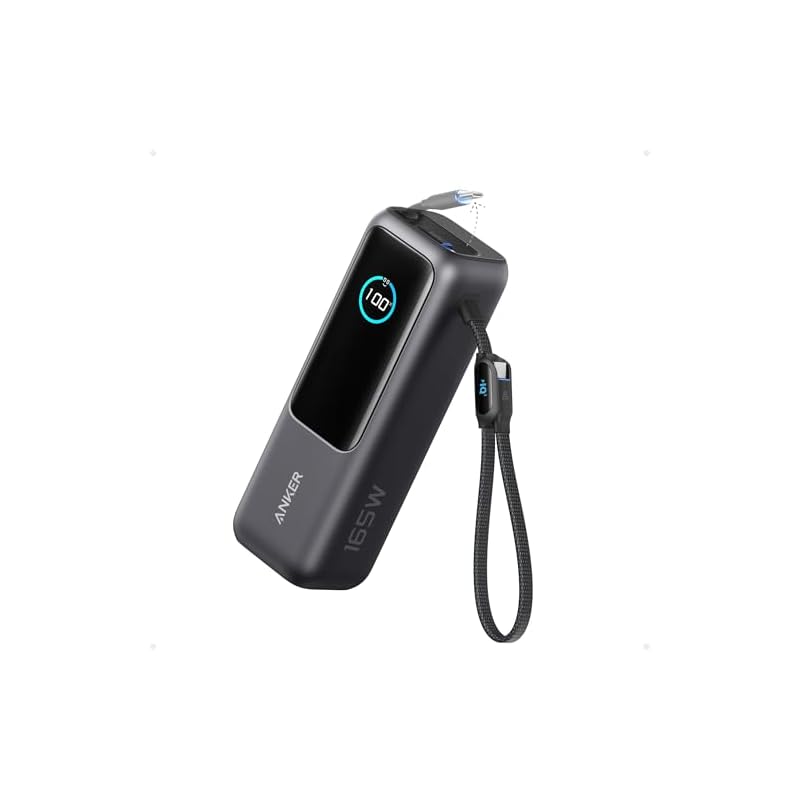
The verdict
The most capable laptop power bank in its size class: three 100W USB-C connections, 165W of shared output, two cables you cannot forget, and a 100W refill. The price of all that is weight, and cables you cannot swap out.
Pros
- Every one of the three USB-C connections delivers up to 100W, so three laptops can charge at full speed at the same time
- 165W of total output across two USB-C connections, and still 130W when three or four devices are plugged in at once
- Refills itself at up to 100W — about 30 percent in 20 minutes, and roughly two hours to full with a 100W-or-higher charger
- Two USB-C cables are built into the body: a 70 cm retractable lead and a 30 cm loop that doubles as a carry strap, so there is no cable to remember
- 90Wh, which sits under the 100Wh airline carry-on limit with margin to spare
- A live display that shows per-port wattage, battery percentage to two decimals, temperature, and estimated recharge time
- ActiveShield 2.0 thermal monitoring, which Anker describes as more than three million temperature checks per day
- A 4.4-star average across more than 12,000 Amazon ratings, and named the best power bank for air travel by Expert Reviews
Cons
- At 595 g it is roughly 200 g heavier than the lightest 25,000mAh rivals, and it is a bag item rather than a pocket one
- The two cables are built in and cannot be replaced on their own, which is the failure mode a detachable-cable rival avoids
Best for
- Travelers who charge a laptop and a phone at the same time and want both running at full speed
- Anyone who has arrived somewhere with a power bank and no cable, since two leads are permanently attached
- People carrying three or four devices who need all of them charging, not taking turns
- Fliers who want the largest capacity that still clears the 100Wh carry-on rule without paperwork
Not ideal for
- Phone-only users, who are carrying around 595 g for capacity they will never drain
- Anyone who wants the longest warranty in the class; 18 months is shorter than the two and three year terms rivals offer
- Buyers who need maximum wattage on a single device, where a 140W PD 3.1 rival has the edge
- People who prefer a cable they can unplug and replace when it eventually wears out
Anker Laptop Power Bank (25K, 165W) Review: Three 100W Ports, Two Built-In Cables
The short answer: this is the power bank for people who charge a laptop and do not want to think about cables. Every one of its three USB-C connections pushes up to 100W, so a laptop, a tablet, and a phone can all draw serious power at the same time instead of queuing. Two USB-C cables are built into the body — one retracts to about 70 cm, the other is a short loop that works as a carry strap — so the usual failure mode of arriving with a battery and no way to connect it simply does not exist. It also refills itself at up to 100W, which is roughly twice the speed most rivals accept. The costs are physical: at 595 g it is a bag item, not a pocket one, and those two cables are permanently attached, so if one wears out you are dealing with the whole unit rather than a spare lead.
Rating: 4.3 / 5
What the Anker Laptop Power Bank is actually built for
There is a version of this product that would have been easier to build. Anker could have shipped a 25,000mAh brick with two USB-C ports, one fast and one slow, and called it a laptop power bank — that is what most of the category does.
What Anker actually built is a charging hub that happens to be portable. The distinction matters, because it explains every unusual choice in the design. Three USB-C connections instead of two. One hundred watts available on each of them, rather than 100W on the top port and a token 30W or 45W on the rest. Two cables living permanently inside the chassis. A display detailed enough to show you what each port is pulling in real time.
The model number is A1695, sold under the listing name Anker Laptop Power Bank, 25,000mAh Travel Essential with 165W Total Output. It is worth writing the model down, because “Anker Laptop Power Bank” is a description Anker applies to several different products, and the A1695 is specifically the one with the two built-in cables.
The commercial picture is established rather than new. As of October 2026 the US listing showed a 4.4-star average across more than 12,000 ratings, and the unit sat inside the top ten of Amazon’s portable power bank category. Expert Reviews named it the best power bank for air travel in its 2026 roundup. This is a mainstream, well-reviewed product, which means the interesting question is not whether it works — it is whether the specific combination of features is the one you need, because you are paying for all of them.
Specs at a glance
| Specification | Anker Laptop Power Bank (A1695) |
|---|---|
| Model number | A1695 |
| Capacity | 25,000mAh / 90Wh |
| Total output | 165W maximum |
| USB-C output | Up to 100W per connection, across three USB-C connections |
| USB-A output | Up to 33W |
| Ports | 2 built-in USB-C cables, 1 USB-C port, 1 USB-A port — four devices at once |
| Output when two USB-C are used | Up to 165W |
| Output when USB-C and USB-A are used | Up to 133W |
| Output when three or four devices are used | Up to 130W |
| Maximum input (self-recharge) | Up to 100W via USB-C |
| Recharge time | Around 2 hours with a 100W-or-higher charger at 25°C; about 30 percent in 20 minutes |
| Built-in cables | 70 cm (2.3 ft) retractable USB-C; 30 cm (0.98 ft) USB-C loop that doubles as a strap |
| Display | Live readout of battery percentage, input, output, temperature, and estimated recharge time |
| Safety | ActiveShield 2.0 thermal monitoring |
| Pass-through charging | Supported, with a 20W-or-higher charger whose input exceeds the output |
| Dimensions | 157 × 54 × 49 mm (6.18 × 2.13 × 1.93 in) |
| Weight | 595 g (about 1.31 lb) |
| Airline rules | 90Wh — under the 100Wh carry-on limit |
| Charging protocols | PD 3.0, QC 3.0, PPS, SCP, UFCS, AFC, Apple 2.4A |
| Warranty | 18 months |
| In the box | Power bank, protective pouch, welcome guide |
Specifications are from Anker’s published product page and the US retail listing. One detail is worth reading twice: Anker notes that the 100W peak recharge rate is only reached when the battery level is above 25 percent, so a refill from truly empty will not hold that figure the whole way.
How the 165W is actually shared
This is the part of the product most buyers get wrong, and it is worth being precise about it, because the headline number and the useful number are not the same thing.
165W is a total, not a per-port figure. No single device draws 165W from this pack. Anker’s own specification puts the maximum at 100W for any one USB-C connection. The 165W appears when two USB-C connections are in use at once — and even then, it is a ceiling on the combined draw, not something either device receives on its own.
The total shrinks as you add devices. Two USB-C connections can share up to 165W. A USB-C and a USB-A together top out at 133W. Once you are charging three or four devices, the whole pack shares up to 130W across them. That is still a genuinely large budget — most 25,000mAh rivals drop well below 100W once three things are plugged in — but it is not “100W each, all day.”
What makes the A1695 unusual is where that budget sits. Compare the shape of the numbers rather than the headline. Most power banks in this capacity class give you one strong port and one or two weak ones. The A1695 gives you three USB-C connections rated to the same 100W ceiling. In practice, that means a 16-inch MacBook Pro, an iPad Pro, and a phone can all be connected without any of them being relegated to the slow lane — which is exactly the scenario the product is designed around, and the reason it shows up on travel roundups.
For anyone whose kit is a laptop plus a phone plus a pair of earbuds, that shape is the whole argument — see the Anker Laptop Power Bank on Amazon.
How it compares
Every pack below holds 25,000mAh. Figures come from each manufacturer’s own product pages.
| Anker Laptop Power Bank (A1695) | UGREEN Nexode 145W (90597A) | INIU P63-E1 | |
|---|---|---|---|
| Capacity | 25,000mAh / 90Wh | 25,000mAh / 90Wh | 25,000mAh |
| Max total output | 165W | 145W | 110W across two ports; 80W across all three |
| Strongest single port | 100W USB-C | 140W USB-C (PD 3.1) | 100W USB-C |
| Second USB-C | Up to 100W | Up to 65W | Up to 45W |
| USB-A | Up to 33W | Up to 22.5W | Up to 18W |
| Number of connections | 4 (2 built-in cables, USB-C, USB-A) | 3 (2 USB-C, USB-A) | 3 (2 USB-C, USB-A) |
| Built-in cable | Yes — retractable 70 cm plus 30 cm strap | No | Detachable lanyard cable |
| Max input (self-recharge) | 100W | 65W | 65W |
| Weight | 595 g | 513 g | 392 g |
| Dimensions | 157 × 54 × 49 mm | 160 × 80 × 26 mm | 110 × 70 × 36 mm |
| Warranty | 18 months | 2 years | 3 years |
UGREEN figures are from UGREEN’s UK and EU product pages for SKU 90597A. INIU figures are from INIU’s official product page for the P63-E1. Where a brand publishes slightly different figures across regional pages, the figure above is from the page named.
Three things fall out of that table, and they map directly onto the buying decision.
Anker wins on shared power and loses on single-device power. If you want the highest possible wattage into one laptop, the UGREEN’s 140W PD 3.1 port beats the Anker’s 100W ceiling. If you want three devices all drawing hard at the same time, the Anker’s three 100W-rated connections are the stronger design. These are different products wearing the same capacity figure.
Weight is the clearest gap in the table. The INIU comes in at 392 g against the Anker’s 595 g — a difference of roughly 200 g, or about half the Anker’s total weight again. Both hold 25,000mAh. That difference is the built-in cables, the larger port array, and the cooling hardware that 165W requires. Whether it is worth carrying is a question about how you travel, not about which pack is better.
Warranty runs the other way. Anker’s 18 months is the shortest term here, against two years from UGREEN and three from INIU. For a device you are going to throw into a bag for years, that is worth knowing before you buy rather than after.
What independent testing found
We have not run this pack on a bench, so everything in this section is attributed to outlets that did, with the nature of their testing stated where they published it.
Expert Reviews named the A1695 the best power bank for air travel in its 2026 roundup, testing packs by connecting them through a USB power meter to Android and iOS phones and a Chromebook, and measuring recharge rate from a 65W USB-C charger. The publication’s pick is specifically about the travel use case — capacity that clears airline rules combined with output that handles a laptop.
The Independent has the most useful long-term data point, because its reviewer has carried this exact pack for roughly a year across international work trips, conferences, and train journeys. His summary of the charging behaviour is the practical one: the pack drives a MacBook “much like a wall plug would,” and even with a phone and earbuds connected at the same time, the power is split intelligently rather than the laptop merely hovering at its current level. He calls out the display as the detail that earns its place, since it shows per-device wattage in real time, the pack’s own percentage to two decimal places, and temperature. His stated caveat is weight — at just under 600 g it is not a pocket item — and he reports the unit surviving several drops over the year.
Pixel Twelve scored it 8 out of 10 and made the point about the naming that is worth repeating: 165W is shared output, not what one laptop receives. Its listed drawbacks are the ones that match this review — 595 g is heavy for phone-only use, heat can reduce sustained output, and it notes owner reports of built-in cable failures. It cites a 4.4 average from more than 12,000 global ratings.
On durability, one caveat applies to all built-in-cable designs. A fixed cable concentrates wear in a place you cannot swap out. Anker rates these cables for more than 20,000 bends and describes the strap as able to support a substantial load, but those are manufacturer durability claims under test conditions rather than a promise about a specific unit dropped off a specific airport bench. The practical read is in the notes section below.
Charging speed: what 100W per port actually delivers
This is the reason to buy this pack over a cheaper one, and it is worth being specific about what “fast” means here, because the number on the box is not the number your device sees.
The laptop figure is the headline, and it is a real one. Anker states that the pack takes a 16-inch MacBook Pro (M3) to 50 percent in about 33 minutes. That is a wall-charger-class result rather than the slow trickle that most power banks manage with a laptop, and it is the difference between topping up between meetings and merely slowing the drain.
Phones charge faster still. Anker quotes an iPhone 16 reaching 50 percent in around 25 minutes. For context on why that matters on the road: it is enough for a substantial top-up in the time it takes to drink a coffee, which is the actual use case for a power bank rather than the theoretical one.
Your device decides how much of the 100W it uses. A 100W port does not push 100W into everything. A MacBook Air will happily draw far less than its maximum; a phone will draw whatever its charging controller allows. The 100W ceiling is what enables the fast results, not a figure every device will hit.
Refilling the pack itself is where this model separates from the field. Most 25,000mAh rivals accept 65W on input. This one takes up to 100W, which is why Anker can quote about 30 percent in 20 minutes and roughly two hours to full with a 100W-or-higher wall charger. That is the difference between a pack you can revive during a layover and one you have to leave plugged in overnight. The caveat from Anker’s own fine print: the 100W peak is only reached when the battery is above 25 percent, so a refill from empty will taper.
Heat is the honest limit on sustained speed. Pixel Twelve notes that heat can reduce output, which is true of every high-wattage pack and is what the ActiveShield 2.0 monitoring is managing. In practice, a long sustained 100W draw will not hold its peak for the entire session. If you are charging one laptop at full speed for an hour, expect the pack to warm and the last part of the charge to be gentler.
The two built-in cables: the reason to buy, and the part to look after
Two USB-C cables live permanently in the chassis, and they are the single feature that most clearly separates this pack from its rivals.
The retractable one is the workhorse. It pulls out to about 70 cm — 2.3 feet — which is long enough to charge a phone you are holding or a laptop on a tray table without the pack dangling. It retracts back into the body when you are done. For anyone who has ever unpacked a power bank and a tangled nest of cables at a security tray, this is the feature that justifies the weight.
The short one is a loop, and it doubles as a carry strap. At roughly 30 cm, it is too short to be generally useful as a charging lead, and that is not its job. It forms a loop on the corner of the pack, so you can hook a finger through it or clip it to a bag. Anker rates the cables for more than 20,000 bends and describes the strap as able to carry a substantial load.
The trade-off is replacement. A cable you can unplug is a consumable; when it frays, you buy another and the pack lives on. A cable that is moulded into the chassis is not. Pixel Twelve’s roundup notes owner reports of built-in cable failures, and that is the structural risk of the design rather than a defect specific to this unit — it applies to every power bank with a fixed cable. The mitigation is behavioural, and it is in the practical notes below.
Worth comparing against the alternative. INIU’s P63-E1 includes a lanyard-integrated USB-C cable that detaches, so the same convenience comes with a replaceable failure point. If you have killed a built-in cable before and it annoyed you, that is the design to compare against. If you have simply forgotten a cable before, the Anker’s built-ins solve the problem more completely.
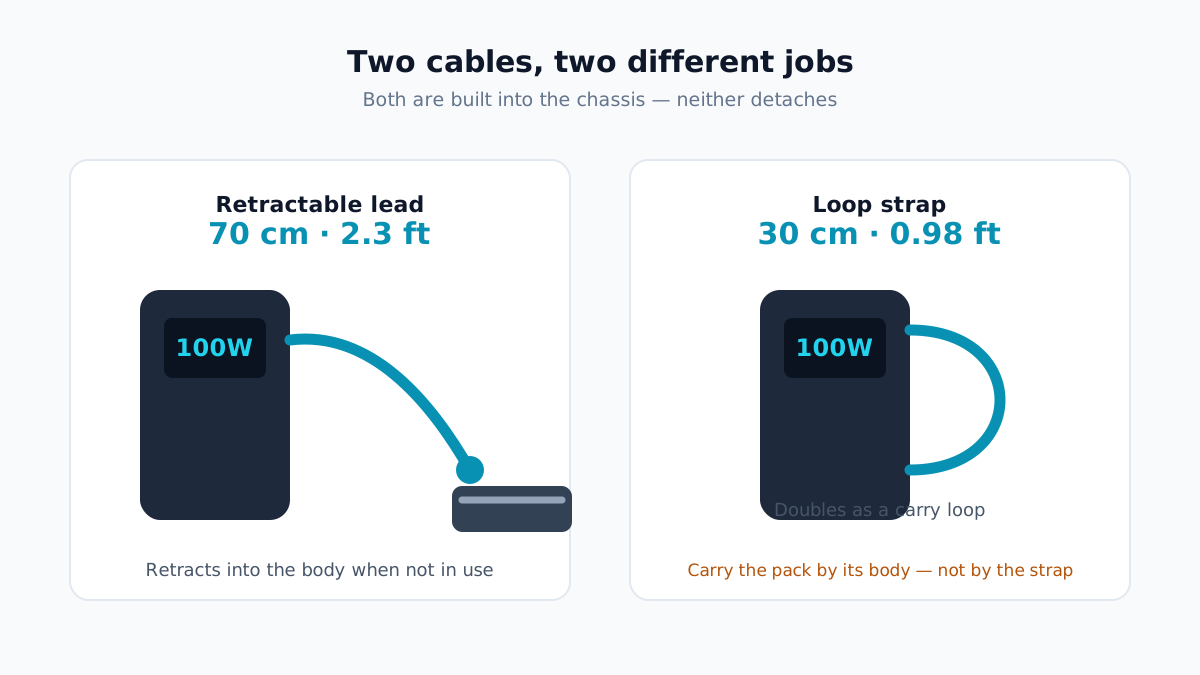
The two cables serve different jobs: the retractable lead does the charging, the short loop carries the pack. Neither comes out. (Diagram, not a product photograph)
Practical notes before you fly
Treat the strap as a strap, not a handle for the whole weight. The short loop is rated to carry load, and it is genuinely convenient for lifting the pack out of a bag. But 595 g swinging from a moulded cable anchor is exactly the stress a fixed-cable design is least able to absorb over years. Carry the pack by its body; use the loop for hooking and clipping, not for swinging. If the loop ever does start to fray, stop putting weight on it and use the retractable lead — the pack keeps working either way, because there is still a separate USB-C port.
Know the weight before you commit, and plan where it lives. At 595 g this is a bag item. It is not going in a jeans pocket, and in a small sling you will notice it. The fair comparison is not against a 10,000mAh pocket pack but against the laptop charger you would otherwise carry — against that, it is roughly comparable, and it does considerably more. If your travel kit is one phone, a 25,000mAh pack of any kind is the wrong tool.
Check the airline figure on your specific unit before a long trip. This pack is 90Wh, which sits under the 100Wh carry-on threshold that most airlines apply without requiring approval. Two things still apply: power banks go in carry-on baggage and never in checked luggage, and airlines can set their own rules inside that limit. The Wh figure is printed on the unit — check it there rather than relying on a product page.
Living with it: the display, the heat, and pass-through
The display is better than it needs to be, and that is the point. Most power banks show four LEDs. This one shows remaining percentage, input wattage, output wattage, estimated recharge time, and temperature. On a pack that is dividing 165W between devices, being able to see what each port is actually pulling turns a guess into a fact. The Independent’s reviewer singled this out as the feature he used most over a year of carrying it.
Pass-through charging works, with one condition. The pack can charge a connected device while refilling itself, which is genuinely useful at an airport outlet where sockets are outnumbered. Anker specifies that it requires a charger rated 20W or higher and that input power needs to exceed output power. With a small travel adapter, expect it to behave as a normal charge rather than a pass-through.
Expect warmth under sustained load, and plan around it. Delivering 100W generates heat; that is physics rather than a flaw, and it is what ActiveShield 2.0’s monitoring is there to manage. The practical consequence, per Pixel Twelve’s testing notes, is that output can step down during a long high-wattage session. For topping up a laptop between meetings this will never be visible. For trying to run a workstation off the pack all afternoon, expect the last stretch to be slower.
The pouch is worth keeping. The pack ships with one, and given a display and two cable exits, it is the difference between a clean bag and a scratched screen.
Travel and flights
For a pack with “Laptop Power Bank” in its name, the airline question has a clean answer, and it is one of the reasons this model gets picked for travel.
90Wh clears the common limit with margin. Most airlines allow portable batteries up to 100Wh in carry-on without prior approval. This pack is rated at 90Wh, so it sits inside that with room to spare — the same reason Expert Reviews named it the best power bank for air travel. Batteries between 100Wh and 160Wh generally require airline approval, which is a different and more annoying process.
Carry-on only, always. Power banks are not permitted in checked luggage on most airlines, regardless of capacity. This applies to every power bank rather than this one, but it is the single most common travel mistake in the category.
Capacity is what makes it a travel pack rather than a commute pack. 25,000mAh is roughly five phone charges or a bit more than one full laptop refill, which is the difference between a pack that gets you through a long-haul flight with devices left over and one that is empty by the time you land.
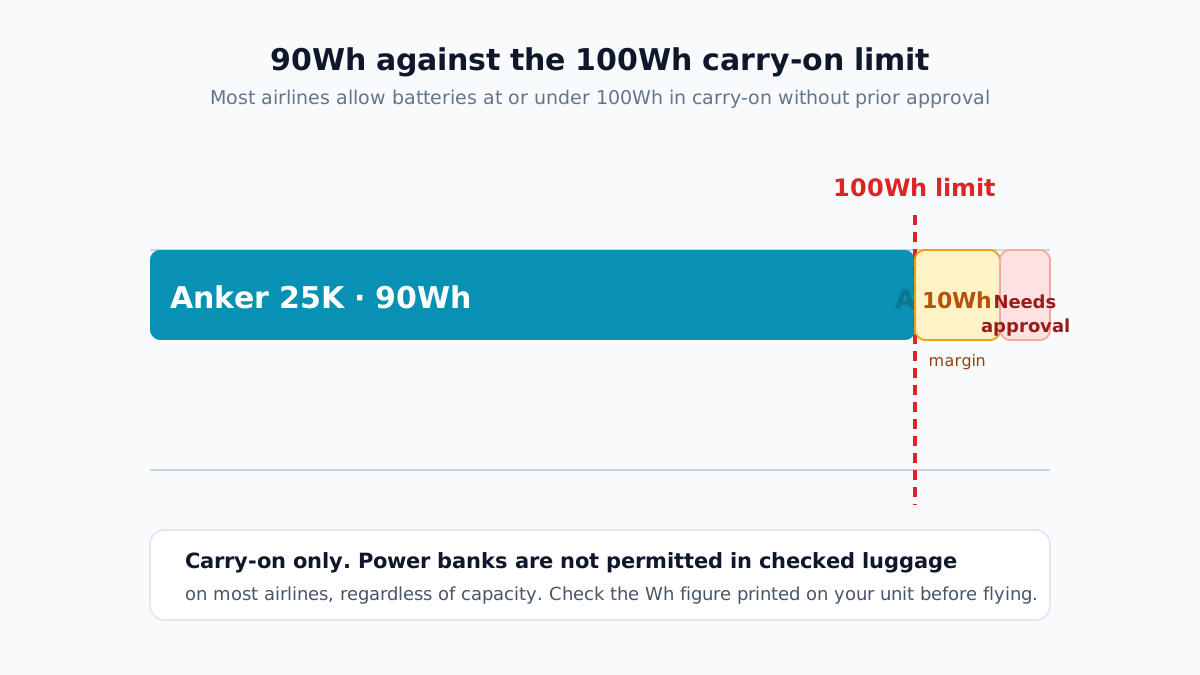
At 90Wh the pack sits under the 100Wh threshold most airlines apply to carry-on batteries. (Diagram, not a product photograph)
Who should buy the Anker Laptop Power Bank
- Travelers charging a laptop and a phone together. This is the design brief. Three USB-C connections rated to the same 100W ceiling means neither device waits its turn.
- Anyone who has arrived with a power bank and no cable. Two leads are permanently attached, and one of them retracts. The failure mode is designed out rather than merely discouraged.
- Multi-device households and work kits. Four simultaneous connections with a 130W shared budget when all are in use is more than most rivals manage at three devices.
- Fliers who want maximum capacity without paperwork. 90Wh clears the 100Wh rule with margin.
- People who value seeing what is happening. The live display showing per-port wattage is genuinely useful on a shared-output pack, and no rival in the comparison table matches it.
If that is you, this is the strongest option in its class — check the Anker Laptop Power Bank on Amazon.
Who should skip it
- Phone-only users. You are carrying 595 g and paying for three 100W connections you will never use. A 10,000mAh pocket pack does the job at a third of the weight.
- Anyone who wants one device charged as fast as physically possible. UGREEN’s Nexode has a 140W PD 3.1 port that beats this pack’s 100W ceiling on a single laptop.
- Weight-first packers. The INIU P63-E1 holds the same 25,000mAh at 392 g — roughly 200 g less.
- Buyers who want the longest warranty. Eighteen months is the shortest term in the comparison table.
- Anyone who wants to replace a worn cable themselves. Both cables here are fixed. The INIU’s lanyard cable detaches.
How to choose a laptop power bank: a short checklist
If you are weighing this against anything else in the class, these are the checks that actually predict whether you will be happy.
- Read the per-port figure, not the total. “165W” tells you what the pack can share. The number that decides your laptop’s charging speed is the ceiling on a single port.
- Check what happens when three devices are plugged in. Many packs collapse to a fraction of their headline once the ports fill up. Find the multi-device figure before you buy.
- Compare input wattage, not just output. A 25,000mAh pack that refills at 65W is one you plan around; one that takes 100W is one you can revive in a layover.
- Weigh it against the thing it replaces. A laptop power bank is competing with the wall charger you would otherwise carry, not with a pocket pack. Judge the weight on that basis.
- Decide whether the cable should detach. A built-in cable cannot be forgotten; a detachable one can be replaced. Pick which failure you would rather live with.
- Check the Wh figure, not just the mAh. Airline rules are written in watt-hours. Anything at or under 100Wh is straightforward on most carriers.
- Compare warranty length. These are devices that live in bags. Two or three years against eighteen months is a real difference.
- Decide whether you need a display. On a pack splitting power across four connections, knowing what each port is drawing is the difference between guessing and knowing.
Frequently asked questions
Is the Anker Laptop Power Bank allowed on planes? Yes. It is rated at 90Wh, which sits under the 100Wh limit most airlines apply to carry-on batteries without requiring approval. It must go in carry-on baggage — power banks are not permitted in checked luggage on most airlines, regardless of capacity.
Does each USB-C port really deliver 100W? Each USB-C connection is rated up to 100W, yes. The 165W headline is combined output, not per-port: two USB-C connections can share up to 165W, a USB-C and USB-A reach 133W, and three or four devices share up to 130W.
How fast does it charge a MacBook? Anker states a 16-inch MacBook Pro (M3) reaches 50 percent in about 33 minutes. An iPhone 16 reaches 50 percent in around 25 minutes, per the same figures. Your device decides how much of the available wattage it draws.
How long does the power bank take to recharge itself? Around two hours with a 100W-or-higher USB-C charger at 25°C, and roughly 30 percent in 20 minutes. Anker notes the 100W peak recharge rate only applies while the battery is above 25 percent.
Can it charge four devices at once? Yes — two built-in USB-C cables plus a USB-C port and a USB-A port. Total shared output with three or four devices connected is up to 130W, so all four charge, but not each at the full single-port rate.
Is it heavy? At 595 g it is one of the heavier 25,000mAh packs. The INIU P63-E1 holds the same capacity at 392 g. Whether that matters depends on whether you are carrying it in a bag or a pocket — it is designed as a bag item.
What happens if a built-in cable breaks? Neither cable detaches, so a worn cable cannot be swapped out on its own — that is the trade-off for never forgetting one. There is still a separate USB-C port, so the pack keeps working even if a built-in lead is damaged. Rivals such as the INIU P63-E1 use a detachable lanyard cable instead.
Does it support pass-through charging? Yes. It can charge a connected device while refilling itself, provided you use a charger rated 20W or higher and the input power exceeds the output.
What is the warranty? Eighteen months. That is shorter than the two-year term UGREEN offers on the Nexode 145W and the three-year term INIU offers on the P63-E1.
View the Anker Laptop Power Bank on Amazon →
About this review
This review is based on Anker’s published product page and specifications, and the US retail listing for model A1695 (ASIN B0DCBB2YTR), plus published testing and long-term use reports from independent outlets including Expert Reviews, The Independent, and Pixel Twelve’s laptop power bank roundup. Competitor figures are taken from UGREEN’s and INIU’s own product pages. The main product image is the retailer’s listing photograph; the other images in this review are diagrams prepared for this page, not photographs of the product. We have not performed instrumented laboratory testing, and nothing here should be read as a measured result. Ratings and sales data are cited with their date because they change over time, and specifications and availability change frequently — always confirm current details on the retailer page before purchasing.
Last updated: October 5, 2026
More from TechWithAll
- INIU Mini Portable Charger (P50) review — A pocketable 10,000mAh pack with detachable lanyard cable, for when 25,000mAh is more than you need.
Browse the full accessories category.