
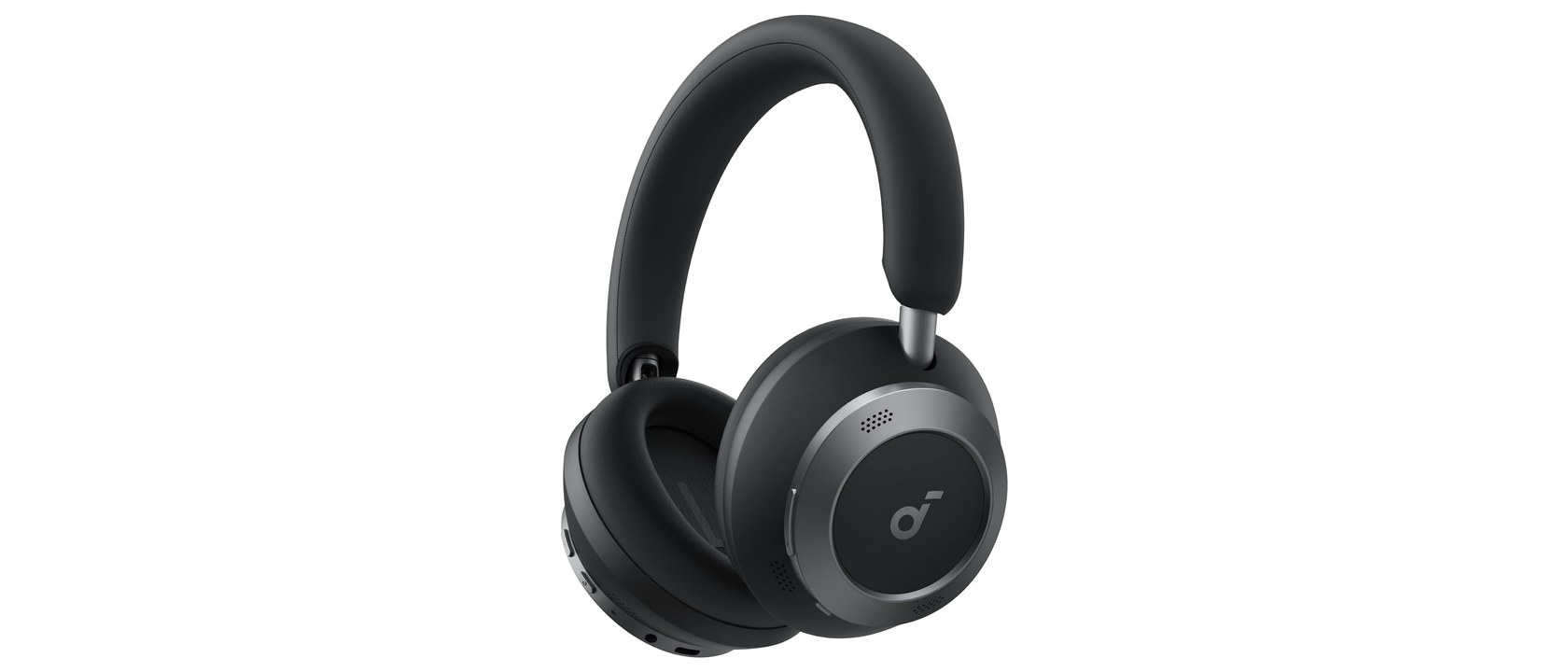
The verdict
The most complete battery-and-portability package in its class, as long as you treat the factory tuning as a starting point for the EQ rather than the finished product.
Pros
- 40 hours of playback with ANC on and 60 with it off, plus the fastest refill ratio in this comparison — five minutes of charge buys eight hours
- Folds to roughly half its working size through a five-segment hinged headband — no other headphone here shrinks this much for packing
- LDAC hi-res streaming and a 3.5 mm wired input, which most headphones at this level leave out
- The app's custom EQ and HearID profile can flatten the bass-heavy factory tuning
- Multipoint pairing on Bluetooth 5.3 that Tom's Guide found held across three devices at once
Cons
- The factory tuning measures far above preference in the bass — plan on spending time in the EQ
- Calls fail in loud environments — RTINGS found the voice algorithm makes you unintelligible against sustained noise like a subway
- Not water resistant, ships with a soft pouch instead of a hard case, and there is no audio over USB
- Enabling LDAC disables both multipoint and the Dolby spatial mode — you pick two of the three
- The physical buttons are small and hard to tell apart by feel
Best for
- Commuters and travelers who want all-week battery and a fold that fits a jacket pocket
- Students and office workers in moderate noise, where its measured isolation genuinely competes with pricier sets
- Android listeners who will turn on LDAC and actually use the app EQ
Not ideal for
- Anyone who takes a lot of calls outdoors in wind or street noise
- Listeners who want a neutral sound out of the box and refuse to touch an EQ
- Gym and workout use — there is no water resistance at all
Soundcore Space One Pro Review: The Foldable Commuter ANC That Lasts All Week
The short answer: the Space One Pro is Soundcore’s play for the commute-and-travel audience, and the bet is unusually specific — give up nothing on battery, charging speed, codec support, or portability, and save money where most buyers will not notice: in the factory sound tuning, the microphone’s behavior in loud places, and the softness of the accessories in the box. Independent testing broadly supports the first half of that bet and correctly identifies the second. If you want a headphone that survives a full work week on one charge and collapses small enough for a jacket pocket, this is a strong pick. If you want flagship-grade voice pickup in loud streets or a sound signature that is finished out of the box, read the sections below before deciding.
Rating: 4.3 / 5
What the Space One Pro is actually built for
Soundcore is Anker’s audio brand, and the Space One Pro (model A3062, released in September 2024) sits at the top of its over-ear lineup. The Amazon listing has held a rating around 4.4 stars since launch, and the product has ranked within the top 400 of Amazon’s over-ear headphones category as of October 2026 — a large enough sample that the score reflects the ordinary buyer’s experience rather than early-adopter enthusiasm.
The design brief is easy to state: this is a headphone for people who put it in a bag twice a day.
Where flagship models from Sony and Bose treat portability as an afterthought — Sony’s WH-1000XM5 famously abandoned folding entirely — the Space One Pro makes the fold the headline feature. It pairs that with a battery claim (sixty hours without noise cancelling) that beats every flagship and a five-minute fast charge that returns eight hours of playback. What it gives up is subtler: a neutral factory sound, a microphone that survives loud streets, and the hard-sided case that most headphones this size traditionally include.
That trade-off is the entire review, so let’s look at it honestly.
Specs at a glance
| Specification | Soundcore Space One Pro |
|---|---|
| Model number | A3062 |
| Drivers | 40 mm, triple-composite diaphragm |
| Frequency response | 20 Hz – 40,000 Hz |
| Impedance / sensitivity | 16 ohm / 93 dB ± 2 dB |
| Total harmonic distortion | Under 3% (manufacturer claim) |
| Active noise cancelling | Adaptive ANC 3.0, four-stage, with six microphones (see below) |
| Bluetooth | 5.3, multipoint |
| Codecs | SBC, AAC, LDAC |
| Battery (rated) | 40 h with ANC on / 60 h with ANC off |
| Fast charging | 5 minutes for 8 hours of playback |
| Full charge time | About 2 hours |
| Wired input | 3.5 mm (cable included) |
| Weight | 286.2 g per soundcore’s spec sheet — see the note below |
| Folded size | About 127 × 98 × 118 mm |
| Water resistance | None — not rated for water or sweat |
| Warranty | 18 months |
Specifications are from soundcore’s and Anker’s official product pages and the Amazon listing. Where official channels disagree with each other or with independent testers, both figures are given and discussed below. Confirm current details on the retailer page before buying.
How the Space One Pro compares
| Soundcore Space One Pro | Sony WH-1000XM5 | Bose QuietComfort Ultra | JBL Tune 770NC | |
|---|---|---|---|---|
| Battery, ANC on | 40 h | 30 h | 24 h (18 h with Immersive Audio) | 44 h |
| Battery, ANC off | 60 h | 40 h | Not published separately | 70 h |
| Fast charge | 5 min → 8 h | 3 min → 3 h | 15 min → 2 h | 5 min → 3 h |
| Full charge | About 2 h | About 3.5 h | About 3 h | About 2 h |
| Weight | 286.2 g | 250 g | 250 g | 232 g |
| Codecs | SBC, AAC, LDAC | SBC, AAC, LDAC | SBC, AAC (aptX Adaptive per Bose’s manual) | SBC, AAC |
| Bluetooth | 5.3 | 5.2 | 5.3 | 5.3 |
| Folds for packing | Yes — to about half size | No | Folds flat, no compression | Flat fold only |
| Wired input | 3.5 mm | 3.5 mm | 2.5 mm-to-3.5 mm cable | 3.5 mm detachable |
Competitor figures are from each brand’s official product pages as of October 2026. All runtime figures are manufacturer claims measured under different conditions, not results from a common test. Bose’s retail page lists only SBC and AAC, while its user manual documents aptX Adaptive through Snapdragon Sound on compatible Android devices — treat the codec row for the Bose accordingly.
Three things in that table are worth dwelling on.
The battery is close to the longest here, and the refill is the fastest. The JBL Tune 770NC actually claims more raw hours in both configurations, and it costs less — but it has no LDAC, no hi-res certification, and a single-microphone ANC system. Among the headphones in this comparison that support hi-res wireless audio, the Space One Pro’s combination of forty hours with ANC on and an eight-hour top-up from five minutes is unmatched. Nobody else here comes close on charging speed.
The fold is the real differentiator. Sony’s WH-1000XM5 does not fold at all — it ships in a case sized around its fixed frame. Bose’s QuietComfort Ultra folds flat but stays full-size. The JBL flat-folds. Only the Space One Pro compresses to roughly half its working volume, which is why it is the only one here that plausibly lives in a jacket pocket or the side pocket of a backpack.
It is the heaviest headphone in the table. The marketing language says lightweight, and 286 grams is not heavy by absolute standards — but it is thirty-six grams more than either flagship and fifty-four more than the JBL. If you are comparing it against the flagships because of the battery and fold numbers, be aware that you are trading away some of their comfort advantage on paper. In practice, reviewers did not find the weight a problem, which the comfort section below covers.
If the fold-and-battery package is what you are after, check the Space One Pro on Amazon.
Battery: what sixty hours actually buys you
The headline number — sixty hours — is the ANC-off figure. With noise cancelling on, which is how most buyers of an ANC headphone will actually use it, soundcore’s own specification is forty hours. That is still the strongest ANC-on rating among the hi-res-capable headphones in this comparison, and it means roughly a full work week of commuting between charges.
The fast charging is the more useful number in practice. Five minutes plugged in returns eight hours of playback — the best refill ratio here by a wide margin. It changes how you treat the battery: instead of planning charges, you top up while showering before a flight and stop thinking about it. A full charge takes about two hours.
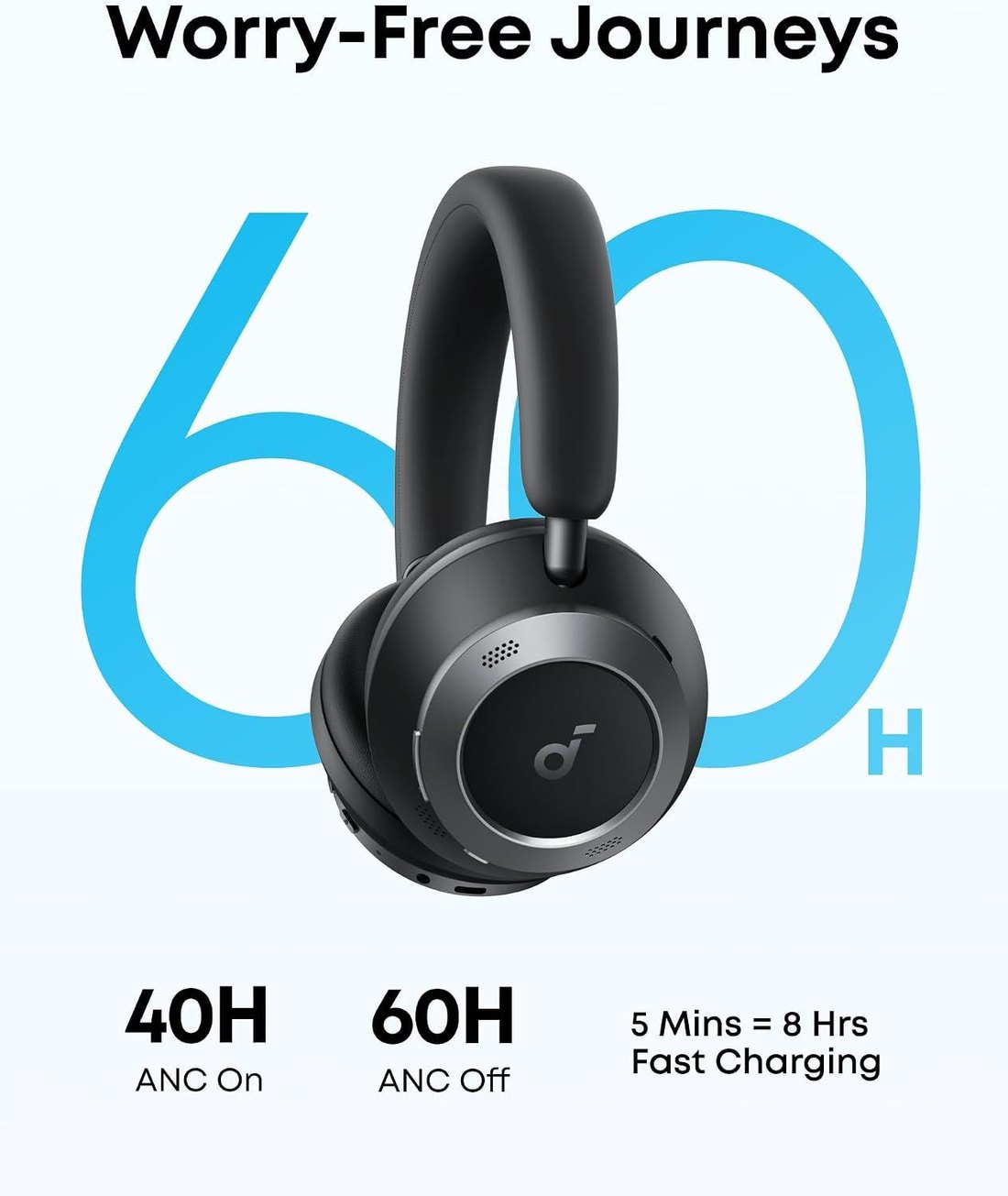
The manufacturer’s own graphic spells out both configurations: 40 hours with ANC on, 60 with it off, and the 5-minutes-for-8-hours fast charge. (Manufacturer product image)
One caution from independent testing: SoundGuys measured the cheaper Space 2 — a sibling model — at over fifty-three hours with ANC on, exceeding its own fifty-hour rating. So Soundcore’s battery ratings in this family tend to be conservative rather than inflated. That is the right direction for a claim to err, but the forty-hour figure is still the one to plan around.
The fold: what “50% smaller” actually means
The FlexiCurve structure is the feature that justifies the “Pro” in the name. The headband is built from five flexible segments connected by three joints that rotate up to 180 degrees, letting the whole assembly collapse inward. soundcore states the mechanism survived ten thousand fold-cycle durability tests.
The folded dimensions tell the story better than the marketing does. Measured by unwire.hk, the headphone goes from roughly 163 × 89 × 191 mm unfolded to 127 × 98 × 118 mm folded — a block closer to a paperback than a headphone case. Tom’s Guide, which has tested far more expensive over-ears, called the folding easier and less creak-prone than JBL’s attempts and noted that no other headphone in its regular rotation packs down this small without a bulky case.
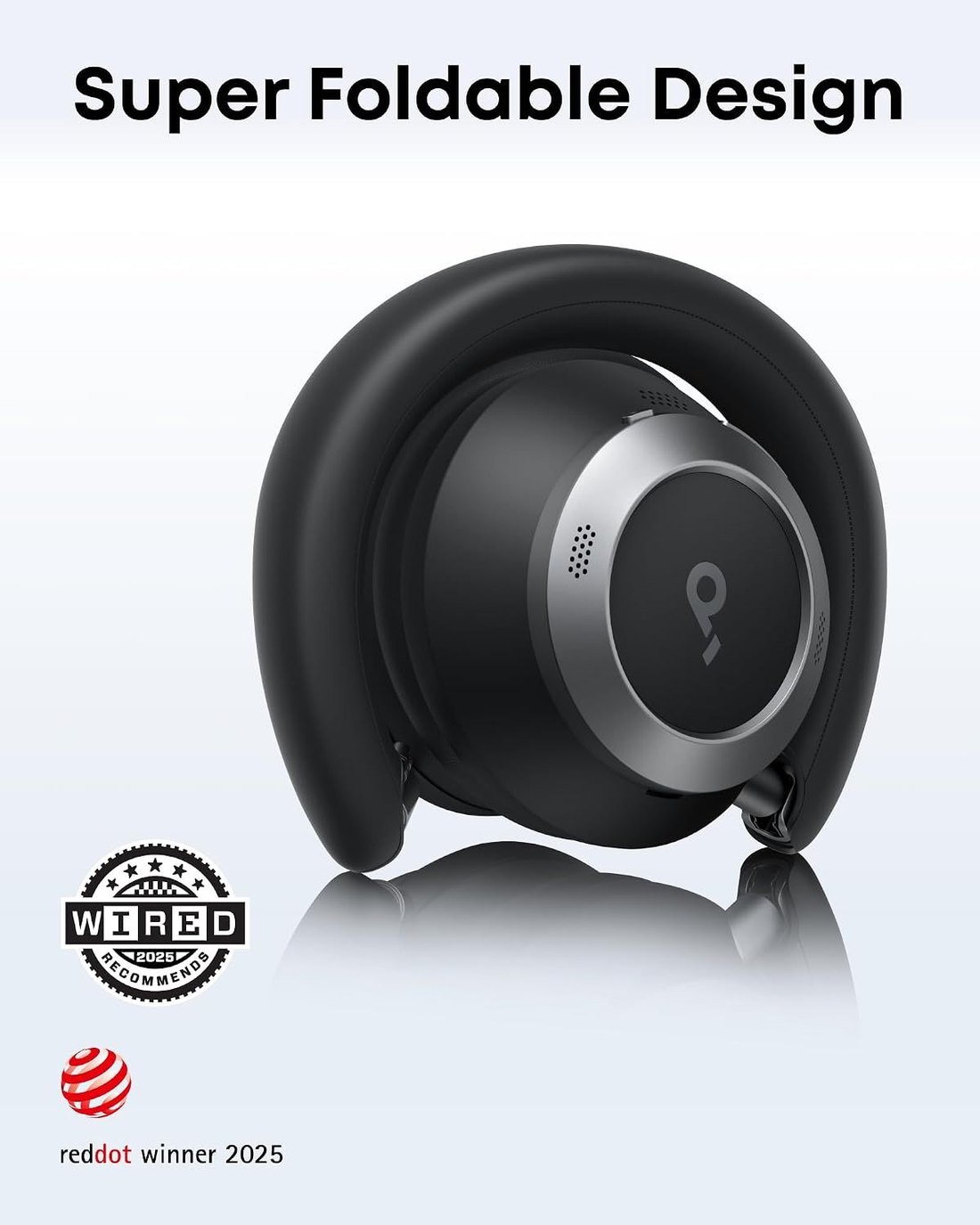
The official product image shows the folded state alongside its Hi-Res certification. The five-segment headband collapses inward rather than just folding flat. (Manufacturer product image)
The trade-off is the carrying case. Because the headphone itself is the storage solution, Soundcore includes only a soft drawstring pouch — there is no hard case in the box. If your bag routinely contains keys, chargers, and other sharp objects, the earcups’ plastic finish will meet them directly. That is a genuine downgrade from the hard cases Sony and Bose include, and it is the direct cost of the fold-itself design.
Noise cancelling: what independent testing actually found
The Space One Pro uses a four-stage adaptive ANC system with six microphones (two feedforward mics were added specifically to widen the noise range the system can target). The measured results are genuinely strong for the price, and the real-world reports are more nuanced. Both are worth reading.
The measurements. SoundGuys measured average noise attenuation of about 84 percent with ANC enabled, with passive isolation alone accounting for 75 percent — meaning the earpads seal well even before the electronics do anything. RTINGS describes the overall noise isolation as excellent, noting that chatty coworkers and engine rumble are “handily mitigated.”
The real world. Tom’s Guide’s verdict was “good, but not excellent”: walking through a city downtown, traffic noise remained audible, and wind whistled over music. In a quiet office, though, colleagues had to wave a hand in front of the reviewer’s face to get attention.
These findings are not actually in conflict — they describe two different noise environments. Against the steady low-frequency drone of transit and HVAC systems, the Space One Pro performs close to the flagship tier. Against transient, mid-frequency noise — traffic bursts, wind, nearby conversation in a loud space — the gap to Bose and Sony remains real. If your use case is a plane, a train, or an office, the measured performance here is excellent value. If it is windy streets, the flagships still earn their premium.
One operational detail that almost every review skips: Adaptive ANC is off by default. The headphones ship in standard ANC mode; the real-time adjustment that soundcore markets heavily must be enabled in the app first. If you never open the app, you are not using the feature the product is named after.
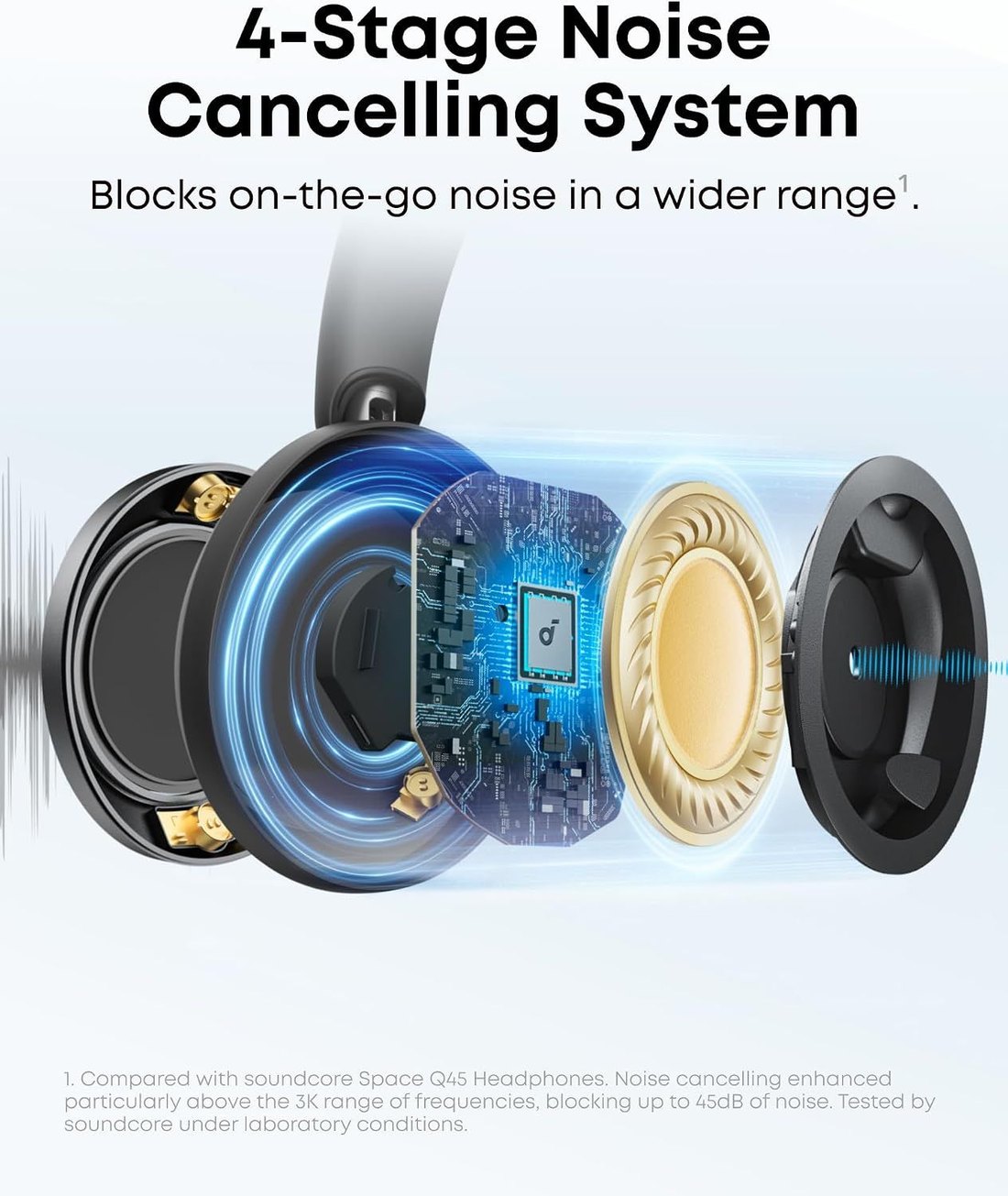
The manufacturer’s diagram of the four-stage ANC system with its added feedforward microphones. (Manufacturer product image)
Sound: the bass question you will have to settle
This is the section where independent testers genuinely disagree, and the disagreement matters for your buying decision.
The measurement: SoundGuys’ frequency response analysis found the default tuning sitting roughly 10 dB above their preference curve through the sub-bass and low bass, dipping through the 2–3 kHz presence region, then spiking about 12 dB around 8–9 kHz. Their verdict was blunt — on bass-forward tracks, the factory sound becomes genuinely fatiguing, and their overall MDAQS score of 2.4 out of 5 reflects a tuning that overwhelms vocals and treble detail.
The listening impression: Tom’s Guide heard the same headphone very differently — “fantastic bass, but not overpowering,” with balanced mids and clear vocals, and gave it 4.5 out of 5 stars.
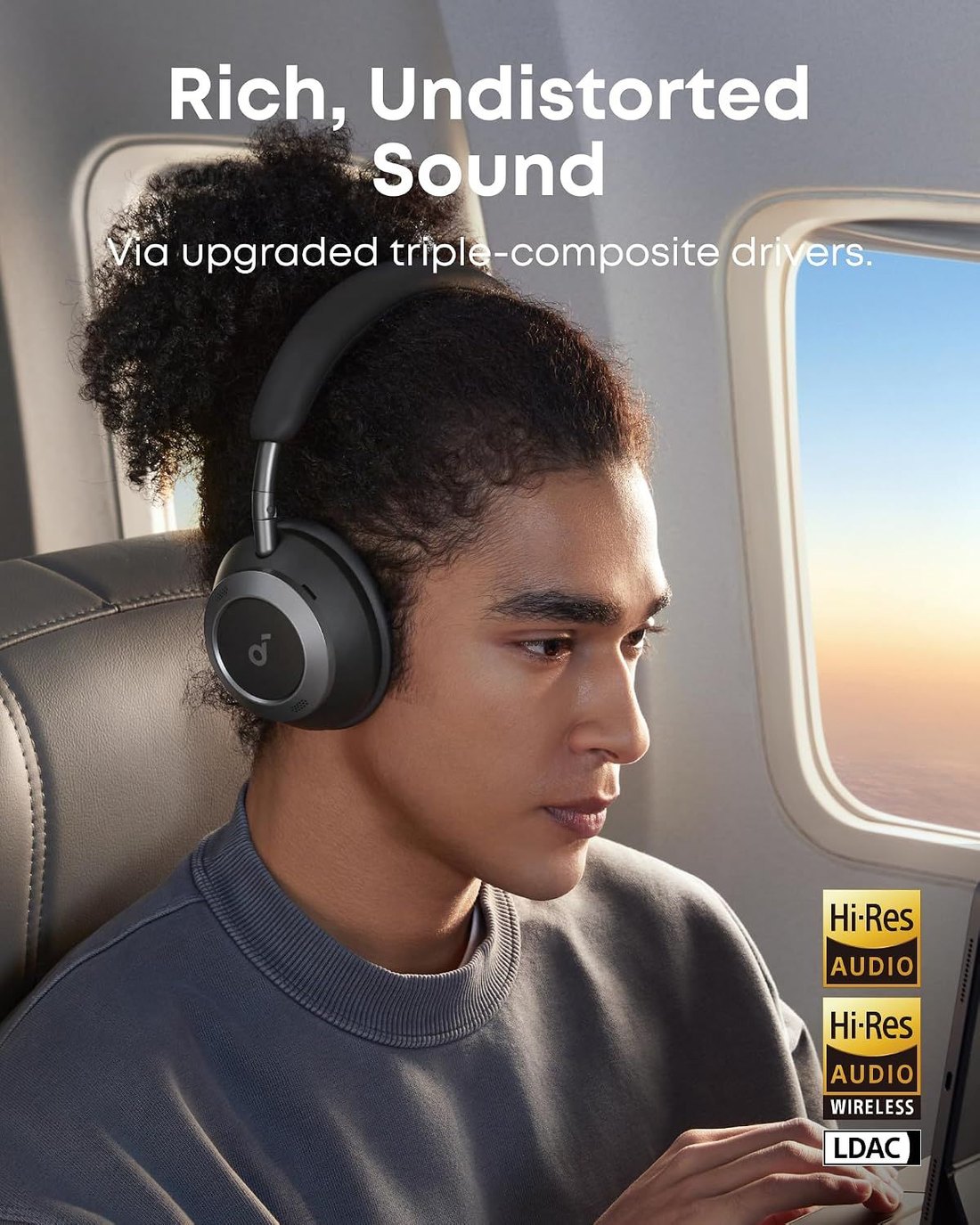
The official product image accompanying the sound-quality marketing. (Manufacturer product image)
Both reports can be true, because they are describing different reference points. The measurement says the factory tuning is emphatically bass-leaning with a bright upper-midrange peak — that is objective. Whether that signature is fatiguing or enjoyable depends on the music you listen to and what you are used to. What is not in dispute: the tuning is a deliberate choice, not an accident, and it is the main area where the cost savings show.
The good news is that the fix is built in. The Soundcore app offers a full custom EQ plus HearID, a hearing-test-based personalization that builds a profile around your ears. SoundGuys — the harshest critic of the default tuning — still scored the app ecosystem highly and confirmed the custom EQ meaningfully flattens the sound. If you are unwilling to spend ten minutes in an app, this is the wrong headphone. If you are willing, most of the criticism above is addressable.
Two codec facts matter here. First, LDAC is Android-only — iPhone owners get AAC regardless of the source file, the same ceiling as every Bluetooth headphone at any price. Second, and almost never mentioned in reviews: LDAC and multipoint are mutually exclusive. Turn on LDAC in the app and the headphones will no longer connect to two devices at once. The same applies to the Dolby spatial mode, which is also disabled while LDAC is active — and soundcore’s own FAQ notes the Dolby effect slightly degrades sound quality and is not recommended for podcasts. You are choosing between hi-res audio, spatial audio, and two-device pairing; the headphones will only give you two at a time.
Calls: the one place it visibly cuts corners
The marketing leads with “6-mic calls.” Soundcore’s own specification table, in the same official pages, lists four microphones with AI enhancement — the total system uses six mics for noise cancelling, four of which serve the call pipeline with the AI algorithm. Even the manufacturer’s channels do not fully agree on how to count them, which is worth knowing before you repeat the “six mics” figure to anyone.
Performance in quiet and moderate conditions is solid. RTINGS found voice comes through intelligibly in ideal conditions, and Tom’s Guide praised call clarity in office use. The failure mode is specific and severe: RTINGS found the noise-removal algorithm “somewhat aggressive,” muffling the voice against moderate noise and making the speaker completely unintelligible against loud sustained noise — their examples were a running vacuum and a arriving subway train. If your calls happen in a quiet home office, this will never matter. If you take calls on platforms and streets, this is the wrong headphone, and no EQ setting fixes it.
Two app features help in ordinary use: sidetone (hearing your own voice in calls) and Easy Chat, which drops the music volume automatically when you start speaking. Both are off by default and enabled in the app.
The manual details nobody covers
These come straight from soundcore’s official FAQ, and they are the things that most reviews — which restate the product page — never mention.
- Multipoint behavior: enabling it requires double-pressing the power button before pairing the second device. More importantly, the Space One Pro uses what soundcore calls “Type 2” multipoint: when two devices are connected, audio plays from whichever device started playback last. If your laptop is playing music and your phone starts a video, the headphones switch to the phone automatically. Some people love this; some find it hijacks their listening. Know which person you are before you enable it.
- Factory reset: with the headphones on, press and hold both the power button and the “+” button together for five seconds — the LED flashes red, then white, then blue to confirm. That is the official method; none of the “hold for 8 seconds” folk wisdom applies here.
- Wearing detection, water resistance, and USB audio: there is no wearing auto-pause sensor mentioned in the official documentation, no water resistance at all, and no audio-over-USB — wired listening means the included 3.5 mm cable only.
- Comfort: the slow-rebound foam and pressure-relieving headband drew strong reviews — Tom’s Guide found them more comfortable than Bose’s flagship, wearing them for hours without hot spots. The counterpoint: aggregated comfort data runs merely average, so this is a try-before-committing category if you are sensitive to clamp force.
Weight: which number is real
This section exists because the official sources disagree with each other, and you deserve to know before reading a number anywhere else.
soundcore.com and Anker’s own product pages list 286.2 g (10.1 oz). Amazon’s listing states 9.6 oz (about 272 g). SoundGuys, which weighed the review unit, reports 283 g. The likely explanation is that Amazon’s field was entered from a different configuration or rounded differently, and the manufacturer’s figure refers to the full assembly. None of these numbers is dramatically different, but the honest summary is: plan on roughly 285 grams, a touch heavier than the flagships it undercuts on battery.
Where the Space One Pro falls short
The factory tuning needs work. This is the big one. The default sound leans hard into bass with a bright upper spike, and whether that reads as “fun” or “fatiguing” depends entirely on your ears and library. The EQ and HearID tools fix it — but the headline here is that you are buying a headphone that requires ten minutes of tuning to sound its best, and SoundGuys’ measured verdict suggests even then it favors bass-forward listening.
Calls collapse in loud environments. Quiet office: fine. Windy street or loud transit: RTINGS’ finding of unintelligible voice is as bad as microphone criticism gets. If you take calls outdoors, look elsewhere or keep a separate earbud for calls.
The accessories match the price. A soft pouch instead of a hard case, no water resistance for gym or rain, no audio over USB, and buttons that Tom’s Guide found too small and indistinct to operate without taking the headphones off. None of these is disqualifying for a commuter headphone; all of them are real, and together they are how the price stays where it does.
Who should buy the Space One Pro
- Daily commuters and frequent flyers. Forty rated hours with ANC on, the fastest top-up here, and the only fold that makes the headphones genuinely pocketable. This is the exact use case the product was designed around, and the independent data says it delivers.
- Students and office workers. Against steady background noise — HVAC, chatter, library ambience — the measured isolation performs close to headphones costing several times as much, and the fold means it disappears into a backpack between classes.
- Android listeners who will use the app. LDAC, HearID, and a genuinely capable custom EQ turn the factory tuning from the product’s biggest weakness into a solvable preference.
If two or more of those describe you, see the current Space One Pro listing on Amazon — and double-check the color and bundle on the page before ordering, since the listing carries several variants.
Who should skip it
- Anyone whose calls happen outdoors. The microphone failure mode in loud, sustained noise is documented and severe.
- Bass-averse listeners who refuse to touch an EQ. If you want a neutral tuning out of the box, buy something tuned that way instead of fighting this one.
- Gym and workout users. No water resistance, and a soft pouch offers no protection against a gym bag’s contents.
How to choose an ANC over-ear at this level: a short checklist
Before comparing spec sheets, decide these five things — they will eliminate most of the field faster than any table.
- Where do your calls happen? If the answer involves wind, streets, or transit, prioritize microphone test results over battery numbers. This is the specification most often skipped by affiliate reviews and most often regretted by buyers.
- Do you actually need hi-res codecs? LDAC matters only on Android with compatible content. On iPhone, ignore the LDAC row entirely — every headphone here drops to AAC.
- Where will the headphones live? If the answer is a backpack pocket rather than a desk, the fold is a daily-use feature, not a spec-sheet curiosity, and the Space One Pro’s design brief starts to make sense.
- Read the ANC results by noise type. “Great ANC” claims hide a consistent pattern: budget and mid-tier sets now match flagships against steady low-frequency noise while still trailing against transient, mid-frequency sounds like wind and nearby voices. Match the test result to your actual environment.
- Budget for the app. At this price, the companion app is not optional — it is where adaptive ANC, EQ, and multipoint controls live. A headphone whose app you dislike is a headphone you will not get value from.
Frequently asked questions
Does the Soundcore Space One Pro work with LDAC on iPhone? No. LDAC is an Android-only codec; iPhones connect via AAC regardless of the audio source. The headphones’ other features — ANC, multipoint, the app EQ — work normally on iOS.
Can it connect to two devices at the same time? Yes, multipoint is supported on Bluetooth 5.3. Enable it by double-pressing the power button before pairing the second device. Note that multipoint and LDAC are mutually exclusive, and the “last device to play wins” switching behavior takes some adjustment.
How do I factory reset the Space One Pro? With the headphones powered on, press and hold the power button and the “+” button together for five seconds. The LED will flash red, then white, then blue to confirm the reset — this is the method from soundcore’s official FAQ.
Is the Space One Pro water resistant? No. It has no IP rating for water or sweat, and soundcore does not market it for exercise use. Keep it out of the rain and the gym.
Does it come with a hard case? No. The box includes a soft carry pouch, a 3.5 mm AUX cable, and a short USB-C charging cable. The fold-inward design is the storage solution, which is also why there is no hard case.
How long does the battery really last? The rated figures are forty hours with ANC on and sixty with it off. Soundcore’s battery ratings in this product family have run conservative — a sibling model exceeded its own rating in independent measurement — so treat forty hours with ANC on as a floor rather than a ceiling.
Is this a good alternative to the Sony WH-1000XM5? On battery, charging speed, foldability, and codec support, it matches or beats the Sony at a fraction of the cost. On low-frequency ANC depth, voice pickup in loud places, and outright sound sophistication, the Sony remains ahead. Choose based on which column matters more to you.
View the Soundcore Space One Pro on Amazon →
About this review
This review is based on the manufacturer’s published specifications and official FAQ documentation, the Amazon retail listing, and published testing from independent outlets including RTINGS, SoundGuys, Tom’s Guide, TechRadar, and unwire.hk. Product images are the manufacturer’s official product images from the retail listing, not photos taken by us. We have not performed instrumented laboratory testing, and nothing here should be read as a measured result. Where independent testers reached different conclusions — most notably on the default sound signature and real-world ANC — both findings are reported above rather than averaged. Specifications and availability change frequently; always confirm current details on the retailer page before purchasing.
Last updated: October 2, 2026
More from TechWithAll
- TAGRY X08 review — Budget earbuds built around battery life and wireless charging.
- Sony WH-1000XM5 review — The noise-cancellation benchmark most people cross-shop against.
- Bose QuietComfort Ultra review — The most comfortable flagship, with better call quality.
Browse the full headphones category.